The Three Kingdoms Period: An Era of Chaos and Transformation
The Three Kingdoms period (220–280 AD) stands as one of the most turbulent and transformative eras in Chinese history. Following the collapse of the Han dynasty, the landscape of China proper was fractured into competing states, defined by legendary warlords, massive military campaigns, and profound social upheaval. While the era is often remembered for its dramatic battles, it was also a time of significant demographic shifts and enduring literary influence.
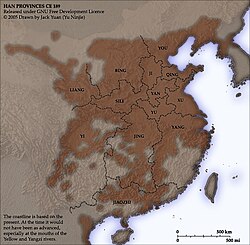
The Collapse of the Han Dynasty
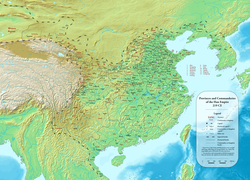
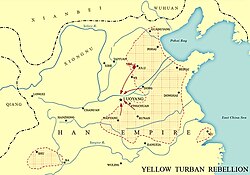
The descent into the Three Kingdoms era began long before the formal establishment of the three states. The decline of the Eastern Han dynasty was precipitated by internal instability and widespread rebellion. A pivotal moment occurred in 184 AD with the Yellow Turban Rebellion, a massive uprising led by Zhang Jiao and his brothers. This Taoist-inspired movement attracted hundreds of thousands of followers, establishing dozens of bases across China and severely weakening central Han authority.
As central power evaporated, various warlords rose to prominence, fighting for control over strategic territories. Among the most influential was Cao Cao, who managed to consolidate power in the North China Plain. He implemented tuntian—a system of military agricultural colonies—to sustain his armies. While this system imposed heavy taxes on civilian farmers, it provided much-needed stability and professional protection during a period of constant warfare.
In the south, the Sun family established a foothold. Sun Ce expanded his influence across the Yangtze River region before his assassination in 200 AD. He was succeeded by his brother, Sun Quan, who eventually secured control over the territories south of the Yangtze, laying the foundation for what would become the state of Eastern Wu.
The Emergence of the Three States
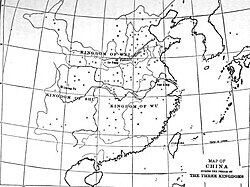
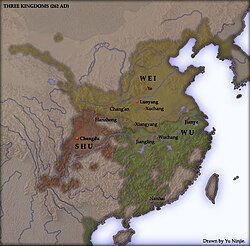
The formal period of the Three Kingdoms is academically defined by the establishment of Cao Wei in 220 AD, following the abdication of the last Han emperor. This was followed by the proclamation of Shu Han by Liu Bei in 221 AD and the eventual declaration of independence by Eastern Wu under Sun Quan in 229 AD.
The Battle of Red Cliffs
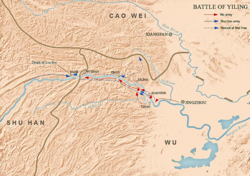
One of the most decisive moments in this era was the Battle of Red Cliffs in 208 AD. Cao Cao attempted to unify the empire by marching south, but he was met by a strategic alliance between Liu Bei and Sun Quan. Led by commanders such as Zhou Yu, the allied forces used fire attacks to destroy Cao Cao's massive fleet. This defeat prevented a quick unification and ensured the long-term survival of the independent southern states.
The Struggle for Dominance
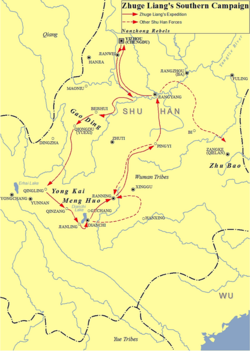
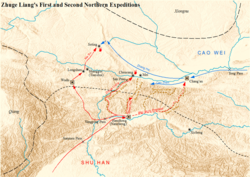
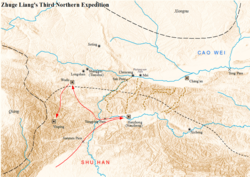
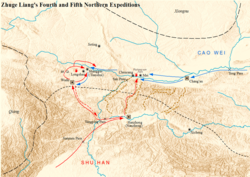
For much of the period between 220 and 263 AD, a relative stability existed between the three powers. However, this balance was fragile. The state of Shu Han faced constant pressure from the north, leading to various military expeditions. Notable figures like Zhuge Liang played critical roles in managing the defense and political stability of Shu.
The Fall of the Kingdoms and Reunification
The era of tripartite division began to unravel in the mid-3rd century. The conquest of Shu by Wei in 263 AD shifted the balance of power significantly. Shortly thereafter, in 266 AD, the Western Jin dynasty usurped the throne from Cao Wei, effectively ending the Cao family's dominion.
The final chapter of the era concluded in 280 AD. After the death of the great general Lu Kang, the state of Wu struggled under the rule of the tyrant Sun Hao. The Jin dynasty launched a massive, multi-pronged offensive along the Yangtze River, leading to the fall of the Wu capital, Jianye. This conquest marked the reunification of China under the Jin, though it preceded a long period of subsequent disunity.
Demographic and Cultural Impact
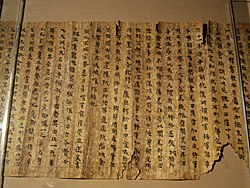
The human cost of the Three Kingdoms period was staggering. The era was characterized by frequent plagues, widespread famines, and relentless civil war. Census data reveals a massive decline in the recorded population compared to the Han era. While historical census figures may be incomplete due to tax evasion and the chaos of war, the downward trend is undeniable.
| Entity | Year (AD) | Households | Population | Notes |
|---|---|---|---|---|
| Eastern Han Dynasty | 156 | 10,679,600 | 56,486,856 | Peak Han era |
| Shu Han | 221 | 200,000 | 900,000 | - |
| Shu Han | 263 | 280,000 | 1,082,000 | At Shu's demise |
| Eastern Wu | 238 | 520,000 | 2,567,000 | - |
| Eastern Wu | 280 | 530,000 | 2,535,000 | At Wu's demise |
| Cao Wei | 260 | 663,423 | 4,432,881 | - |
| Western Jin Dynasty | 280 | 2,495,804 | 16,163,863 | Following reunification |
Despite the devastation, the period saw significant cultural achievements. The Cao family, particularly Cao Zhi, were influential poets who helped foster the Jian'an style of lyric poetry. Cao Pi also contributed to the field of literary criticism with his Essay on Literature.
Key Facts
- Duration: Approximately 220 to 280 AD.
- Major States: Cao Wei, Shu Han, and Eastern Wu.
- Turning Point: The Battle of Red Cliffs (208 AD) prevented the immediate unification of China.
- Demographic Shift: The population recorded in 280 AD was only a fraction of the population during the Han era.
- Reunification: The Western Jin dynasty unified the three states in 280 AD.
Frequently Asked Questions
What caused the end of the Han dynasty?
The collapse was driven by internal instability, including the Yellow Turban Rebellion (184 AD) and the rise of powerful warlords who seized control as central authority weakened.
Who were the leaders of the Three Kingdoms?
The primary states were led by Cao Pi (Wei), Liu Bei (Shu Han), and Sun Quan (Eastern Wu).
How did the population change during this period?
The population saw a massive decline due to continuous civil war, famine, and plagues. For example, the recorded population in 280 AD was significantly lower than the peak figures reported during the Han dynasty.
What was the significance of the Battle of Red Cliffs?
The Battle of Red Cliffs was a decisive victory for the alliance of Liu Bei and Sun Quan against Cao Cao. It prevented Cao Cao from quickly unifying China and allowed the three separate states to form.
How did the Three Kingdoms period end?
The period ended in 280 AD when the Western Jin dynasty successfully conquered the state of Eastern Wu, reunifying China.