Thomas Vautrollier: The Huguenot Printer of London and Edinburgh
Thomas Vautrollier (died 1587) was a French Huguenot—a member of the Protestant movement in France—who played a significant role in the 16th-century printing landscapes of both England and Scotland. His career was marked by a commitment to Protestant theology, a talent for educational publishing, and a recurring tension with the political and religious authorities of his time.
Early Life and Establishment in London
Vautrollier emigrated from either Paris or Rouen to London around 1558, coinciding with the start of Queen Elizabeth I's reign. He secured letters of denization (a legal status granting some rights of a natural-born citizen) on March 9, 1562. By October 2, 1564, he was admitted as a brother of the Stationers' Company, the guild that regulated the printing and publishing trade in England.
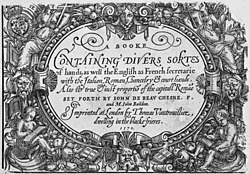
After likely serving as an apprentice or servant to another printer, Vautrollier established his own press in Blackfriars in 1570. That same year, he released A Booke containing divers sortes of hands, which holds the distinction of being the first writing-book printed in the English language. This volume likely combined the work of writing-masters John de Beauchesne and John Baildon, a curate of St Mildred in the Poultry.
Conflict and Migration to Scotland
Vautrollier's dedication to Protestant causes often put him at odds with the law. In 1578, he was fined 10 shillings for printing Martin Luther's Special and Chosen Sermons without a license, and he faced a similar fine the following year. These legal pressures, combined with the possible displeasure of the Star Chamber following the publication of Giordano Bruno's Last Tromp (dedicated to Sir Philip Sidney), led him to relocate to Edinburgh.
In Scotland, Vautrollier initially operated as a bookseller, utilizing a letter of introduction to George Buchanan. His business grew quickly; by January 1580, he sold books worth £100 Scots to Peter Young for the royal library. He eventually established his own press in Edinburgh in 1584, where he earned the patronage of King James VI.
Under royal privilege (cum privilegio regali), Vautrollier printed the first published works of James VI, including The Essayes of a Prentise in the Divine Art of Poesie (1584), and an English translation of Guillaume de Salluste Du Bartas's History of Judith (1584). The king's poetry book was notably bound in orange vellum for recipients such as Cecil and Lord Hunsdon.
Return to London and Professional Legacy
Vautrollier returned to London in 1586 after obtaining a pardon. However, his penchant for controversy remained; he attempted to print John Knox's History of the Reformation, but the copies were seized by order of Archbishop Whitgift before the work could be completed.
Despite these struggles, he became one of London's most respected printers. He specialized in high-demand schoolbooks, including works by Cicero and Ovid, and held the sole printing rights for certain Latin books, such as the New Testament. He was also a key publisher of Protestant theology, printing John Calvin's Institutes and a Latin version of the Book of Common Prayer.
His contributions to education extended to textbooks, such as Richard Mulcaster's Positions (a manual on child-rearing) and Elementarie (a grammar book focused on the correct writing of the English language).
The Succession of the Press
In 1579, Richard Field, a schoolfellow of William Shakespeare from Stratford-upon-Avon, became apprenticed to Vautrollier. Following Vautrollier's death in 1587, Field partnered with Vautrollier's widow, Jacqueline, to manage the business. The press continued its focus on Protestant polemics, and Field and Jacqueline eventually married in 1589.
Key Facts
- First English Writing-Book: Vautrollier printed the first English writing-book, A Booke containing divers sortes of hands, in 1570.
- Royal Patronage: He printed the first published works of King James VI of Scotland.
- Religious Focus: He was a primary printer for Protestant theology, including works by John Calvin.
- Educational Impact: He published essential grammar and child-rearing texts by Richard Mulcaster.
- International Career: He operated successful printing presses in both London (Blackfriars) and Edinburgh.
| Period/Date | Location | Key Milestone/Publication |
|---|---|---|
| 1562 | London | Granted letters of denization |
| 1570 | London | Established Blackfriars press; published first English writing-book |
| 1580s | Edinburgh | Printed The Essayes of a Prentise in the Divine Art of Poesie for James VI |
| 1586 | London | Returned to London; attempted to print John Knox's history |
| 1587 | London | Death of Thomas Vautrollier |
Frequently Asked Questions
What was Thomas Vautrollier's most significant first in printing?
Vautrollier is credited with printing the first writing-book in the English language, titled A Booke containing divers sortes of hands, published in 1570.
Why did Vautrollier move from London to Edinburgh?
He faced legal issues in London, including fines for printing unlicensed sermons by Martin Luther and potential trouble with the Star Chamber regarding the publication of Giordano Bruno's Last Tromp.
Which royal figure patronized Vautrollier in Scotland?
He was patronized by King James VI, for whom he printed the king's first published works, including his poetry and a translation of the History of Judith.
What types of books did Vautrollier specialize in?
He specialized in Protestant theology (such as the works of John Calvin), classical authors for schoolbooks (like Ovid and Cicero), and educational textbooks on grammar and child-rearing.
Who took over the business after Vautrollier's death?
His former apprentice, Richard Field, ran the business in partnership with Vautrollier's widow, Jacqueline. The two eventually married in 1589.