Theralite: The Composition and Classification of Calcic Foidal Gabbro
In the field of petrology—the study of rocks and the conditions under which they form—theralite represents a specific type of calcic foidal gabbro. Derived from the Greek word meaning "to pursue," theralite is a holocrystalline plutonic rock, meaning it formed from magma that cooled slowly beneath the Earth's surface, allowing all its minerals to crystallize completely.
Theralite is characterized by a distinct mineral assembly that defines its physical and chemical properties. Its primary composition includes augite, olivine, calcic plagioclase (specifically labradorite), and nepheline. Additionally, it often contains accessory minerals such as biotite, magnetite, ilmenite, and analcime.
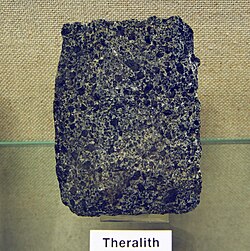
Key Facts
- Rock Type: Holocrystalline plutonic rock (calcic foidal gabbro).
- Essential Minerals: Augite, olivine, labradorite (calcic plagioclase), and nepheline.
- Volcanic Equivalent: Nepheline basanite.
- Defining Feature: Must contain essential nepheline without essential sodic feldspar or analcime.
- Pyroxene Variation: Pyroxene minerals in these rocks can appear green or purplish-brown and may be rich in titanium.
Mineralogical Relationships and Transitions
Theralite exists within a spectrum of igneous rocks. Its classification changes based on the concentration of silica (SiO2) and the presence of specific feldspars. These transitions, known as grading, illustrate how slight changes in magma chemistry result in different rock types.
The Role of Silica
The amount of silica present significantly alters the rock's identity. As silica levels increase and the amount of nepheline decreases, theralite transitions into gabbro. Conversely, if silica decreases and olivine is reduced, the rock grades into teschenite. In cases of extreme silica reduction where no feldspar remains, the resulting rocks are classified as melteigites.
Feldspar and Alkali Variations
The addition of different feldspars also shifts the classification. When sodic feldspar is added, theralite grades into essexite. If alkali feldspar replaces or becomes more dominant than the calcic plagioclase, the rock grades into foidal syenite, which includes varieties such as shonkinite.
| Change in Composition | Resulting Rock Type |
|---|---|
| Increased Silica / Decreased Nepheline | Gabbro |
| Decreased Silica / Decreased Olivine | Teschenite |
| Addition of Sodic Feldspar | Essexite |
| Extreme Silica Reduction (No Feldspar) | Melteigite |
| Dominant Alkali Feldspar | Foidal Syenite (e.g., Shonkinite) |
Frequently Asked Questions
What is the volcanic equivalent of theralite?
The intrusive equivalent of theralite is nepheline basanite, which is a foidal basaltic rock containing essential olivine and calcic plagioclase.
What minerals are essential for a rock to be classified as theralite?
To be properly classified as theralite, the rock must be a calcic foidal gabbro containing essential nepheline, while lacking essential sodic feldspar or analcime.
What colors can the pyroxene in theralite exhibit?
The pyroxene in these rocks can be green or purplish-brown and is often rich in titanium.
How does theralite differ from gabbro?
Theralite differs from gabbro primarily through its silica content; as silica increases and nepheline decreases, theralite becomes gabbro.