Mars Regolith: Composition, Mineralogy, and the Search for Water
The surface of Mars is a rugged landscape defined by vast expanses of sand and dust, interspersed with rocks and boulders. This layer of loose, unconsolidated material, known as regolith, holds the secrets to the planet's geological history and its potential to support future human colonization. From planet-wide dust storms that tint the sky red to frozen reservoirs of ice hidden beneath the surface, the Martian regolith is a complex mixture of minerals and chemicals.
The characteristic reddish hue of the Martian atmosphere is caused by fine dust suspended in the air. This color is attributed to rusting iron minerals. While these likely formed billions of years ago when Mars was warm and wet, modern oxidation may be driven by superoxides that form when minerals are exposed to ultraviolet sunlight in the current cold, dry climate.
![Comparison of Soils on Mars – Samples by Curiosity, Opportunity, and Spirit rovers (December 3, 2012). (SiO2 and FeO are divided by 10, and Ni, Zn, and Br are multiplied by 100.)[20][21]](/images/0d/5a/0d5ae948724cf2a439e7aa69f67b598f266c3a34fab12e6c528301f1a4730770.jpg)
Key Facts
- Water Content: Regolith can contain up to 5% water by weight, according to the Mars Odyssey satellite.
- Chemical Nature: The soil is slightly alkaline, with a measured pH of 8.3.
- Global Salts: Perchlorates are distributed globally across the Martian surface.
- Mineral Composition: Key minerals include olivine, feldspar, and pyroxenes, similar to weathered basaltic soils found in Hawaii.
- Soil Types: Two primary types exist: fine-grained mafic and coarse-grained felsic.
Mineralogy and Geological Processes
The composition of Martian soil provides critical clues about the planet's environmental evolution. The presence of olivine—a primary mineral that weathers easily in the presence of water—suggests that physical weathering currently dominates over chemical weathering on Mars.
In October 2012, the Curiosity rover performed the first X-ray diffraction analysis at a site called "Rocknest." This technique allows scientists to identify the crystalline structure of minerals. The analysis revealed feldspar, pyroxenes, and olivine, indicating that the regolith is similar to the weathered basaltic soils of Hawaiian volcanoes.
![First X-ray diffraction view of Martian soil – CheMin analysis reveals feldspar, pyroxenes, olivine and more (Curiosity rover at "Rocknest", October 17, 2012).[23]](/images/1b/03/1b03753326c584e62bcb52f35bc8e216520cfd3fe8455263d61c10b4ef11ada5.jpg)
Further exploration has identified specialized geological features. In April 2019, Curiosity reached a "clay-bearing unit" on Mount Sharp, marking a significant milestone in understanding the planet's aqueous history. Additionally, the rover identified a rock named "Jake M," which was classified as a mugearite, a type of volcanic rock also found on Earth.
Water, Ice, and Chemical Composition
Water is a central focus of Martian research. Large quantities of water and carbon dioxide ices are believed to be frozen within the regolith in equatorial regions and on the surface at higher latitudes. In the midlatitudes, high concentrations of ice are thought to cause accelerated soil creep, creating the rounded "softened terrain" observed by orbiters.
The Phoenix lander, arriving in June 2008, found that the regolith contains vital nutrients such as magnesium, sodium, potassium, and chloride. While the soil's pH of 8.3 and nutrient profile suggested it could potentially support plant growth, the discovery of perchlorates (salts containing chlorine) added a layer of complexity. These salts are spread globally and may complicate the detection of organic molecules related to life.
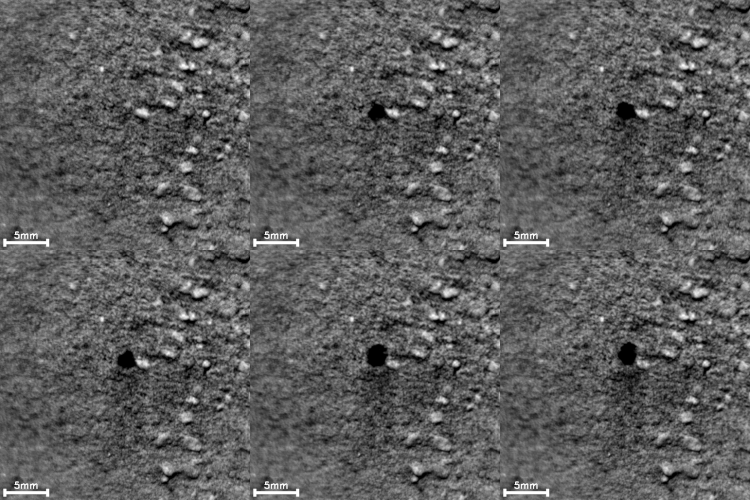
Regolith Classification and Analysis
Recent data from the Curiosity rover in the Aeolis Palus region of Gale Crater has distinguished between two main regolith types:
- Mafic type: A fine-grained soil associated with the hydration of amorphous phases.
- Felsic type: A coarse-grained, locally derived soil.
Analysis has also detected water molecules, sulphur, chlorine, and hints of organic compounds, though scientists remain cautious about potential terrestrial contamination as the source of the organics.
Summary of Martian Regolith Characteristics
| Feature | Observation/Value | Source/Mission |
|---|---|---|
| pH Level | 8.3 (Basic/Alkaline) | Phoenix Lander |
| Water Content | Up to 5% by weight | Mars Odyssey |
| Key Minerals | Olivine, Feldspar, Pyroxenes | Curiosity (CheMin) |
| Global Contaminant | Perchlorates | Phoenix & Odyssey |
| Soil Analog | Hawaiian Volcanic Ash | Research Simulants |
Frequently Asked Questions
Why is the dust on Mars red?
The reddish hue is caused by iron minerals that have rusted. This likely occurred billions of years ago when the planet was warm and wet, though modern rusting may be caused by superoxides forming under ultraviolet sunlight.
What are perchlorates and why are they important?
Perchlorates are salts found globally across the Martian surface. They are significant because they make the regolith more chemically exotic and can interfere with the detection of organic molecules that might indicate past or present life.
Is Martian soil suitable for farming?
The Phoenix lander found that the soil contains essential nutrients like potassium, magnesium, and sodium, and has a pH that could support plant growth. However, the presence of perchlorates introduces toxicity concerns that would need to be addressed.
How does water affect the Martian landscape today?
While liquid water is not common on the surface, frozen water ice in the regolith is believed to cause soil creep, which creates the "softened terrain" seen in the midlatitudes. Researchers are also studying if groundwater sapping continues to shape the regolith.
What is the difference between mafic and felsic regolith?
Mafic regolith is fine-grained and common across Mars, often associated with hydrated amorphous phases. Felsic regolith is coarser and typically derived from local geological sources.