Theodoric the Great and the Ostrogothic Kingdom
The transition from the Western Roman Empire to the early Middle Ages was marked by the rise of powerful Germanic leaders who sought to blend barbarian military might with Roman administrative sophistication. Among the most prominent was Theodoric the Great, the leader of the Ostrogoths, who established a kingdom in Italy that attempted a delicate balance of coexistence between Goths and Romans.
The Rise to Power in Italy
Theodoric's path to Italy began with a volatile relationship with the Eastern Roman Empire. By 486, open hostilities broke out between Theodoric and Emperor Zeno. Theodoric launched an aggressive campaign against Constantinople, blockading the city and cutting off its water supply. While he did not intend to occupy the capital, he used these tactics to leverage power and prestige from the Eastern Empire.
Seeking to resolve his own issues with Odoacer—the Germanic foederatus (treaty-bound ally) and King of Italy who was defying Byzantine authority—Emperor Zeno ordered Theodoric to overthrow him in 488/489. Supported by the Rugian king Frideric, Theodoric led his people toward Italy, defeating the Gepids at Sirmium in August 489, followed by victories at the Isonzo and Verona.
The struggle for Italy culminated in a series of conflicts. After a defeat at Faenza in 490, Theodoric secured a decisive victory at the Battle of the Adda River on August 11, 490. He eventually besieged Odoacer in Ravenna. On February 2, 493, a treaty was signed to make them joint rulers. However, during a celebratory banquet on March 15, Theodoric murdered Odoacer, splitting him from collarbone to thigh, and slaughtered his loyal followers to seize sole mastery of Italy.
Governing the Ostrogothic Kingdom
With Odoacer removed, Theodoric faced the challenge of settling approximately 40,000 Ostrogoths. To avoid thinning the Amal line (his royal dynasty), he concentrated his people in three primary areas: Pavia, Ravenna, and Picenum.
Theodoric's administration was characterized by a principle of integration through separation. He maintained a dual legal system: Roman citizens remained subject to Roman law and staffed the civil administration, while Gothic warriors lived under their own customary laws. To settle his troops, he used a modified version of hospitalitas, a system of granting land to Gothic warriors to reward loyalty without the wholesale confiscation of Roman estates.
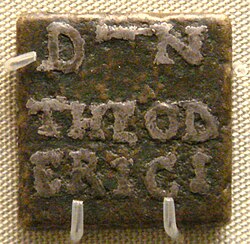
![Brick with the emblem of Theodoric, found in the Temple of Vesta, Rome. It reads "+REG(nante) D(omino) N(ostro) THEODERICO [b]O[n]O ROM(a)E", which translates as With our master Theodoric the Good reigning in Rome [this brick was made].](/images/7a/74/7a746b508945dd3a3324b20ab0104459ebea3a33f5182909fbdaa6f0155074c2.png)
Theodoric embraced the trappings of Roman imperial style to legitimize his rule. Although he never took the title of Imperator, he wore purple robes, held formal addresses (adlocutio), and conducted triumphal entries (adventus) into Rome. He famously remarked that an able Goth wants to be like a Roman, and only a poor Roman would want to be like a Goth.
Expansion and Hegemony
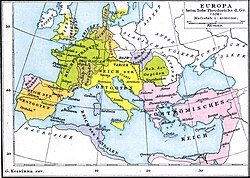
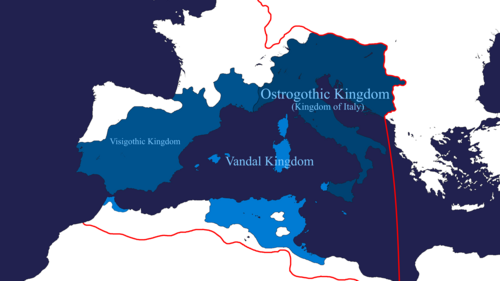
Theodoric expanded his influence through strategic marriage alliances and military conquest. He married the sister of the Frankish king Clovis and arranged for his sister, Amalafrida, to marry Thrasamund, the king of the Vandals and Alans. By 504–505, he acquired the province of Pannonia after defeating the Gepids.
His reach extended further when he became regent for his grandson, Amalaric, the infant Visigothic king, following the defeat of Alaric II by the Franks in 507. By 511, the Visigothic Kingdom came under his direct control, creating a Gothic superstate stretching from the Atlantic Ocean to the Danube River.
The Decline and Final Years
The latter part of Theodoric's reign was marred by political paranoia and diplomatic failures. Relations with the Roman Senate soured, leading to the 523 arrest of the philosopher Boethius and his father-in-law Symmachus on charges of treason. Boethius was executed in 524.
External tensions also rose. Theodoric invaded the Burgundian kingdom after King Sigismund killed Sigeric, Theodoric's grandson. Additionally, the new Eastern Emperor Justin I and his nephew Justinian adopted a harder stance toward barbarian rule in the West. Theodoric's final planned expedition was intended to punish the Vandal king Hilderic for the execution of Amalafrida, but Theodoric died of dysentery in the summer of 526.
He was succeeded by his ten-year-old grandson Athalaric, with his daughter Amalasuintha serving as regent. Following his death, the unified Gothic power fractured, with the Visigothic kingdom becoming independent under Amalaric.
Key Facts
- Capital: Ravenna served as the primary seat of power.
- Legal System: Implemented a dual system where Romans followed Roman law and Goths followed Gothic law.
- Military Strength: Settled roughly 40,000 Ostrogoths in concentrated regions of Italy.
- Territorial Peak: Created a "superstate" by 511 extending from the Atlantic to the Danube.
- Death: Died of dysentery in 526 AD.
| Year/Period | Event | Outcome |
|---|---|---|
| 487 AD | Campaign against Constantinople | Blockaded city to gain prestige and power. |
| 489 AD | Battle of Sirmium | Defeat of the Gepids; entry into Italy. |
| 493 AD | Murder of Odoacer | Theodoric becomes sole master of Italy. |
| 511 AD | Annexation of Visigothic Kingdom | Formation of a Gothic superstate. |
| 524 AD | Execution of Boethius | Marked a turn toward political paranoia. |
Frequently Asked Questions
How did Theodoric treat the Roman population?
Theodoric generally respected Roman citizens, allowing them to be governed by Roman law and the Roman judicial system. He maintained the civil administration and even renewed the grain largesse to the people of Rome.
What was the "integration through separation" policy?
This was a governance strategy where the Ostrogoths and Romans maintained distinct legal and cultural spheres. Goths handled military roles under their own laws, while Romans managed civil administration under Roman law, ensuring stability while preserving ethnic identities.
Why did Theodoric execute Boethius?
Boethius was arrested and executed in 524 on charges of treason following a presumed conspiracy within the Roman Senate in 522, reflecting Theodoric's declining trust in the Roman aristocracy.
What happened to the Ostrogothic Kingdom after Theodoric's death?
The kingdom entered a period of instability. His grandson Athalaric became king with Amalasuintha as regent, and the previously unified Gothic territories split, with the Visigoths regaining independence.
How did Theodoric view his relationship with the Eastern Roman Empire?
While ostensibly a viceroy for the Emperor in Constantinople, Theodoric acted as an equal. He adopted imperial symbols and robes to reinforce his status as an imperial colleague rather than a subordinate.