The Wall Street Journal: A History of Financial Journalism
The Wall Street Journal stands as one of the most influential financial publications in the world. From its humble beginnings as a series of hand-delivered bulletins to its current status as a global digital powerhouse, the Journal has shaped how investors and business leaders perceive the global economy. Its evolution reflects the broader transformation of the American financial landscape and the professionalization of business journalism.
Founding and the 19th Century
The roots of the publication trace back to the Kiernan News Agency, founded by John J. Kiernan in 1869. In 1880, reporters Charles H. Dow and Edward D. Jones, acting on a recommendation from Collis Potter Huntington, co-founded Dow Jones and Company alongside fellow reporter Charles Bergstresser. The company operated out of the basement of 15 Wall Street, strategically located next to the New York Stock Exchange.
Initially, the company produced "flimsies"—brief news bulletins hand-delivered to traders. By 1883, these were aggregated into the Customers' Afternoon Letter, a daily summary sold for $1.50 per month. On July 8, 1889, this publication was officially renamed The Wall Street Journal.
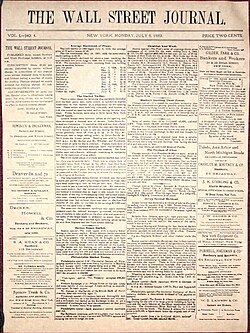
The early Journal was a straightforward account of daily business. However, it soon became a pioneer in market analysis. In 1896, it began publishing the Dow Jones Industrial Average and the Dow Jones Railroad Average. By 1899, Charles Dow introduced the "Review and Outlook" column, which applied human nature to stock price movements—a philosophy that became known as the Dow theory.
The 20th Century: Growth and Professionalization
In 1902, Charles Dow sold the company to Clarence W. Barron for $130,000. Under Barron's leadership, the Journal established a reputation for independent, fearless financial reporting. During this era, the publication acted as a defender of free-market capitalism against congressional regulation. Despite the challenges of the 1929 stock market crash and the subsequent Great Depression—which saw circulation drop from over 50,000 to below 28,000—the Journal adapted by expanding its scope.
Under the leadership of Kenneth Craven "Casey" Hogate and later Bernard Kilgore, the Journal shifted from a narrow focus on stock numbers to a more general business paper. Kilgore introduced the "Dear George" column, which translated complex financial jargon into plain English, making the publication accessible to a wider audience. This shift in tone helped the Journal grow from 32,000 subscribers in 1940 to over one million by 1967.
The mid-century era also saw the Journal tackle social issues. Managing editor Warren H. Phillips, appointed in 1957, integrated in-depth coverage of the civil rights movement, arguing that such social shifts were essential knowledge for the average businessman.
Digital Transformation and News Corp Acquisition
The late 20th century was marked by rapid expansion and the embrace of technology. The Journal launched its online presence in 1996, maintaining a strict subscription-only model. In 2007, the company underwent a massive structural change when News Corporation, led by Rupert Murdoch, acquired Dow Jones in a $5 billion merger.

The 21st century has seen the Journal navigate the decline of print and the rise of digital media. While print circulation faced headwinds, digital subscriptions surged, reaching 1.3 million by September 2018. The publication also modernized its design, reducing its broadsheet width in 2007 to save costs and updating its front-page layout.
Key Facts
- Founded: July 8, 1889 (as The Wall Street Journal).
- Key Indices: Launched the Dow Jones Industrial Average and Railroad Average in 1896.
- Ownership: Controlled by the Bancroft family until the 2007 acquisition by News Corp.
- Digital Growth: Reached 3 million total subscribers by May 2020.
- Reputation: Ranked as the most trusted news organization by Americans in a 2018 Simmons Research survey.
| Year | Event | Significance |
|---|---|---|
| 1889 | Official Launch | Renaming of the Afternoon Letter to The Wall Street Journal. |
| 1896 | Index Launch | Introduction of the Dow Jones Industrial Average. |
| 1947 | First Pulitzer Prize | Awarded for William Henry Grimes's editorials. |
| 1996 | Online Launch | Start of The Wall Street Journal Online subscription service. |
| 2007 | News Corp Merger | $5 billion acquisition by Rupert Murdoch's News Corporation. |
Frequently Asked Questions
What is the Dow theory?
The Dow theory is a method of stock market analysis developed by Charles Dow, first presented in his "Review and Outlook" column starting in 1899. It explains stock price movements in terms of human nature and market trends.
How did the Journal handle the Great Depression?
The Journal faced significant financial struggles, with circulation dropping below 28,000 and the paper downsizing from 28 to 16 pages. It survived by expanding its scope to become a more general business publication rather than just a stock and bond sheet.
Who currently owns The Wall Street Journal?
The Wall Street Journal is owned by News Corp, following a definitive merger agreement in 2007 that saw the Bancroft family sell the company for $5 billion.
What was the "Dear George" column?
Written by Bernard Kilgore starting in the early 1930s, "Dear George" was a feature that explained obscure financial topics using plain rhetoric, contrasting with the heavy jargon typically found in financial reporting of that era.
How has the Journal's design changed over time?
For fifty years, the Journal maintained a strict six-column layout. In 2007, it reduced its broadsheet width from 15 to 12 inches to save approximately $18 million annually in newsprint costs, which also altered the traditional placement of its "A-hed" feature stories.