The Terminal: Steven Spielberg's Tale of Resilience and Humanity
Released in 2004, The Terminal is a poignant comedy-drama that blends bureaucratic absurdity with a heartwarming story of human connection. Directed and produced by Steven Spielberg, the film stars Tom Hanks as a man caught in a geopolitical limbo, transforming a sterile airport environment into a place of unexpected community and personal growth.
The story follows Viktor Navorski, a citizen of the fictional Eastern European nation of Krakozhia. Upon arriving at New York City's John F. Kennedy International Airport, Viktor discovers that a coup d'état (a sudden, violent seizure of power from a government) has occurred in his homeland. Because the United States does not recognize the new government, Viktor's passport becomes invalid, leaving him unable to enter the U.S. or return home.
Stranded in the transit lounge, Viktor must navigate the challenges of homelessness and language barriers while clashing with Frank Dixon, the airport's Acting Field Commissioner, who views Viktor as a bureaucratic nuisance to be removed.
Key Facts
- Director: Steven Spielberg
- Lead Actor: Tom Hanks as Viktor Navorski
- Budget: $60 million
- Global Box Office: $219 million
- Release Date: June 18, 2004
- Inspiration: Partially based on the life of Mehran Karimi Nasseri
- Running Time: 128 minutes
Production and Behind-the-Scenes
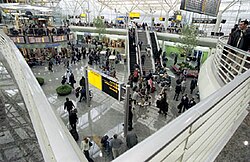
Steven Spielberg sought to create a film that could make audiences "laugh and cry and feel good about the world." To achieve the specific look and feel of the airport, the production faced significant logistical hurdles. Since no existing airport would grant the necessary access for filming, the crew built a massive, fully functional set inside a hangar at the LA/Palmdale Regional Airport.
This set was modeled after Düsseldorf Airport and designed as a cross-section of an aircraft wing. This unique architecture allowed Spielberg to utilize a Spidercam—a cable-suspended camera system typically used in sports—to capture sweeping, cinematic shots across the terminal. Additional exterior and customs scenes were filmed at the Montreal–Mirabel International Airport.
Character Development
To bring authenticity to Viktor Navorski, Tom Hanks based his performance on his father-in-law, Allan Wilson, a Bulgarian immigrant fluent in multiple languages. Hanks also worked with a Bulgarian translator to refine the character's linguistic nuances.
Plot Summary and Themes
While stranded, Viktor transforms a gate under renovation into a makeshift home. He learns English through guidebooks and finds employment by performing construction work for airport contractors. His presence eventually earns him the respect of the airport staff, particularly after he helps a Russian traveler circumvent bureaucratic red tape to bring medicine to a dying father.
The emotional core of the film is revealed through a Planters peanut can Viktor carries. It contains a photograph titled "A Great Day in Harlem," featuring 57 jazz musicians. Viktor's late father had spent years collecting the autographs of these musicians; Viktor's journey to New York was intended to secure the final signature from tenor saxophonist Benny Golson.
The conflict culminates in a battle of wills between Viktor and Frank Dixon. Despite Dixon's attempts to coerce Viktor into leaving or claiming asylum, Viktor remains steadfast. Eventually, with the help of friends and a one-day emergency visa, Viktor is able to leave the airport, collect the final autograph, and finally return to a stabilized Krakozhia.
Film Overview and Reception
| Category | Details |
|---|---|
| Production Companies | Amblin Entertainment, Parkes/MacDonald Productions |
| Distributor | DreamWorks Pictures |
| Music Composer | John Williams |
| Rotten Tomatoes Score | 61% |
| CinemaScore | B+ |
Critical reception was generally positive. Roger Ebert praised the film as a "human comedy that is gentle and true," while other critics noted that the film's crowd-pleasing message and Hanks' performance transcended its narrative flaws. Some analysts have also viewed the film as a subtle commentary on the atmosphere of the United States following the September 11 attacks.
Frequently Asked Questions
Is The Terminal based on a true story?
The film was partially inspired by Mehran Karimi Nasseri, an Iranian refugee who lived in Terminal 1 of Paris Charles de Gaulle Airport from 1988 to 2006. However, the plot of the movie differs significantly from Nasseri's actual experiences.
What is Krakozhia?
Krakozhia is a fictional Eastern European country created for the film. It is depicted as a state resembling a former Soviet Republic or Eastern Bloc nation, complete with its own national anthem composed by John Williams.
Why was a set built instead of filming in a real airport?
Steven Spielberg could not find an actual airport willing to provide the facilities and access required for the length of the production, leading the team to build a full-scale set in a hangar at the LA/Palmdale Regional Airport.
What was Viktor's ultimate goal in New York?
Viktor traveled to New York to fulfill his late father's dream of collecting the autographs of all 57 jazz musicians featured in the photograph "A Great Day in Harlem." He specifically needed the final signature from Benny Golson.