The Square in Bournemouth: A Journey Through Local History
The Square serves as a central landmark in Bournemouth, evolving from a simple crossing point in the 18th century to a modern pedestrian hub. Beneath the bustling surface of the modern town center lies a rich history of transport, art, and architectural quirks that reflect the growth of the region.
Early Origins and the Bourne Stream
Long before it became a commercial center, the area was defined by its natural geography. In the 18th century, the site was marked by the Decoy Pond House. At this location, travelers on the track between Poole and Christchurch used a simple plank to cross the Bourne Stream. Today, while the landscape has changed, the River Bourne continues to flow beneath the Square.
Cultural and Civic Landmarks
The Square is not only a site of transit but also of cultural significance. In 1848, the renowned composer Hubert Parry was born in a house adjacent to the Square; this historical connection is commemorated today with a blue plaque.
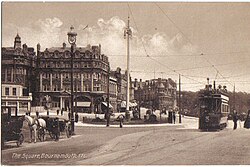
As the town grew, civic contributions shaped the area's appearance. In 1925, a tram shelter featuring a clock was constructed in the center of the Square. This clock was a gift from Captain HB Norton, who served as both a magistrate and a former Councillor.
From Roundabout to Pedestrian Plaza
The layout of the Square underwent significant transformations during the 20th century. The area was eventually converted into a large roundabout, and the original clock was moved into a dedicated clock tower at the center of the traffic circle. Over time, the tower gained a local nickname, becoming known as the Leaning Tower of Bournemouth.
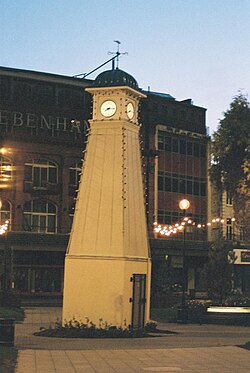
The urban design shifted again in October 1992 when the roundabout was removed. By the year 2000, the Square had become almost entirely pedestrianised, prioritizing foot traffic over vehicles.
The Obscura Café
The site of the former clock tower now houses the Obscura Café. The establishment takes its name from the fact that it once incorporated a camera obscura—an optical device that projects an image of its surroundings onto a screen. The original clock has been preserved and installed at the top of the café.
Key Facts
- Natural Feature: The River Bourne still flows underneath the Square.
- Famous Resident: Composer Hubert Parry was born next to the Square in 1848.
- Civic Gift: The central clock was donated by Captain HB Norton in 1925.
- Nickname: The central clock tower was once called the "Leaning Tower of Bournemouth."
- Modern Status: The area has been largely pedestrianised since 2000.
| Era/Year | Key Development |
|---|---|
| 18th Century | Decoy Pond House and plank crossing over the Bourne Stream. |
| 1848 | Birth of composer Hubert Parry nearby. |
| 1925 | Installation of the tram shelter and clock by Captain HB Norton. |
| Late 20th Century | Conversion to a roundabout and creation of the "Leaning Tower." |
| 1992 | Removal of the roundabout. |
| 2000 | Completion of near-total pedestrianisation. |
Frequently Asked Questions
What is the history of the water in The Square?
The River Bourne flows beneath the Square. In the 18th century, the area was known for the Decoy Pond House, where a plank was used to cross the stream on the route from Poole to Christchurch.
Who was Hubert Parry?
Hubert Parry was a composer born in 1848 in a house next to the Square. His birthplace is currently marked with a blue plaque.
Why was the clock tower called the "Leaning Tower of Bournemouth"?
The clock tower, which was located at the center of the Square when it functioned as a large roundabout, earned this nickname due to its perceived tilt.
What is the Obscura Café?
The Obscura Café is located on the site of the old clock tower. It is named after the camera obscura (an optical projection device) that it once housed, and it still features the original clock at its top.
When did The Square become pedestrianised?
While the roundabout was removed in October 1992, the Square became almost totally pedestrianised by the year 2000.