The New American Cyclopædia: A 19th Century Knowledge Landmark
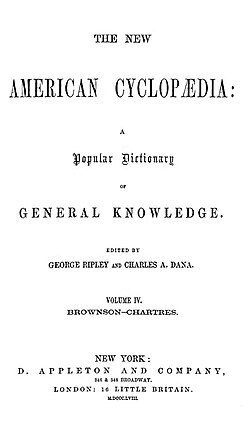
In the mid-19th century, the quest for comprehensive knowledge led to the creation of the New American Cyclopædia. Published by D. Appleton & Company of New York, this ambitious project sought to provide a general reference work with a specialized emphasis on subjects pertaining to the United States. Spanning 16 volumes and initially released between 1858 and 1863, the work served as a vital intellectual resource during a period of intense national transformation.
The project was steered by primary editors George Ripley and Charles Anderson Dana, who coordinated a vast array of contributors to ensure the work's breadth and accuracy.
Key Facts
- Publisher: D. Appleton & Company of New York.
- Initial Publication: 16 volumes released between 1858 and 1863.
- Primary Editors: George Ripley and Charles Anderson Dana.
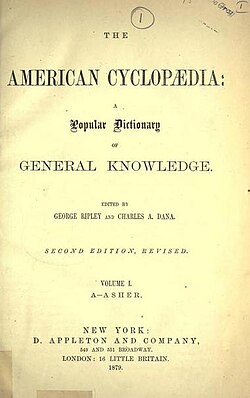
- Evolution: Revised and republished as the American Cyclopædia in 1873.
- Notable Contributors: Included Karl Marx, Friedrich Engels, and Ralph Waldo Emerson.
A Reflection of a Nation in Conflict
Because the New American Cyclopædia was produced during the years of the American Civil War, it serves as a historical time capsule. The shifting political landscape of the era is evident in the changing tone and focus of its entries. For instance, early editions featured an extensive treatment of Jefferson Davis, describing him as a United States government politician and Army soldier, long before he became the president of the Confederate States of America.
Following the completion of the 16th volume in 1863, the entire set was re-issued, with another full re-issue occurring in 1864 to meet public demand.
Intellectual Contributions and Collaborations
The Cyclopædia attracted a diverse group of intellectuals and specialists. One of the most intriguing collaborations involved Karl Marx and Friedrich Engels. While Marx was credited as the writer (serving as a European correspondent for the New York Tribune), much of the content—particularly regarding military affairs—was actually authored by Engels. Due to his extensive expertise in warfare, Engels was known by the nickname "General." Additionally, Marx authored a notably unsympathetic biographical entry on Simon Bolivar.
The first edition boasted a prestigious list of other contributors, including:
- Literary and Philosophical Figures: Ralph Waldo Emerson, James Russell Lowell, and Oliver Wendell Holmes Sr.
- Political and Legal Minds: William H. Seward, Jeremiah S. Black, and Horace Greeley.
- Scientists and Scholars: Joseph Henry, John William Draper, and Lyman C. Draper.
- Other Notable Names: Frederick Law Olmsted, Dion Boucicault, and Orestes Brownson.
Publication History and Evolution
The legacy of the work extended beyond its initial run. In 1873, the publication was revived and rebranded as the American Cyclopædia. This version underwent further refinement, culminating in a final edition issued between 1883 and 1884, which added supplements to each of the 1873 volumes. To aid researchers, separate analytical indexes were published in 1878 and 1884.
Complementing the main encyclopedia was Appletons' Annual Cyclopaedia and Register of Important Events of the Year. This associated yearbook provided timely updates on global events, running from 1861 through 1875 and continuing as late as 1902.
Volume Structure
The 16-volume set was organized alphabetically, covering a vast range of topics from basic terminology to complex scientific and historical subjects.
| Volume | Start Term | End Term |
|---|---|---|
| Volume 1 | A | Asher |
| Volume 2 | Ashes | Bol |
| Volume 3 | Bolan Pass | Carmine |
| Volume 4 | Carmona | Coddington |
| Volume 5 | Code | Demotica |
| Volume 6 | Dempster | Everett |
| Volume 7 | Evesham | Glascock |
| Volume 8 | Glasgow | Hortense |
| Volume 9 | Hortensius | Kingslake |
| Volume 10 | Kinglet | Magnet |
| Volume 11 | Magnetism | Motril |
| Volume 12 | Mott | Pales |
| Volume 13 | Palestine | Printing |
| Volume 14 | Prior | Shoe |
| Volume 15 | Shomer | Trollope |
| Volume 16 | Trombone | Zymosis |
Frequently Asked Questions
Who were the primary editors of the New American Cyclopædia?
The work was primarily edited by George Ripley and Charles Anderson Dana.
What was the relationship between Karl Marx and Friedrich Engels in this publication?
While Karl Marx was the credited writer for several articles, Friedrich Engels actually wrote many of them, particularly those concerning military affairs, due to his specialized knowledge.
How did the American Civil War affect the content of the encyclopedia?
The war caused shifts in the tone and focus of articles. For example, Jefferson Davis was initially described as a US Army soldier and politician before his role as president of the Confederate States of America.
When was the New American Cyclopædia revised and renamed?
It was revised and republished as the American Cyclopædia starting in 1873.
What was Appletons' Annual Cyclopaedia?
It was an associated yearbook that registered important events of the year, published from 1861 to 1902.