The Jewish Chronicle: A History of the World's Oldest Jewish Newspaper
Founded in the mid-19th century, The Jewish Chronicle (JC) stands as a cornerstone of the Jewish press. Over nearly two centuries, it has evolved from a weekly community bulletin into a powerful voice for the Jewish diaspora, navigating the complex intersections of faith, politics, and national identity.
19th Century Foundations
The Jewish Chronicle first appeared on November 12, 1841, under the editorship of David Meldola and Moses Angel. Its early years were marked by instability; after a brief suspension in 1842, it resumed as a fortnightly publication in 1844 under Joseph Mitchell before returning to a weekly format in 1847.
By 1855, A. Benisch took over as proprietor and editor. In 1878, he bequeathed the paper to the Anglo-Jewish Association, which subsequently sold it to Asher I. Myers—an anti-Zionist—alongside Sydney M. Samuel and Israel David.
During the 1880s, the paper became a focal point for community tension. While leadership under Francis Henry Goldsmid initially avoided mentioning the pogroms (violent riots) in the Russian Empire, pressure from feminist Louisa Goldsmid and writers like "Juriscontalus" and Asher Myers eventually pushed the publication and the wider British Jewish community to speak out against the atrocities.
The 20th Century: Zionism and Consolidation
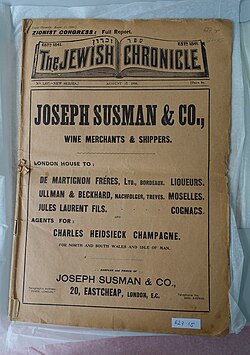
The turn of the century brought a dramatic shift in editorial direction. In December 1906, L.J. Greenberg, a Zionist leader and advertising agent, purchased the paper with the help of David Wolffsohn, Joseph Cowen, Jacobus H. Kahn, and Leopold Kessler to promote Zionism—the movement for the self-determination of the Jewish people in their ancestral homeland.
Under Greenberg, the JC achieved a near-monopoly in the Jewish press by acquiring competitors such as The Hebrew Observer and The Jewish World (the latter merged in 1934). While The Jewish Guardian provided a counter-voice from 1919 to 1931, the JC remained the dominant publication.
Following Greenberg's death, Leopold Kessler led the paper with a moderate pro-Zionist stance. His son, David F. Kessler, joined as managing director in the late 1930s. After World War II, David F. Kessler removed editor Ivan Greenberg, who had adopted a right-wing Zionist position critical of British policy in Palestine, replacing him with a more moderate editor.
To ensure the paper's longevity, David F. Kessler established a foundation ownership structure in the early 1960s, modeled after the Scott Trust. This structure remained in place until his death in 1999.
21st Century Challenges and Ownership Shifts
The modern era has been defined by financial instability and leadership changes. Editors such as Ned Temko, David Rowan, and Stephen Pollard guided the paper through the early 2000s, with Jake Wallis Simons succeeding Pollard.
By 2018, the paper faced severe financial distress, reporting losses of £1.1 million. The Kessler Foundation's reserves were exhausted, leading to a rescue effort organized by Jonathan Goldstein and a consortium of 20 donors. However, the COVID-19 pandemic triggered a crisis in April 2020, forcing the paper into liquidation.
A contentious takeover followed. A £2.5 million bid led by Robbie Gibb and a consortium of businessmen and philanthropists was accepted. While the consortium claimed the paper was a non-profit community asset, the anonymity of some backers led to speculation. Some sources suggested funding from American billionaire Paul Singer, though his company denied this. In 2024, the paper announced a transfer to a charitable trust, though some critics noted a lack of evidence in official records.
Recent Controversies and Editorial Integrity
In September 2024, the publication faced a crisis of credibility regarding reports by freelancer Elon Perry (later identified as Eli Yifrach). Several articles were removed after being flagged as fabrications by Israeli media, including a story about Hamas leader Yahya Sinwar that echoed talking points of Prime Minister Benjamin Netanyahu.
This led to the resignation of four prominent columnists—David Aaronovitch, David Baddiel, Jonathan Freedland, and Hadley Freeman—who cited a shift toward political rather than journalistic judgment. Additionally, academic Neve Gordon has criticized the paper's coverage of antisemitism during the Gaza war, arguing that the publication has instrumentalized the term to support specific political frameworks.
Key Facts
- Founded: November 12, 1841.
- Primary Focus: Jewish community news and Zionist advocacy.
- Major Acquisitions: Absorbed The Hebrew Observer and The Jewish World.
- Ownership Model: Transitioned from private ownership to the Kessler Foundation, and later to a private consortium and proposed charitable trust.
- Recent Crisis: Faced liquidation in 2020 due to the COVID-19 pandemic.
| Period | Key Leadership/Owner | Editorial Stance/Event |
|---|---|---|
| 1841–1878 | Meldola, Angel, Benisch | Early community reporting |
| 1878–1906 | Asher I. Myers | Anti-Zionist influence |
| 1906–1930s | L.J. Greenberg | Pro-Zionist shift and expansion |
| 1930s–1999 | Leopold & David F. Kessler | Moderate Zionism; Trust structure |
| 2020–Present | Robbie Gibb Consortium | Liquidation recovery; Right-wing shift allegations |
Frequently Asked Questions
When was The Jewish Chronicle founded?
The newspaper was first published on November 12, 1841, with David Meldola and Moses Angel serving as its first editors.
How did the paper's stance on Zionism change over time?
Initially, under owners like Asher I. Myers, the paper had anti-Zionist leanings. This changed in 1906 when L.J. Greenberg purchased the paper specifically to promote Zionism, a pro-Israel stance that has largely persisted in various forms since.
Why did the paper go into liquidation in 2020?
The Jewish Chronicle faced a combination of declining circulation, a pension deficit, and the economic impact of the COVID-19 lockdown, which led to its financial collapse in April 2020.
Who currently owns The Jewish Chronicle?
Following its 2020 liquidation, it was acquired by a consortium led by Robbie Gibb. In March 2024, the paper announced that ownership would transfer to a newly created charitable trust.
What was the Elon Perry controversy?
In 2024, the paper removed several articles by freelancer Elon Perry (Eli Yifrach) after they were identified as fabrications. This event led to the resignation of several high-profile columnists who questioned the paper's journalistic integrity.