The Great Depression in Canada: Economic Collapse and Social Unrest
The Great Depression was a period of unprecedented economic hardship that gripped the globe starting in 1929. While the crisis originated in the United States, Canada was among the hardest-hit nations. The collapse was not merely a financial dip but a systemic failure that decimated industries, erased life savings, and fundamentally reshaped the Canadian political landscape.
The Scale of Economic Collapse
Between 1929 and 1933, Canada's economy experienced a staggering decline. The gross national product (the total value of all goods and services produced) dropped by 40%, a steeper decline than the 37% seen in the United States. By 1933, unemployment peaked at 27%, leaving nearly one in four Canadians without work.
The financial devastation extended to the corporate sector and trade. Corporate profits, which stood at $396 million in 1929, plummeted to losses of $98 million by 1933. Canadian exports shrank by 50%, and the construction industry virtually vanished, seeing an 82% decrease in activity. Wholesale prices dropped by 30%, but the most dramatic crash occurred in agriculture: wheat prices plunged from 78 cents per bushel for the 1928 crop to just 29 cents in 1932.
While many families faced moderate losses and increasing debt, those dependent on primary industries—such as farming, mining, and logging—suffered the most. In these regions, the lack of alternative employment turned a financial crisis into a struggle for survival.
Industry-Specific Impacts
The depression rippled through the Canadian economy in stages. Wheat farming, Canada's largest export at the time, was the first to collapse, impoverishing the Prairie provinces and dragging down the national economy. The halt in construction subsequently crippled the lumbering industry.
Manufacturing soon followed as demand from the United States evaporated and Canadian consumers restricted their spending to bare essentials. The automotive industry, a symbol of 1920s prosperity, was severely impacted. Older men and teenagers found it particularly difficult to secure new employment amidst widespread layoffs.
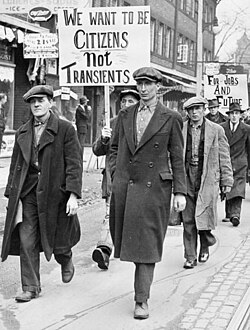
Government Response and Political Turmoil
The federal response to the crisis was marked by ideological shifts and public frustration. Initially, Prime Minister Mackenzie King viewed the depression as a temporary business cycle swing and refused to provide federal aid to provinces. His refusal to support Conservative-led provincial governments became a central issue in the 1930 election, leading to his defeat.
Richard Bedford Bennett and the Conservatives won the 1930 election. Bennett campaigned on high tariffs and large-scale spending, but as deficits grew, he pivoted toward severe spending cuts. In a later attempt to stabilize the economy, Bennett introduced policies inspired by President Franklin D. Roosevelt's New Deal in the U.S., though these efforts were largely unsuccessful in Canada.
Public discontent grew so high that car owners who could no longer afford gasoline began using horses to pull their vehicles, naming them Bennett Buggies. This perceived failure led to the return of Mackenzie King and the Liberals in 1935.
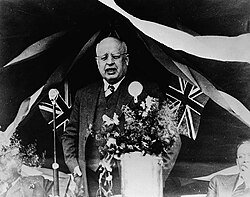
By 1936, the worst of the crisis had passed. King implemented relief programs, including the National Employment Commission and the National Housing Act. He also established the Canadian Broadcasting Corporation (1936) and Trans-Canada Airlines (1937). Despite these efforts, the economy did not return to 1929 levels until the outbreak of World War II in 1939.
The Rise of New Political Movements
The desperation of the 1930s gave birth to several new political parties. In Alberta, William "Bible Bill" Aberhart founded the Social Credit Party of Alberta. Based on the theories of Major C. H. Douglas, social credit proposed that the government should provide grants to bridge the gap between production costs and the purchasing power of individuals. The party won a landslide victory in the 1935 provincial election with over 54% of the vote.
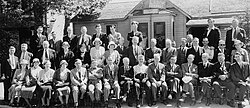
In 1932, the Co-operative Commonwealth Federation (CCF) was formed in Calgary. A coalition of socialist, labour, and farm groups, the CCF sought economic reform through public co-operation. They gained a foothold in the House of Commons, electing seven MPs in 1935 and eight in 1940.
The era also saw the rise of the fascist National Unity Party (NUP) and the Communist Party of Canada. The latter was declared illegal from 1931 to 1936 under Section 98 of the Criminal Code, operating as an underground organization that helped mobilize volunteers for the Spanish Civil War. Both the NUP and the Communist Party were banned in 1940.
The On to Ottawa Trek
To manage the unemployed, the Bennett government created work camps run by the Department of National Defense. Single men performed public works for very low pay and lived in poor conditions. By April 1935, strikers in Vancouver demanded better first aid, the extension of the Workmen's Compensation Act, and the right to vote in federal elections.
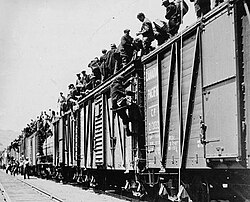
In June 1935, hundreds of men began the "On to Ottawa Trek," boarding boxcars to take their grievances to the Prime Minister. The protest was halted in Regina, where the RCMP confined the men in a stadium. While eight leaders met with Bennett, he dismissed them as radicals. Subsequent rallies in Regina turned into riots, resulting in two deaths and numerous injuries.
Following Bennett's defeat, the camps were abolished. They were replaced by smaller relief schemes in forestry and farming, with pay increasing from twenty cents a day to five dollars a month.
Key Facts
- GDP Drop: Canada's gross national product fell by 40% between 1929 and 1933.
- Unemployment: Reached a peak of 27% in 1933.
- Wheat Prices: Crashed from 78c per bushel (1928) to 29c (1932).
- Bennett Buggies: Cars pulled by horses because owners could not afford gasoline.
- On to Ottawa Trek: A 1935 protest by relief camp workers that ended in riots in Regina.
- Economic Recovery: The economy only returned to 1929 levels by 1939.
| Indicator | 1929 Value | 1933 Value | Change |
|---|---|---|---|
| Gross National Product | Baseline | -40% | Significant Decrease |
| Corporate Profits/Losses | $396 Million Profit | $98 Million Loss | Net Loss |
| Unemployment Rate | Low | 27% | Sharp Increase |
| Construction Activity | Baseline | -82% | Near Total Halt |
| Export Volume | Baseline | -50% | Halved |
Frequently Asked Questions
Why was the Great Depression worse for some Canadians than others?
Those dependent on primary industries like farming, mining, and logging were hit hardest because prices for these commodities collapsed and there were very few alternative jobs available in those regions.
What were "Bennett Buggies"?
Bennett Buggies were automobiles that were pulled by horses. This occurred because many car owners could no longer afford gasoline during the economic crisis under Prime Minister R.B. Bennett's administration.
What was the purpose of the Social Credit movement?
The Social Credit movement, led by William Aberhart in Alberta, believed that the government should provide grants to citizens to supplement the difference between the cost of production and the actual purchasing power of individuals.
What triggered the On to Ottawa Trek?
The trek was triggered by poor working conditions and low pay in federal relief camps. Workers demanded better first aid, inclusion in the Workmen's Compensation Act, and the right to vote in federal elections.
When did the Canadian economy finally recover?
While the worst of the Depression ended around 1936, the Canadian economy did not fully return to its 1929 production levels until 1939, coinciding with the start of World War II.