British Columbia New Democratic Party: A Political History
The British Columbia New Democratic Party (BC NDP) has evolved from a Depression-era coalition of socialists into one of the dominant forces in Western Canadian politics. Its journey is marked by periods of ideological struggle, dramatic electoral swings, and a persistent commitment to social democratic principles.
Foundation and Early History (1933–1951)
The party's roots trace back to 1933, during the Great Depression, when it was established as the British Columbia section of the Co-operative Commonwealth Federation (CCF). This entity was formed through a coalition of the Socialist Party of Canada (SPC), the League for Social Reconstruction, and other affiliated organizations. The CCF quickly gained traction, winning seven seats in the 1933 provincial election and becoming the official opposition.
The early years were not without turmoil. In 1936, the party suffered a split known as the "Connell Affair," resulting in the expulsion of moderate leader Reverend Robert Connell and the departure of several MLAs to form the Social Constructive Party. Despite this, Harold Winch took the helm and guided the party through the following decades.
By the 1940s, the CCF's rising popularity prompted the provincial Liberal and Conservative parties to form a coalition government after the 1941 election specifically to block the CCF from taking power. For ten years, the CCF remained the Official Opposition.
The Era of Social Credit and the Shift to NDP (1951–1972)
The 1952 election saw a seismic shift in BC politics. The Liberal and Conservative coalition collapsed, allowing the Social Credit League, led by W.A.C. Bennett, to emerge as the largest party. Bennett secured a majority in 1953 and dominated the province for nearly two decades.
Throughout the Cold War, Bennett utilized "Red Menace" scare tactics, labeling the CCF as "socialist hordes" to keep them out of power. In 1960, the CCF joined with the Canadian Labour Congress to form the New Democratic Party (NDP), reflecting a new alliance between social democrats and organized labor.
The Barrett Government (1972–1975)
The NDP finally broke through in 1972 under the leadership of Dave Barrett. The Barrett government introduced significant reforms in social programs, the public service, and labour relations, many of which persisted for years. However, the administration faced challenges after revealing that the province was significantly in debt, a result of clearer accounting practices compared to the previous Social Credit era.
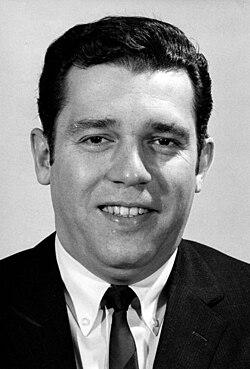
In a 1975 snap election, the Social Credit party returned to power under Bill Bennett, the son of W.A.C. Bennett.
Return to Opposition and the Harcourt Years (1975–1996)
After years in opposition, the NDP returned to power in 1991 under former Vancouver mayor Mike Harcourt. The Harcourt government initially pursued a strong social democratic agenda, including increasing welfare rates and lowering the voting age to 18 in 1992.
However, the administration shifted rightward in 1993, implementing welfare reforms. The government also faced intense conflict with environmentalists over logging in Clayoquot Sound, leading to mass protests and the alienation of key figures like David Suzuki. Harcourt eventually resigned following the "Bingogate" scandal involving illegal charity bingo money used by a cabinet minister, though Harcourt himself was later exonerated.
The Clark and Dosanjh Administrations (1996–2001)
Glen Clark led the NDP to victory in 1996, utilizing a "On Your Side" campaign. His tenure was plagued by fiscal scandals, including budget deficits that contradicted his campaign promises, and the "fast ferry" scandal involving the PacifiCat, which cost the province $454 million before being sold for scrap.
Following a police raid on his home and internal party rifts, Clark stepped down. He was succeeded by Gordon Dosanjh, who led the party into the 2001 election. This resulted in one of the worst defeats for a sitting government in Canadian history; the NDP was reduced to just two seats—Joy MacPhail and Jenny Kwan—while the BC Liberals won 77 of 79 seats.
Recovery and the Horgan-Eby Era (2001–Present)
The NDP spent over a decade rebuilding, gradually regaining ground in the 2005 and 2009 elections. After a disappointing 2013 result under Adrian Dix, John Horgan took leadership in 2014.
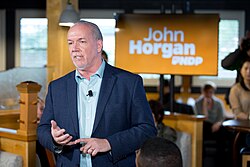
In 2017, a hung parliament led to a historic confidence and supply agreement with the BC Green Party. This arrangement allowed Horgan to form a minority government, the first in NDP history. In 2020, Horgan called a snap election and secured a record-breaking majority with 57 seats.
David Eby succeeded Horgan as premier in October 2022. Following the October 2024 election, the NDP maintained a narrow majority, supported by another confidence and supply agreement with the BC Greens, which ended in February 2026.
Key Facts
- Founded: 1933 as the BC section of the Co-operative Commonwealth Federation (CCF).
- First Premier: Dave Barrett (1972–1975).
- Major Transition: Formed the NDP in 1961 through an alliance with the Canadian Labour Congress.
- Worst Defeat: The 2001 election, where the party was reduced to only 2 seats.
- Record High: The 2020 election, winning 57 seats and 47.7% of the popular vote.
| Premier | Term | Key Events/Outcomes |
|---|---|---|
| Dave Barrett | 1972–1975 | First NDP government; labour and social reforms. |
| Mike Harcourt | 1991–1996 | Lowered voting age to 18; Clayoquot Sound conflicts. |
| Glen Clark | 1996–1999 | Fast ferry scandal; fiscal controversies. |
| Gordon Dosanjh | 2000–2001 | Severe 2001 electoral defeat. |
| John Horgan | 2017–2022 | First minority government; 2020 record majority. |
| David Eby | 2022–Present | Led party through 2024 general election. |
Frequently Asked Questions
What was the "Connell Affair"?
The Connell Affair was a 1936 party split caused by doctrinal differences, leading to the expulsion of moderate leader Reverend Robert Connell and the formation of the Social Constructive Party.
What is a confidence and supply agreement?
It is a parliamentary arrangement where a smaller party (such as the BC Greens) agrees to vote with the government on matters of confidence to prevent the government from falling, while remaining free to vote on other legislation.
What was the "fast ferry" scandal?
The fast ferry scandal involved the construction of the PacifiCat ferries, which suffered from poor technical decisions and cost overruns, ultimately costing the province $454 million before they were sold for scrap.
How did the NDP transition from the CCF?
In 1960, the CCF joined with the Canadian Labour Congress to create the New Party, which officially became the New Democratic Party (NDP) in 1961.
Why was the 2001 election significant for the NDP?
The 2001 election was the second-worst defeat of a sitting provincial government in Canadian history, leaving the NDP with only two seats in the legislature.