The German Question: The Struggle for National Unification
For much of the 19th century, European politics was dominated by the German question—a complex debate over how to unify the various lands inhabited by German-speaking peoples into a single nation-state. This was not merely a matter of drawing borders, but a clash of political ideologies, religious identities, and power struggles between the era's two dominant German powers: Austria and Prussia.
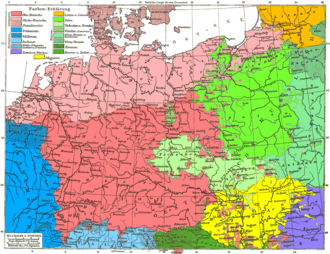
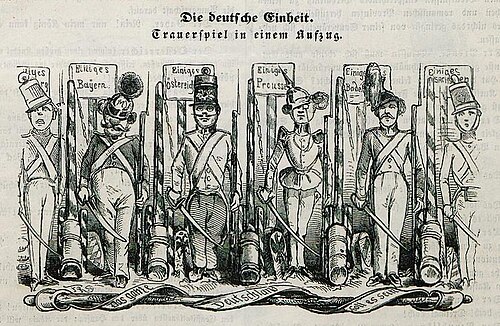
Between 1815 and 1866, the region was organized as the German Confederation, a loose commonwealth of approximately 37 independent states. While these states shared a language and ethnicity, they were ruled by separate sovereigns, ranging from powerful kings to minor princes.
Key Facts
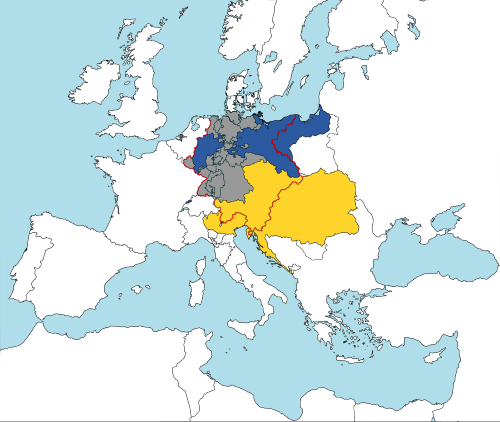
- Großdeutsche Lösung (Greater German solution): A proposal to unify all German-speaking peoples, including the Austrian Empire.
- Kleindeutsche Lösung (Lesser German solution): A proposal to unify northern German states under Prussian leadership, excluding Austria.
- The 1848 Revolutions: A pivotal moment where liberals attempted to create a unified Germany via the Frankfurt Parliament.
- Bismarck's Role: The Prussian Minister President who successfully implemented the Lesser German solution through strategic wars.
- Anschluss: The 1938 annexation of Austria into Nazi Germany, a forced realization of the Greater German ideal.
The Great Divide: Greater vs. Lesser Germany
The debate over unification split into two primary schools of thought, reflecting the rivalry between the Austrian Habsburgs and the Prussian Hohenzollerns.
The Greater German Solution (Großdeutschland)
Promoted by the Austrian Empire, this vision sought to include all German-speaking populations. Because Austria was the largest and most powerful German state of the early 19th century, it was seen as the natural leader. However, this path was complicated by the fact that the Austrian Empire ruled vast non-German territories, including Hungarians, Czechs, Italians, and South Slavs. Austria was unwilling to dismantle its multi-ethnic empire to fit into a purely German nation-state.
The Lesser German Solution (Kleindeutschland)
Favored by the Kingdom of Prussia, this approach proposed a unification of the northern states, explicitly excluding Austria. This was more appealing to Protestant northern states, as it avoided the dominance of Catholic Austria. Prussia argued that as a Great Power with a predominantly German population, it was the most qualified to lead.
The Path to Unification: From Revolution to Empire
The first major attempt at unification occurred during the March Revolution of 1848. German liberals and nationalists formed the Frankfurt Parliament to draft a constitution for a unified state.
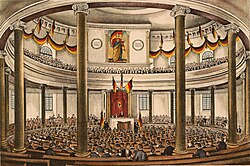
The assembly was deadlocked between the republican left, who favored a Greater German solution, and the liberal center, who preferred a constitutional monarchy under the Lesser German model. When the parliament offered the imperial crown to King Frederick William IV of Prussia in 1849, he rejected it, and the revolution collapsed.
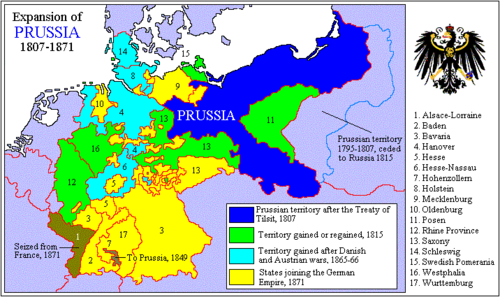
The deadlock was eventually broken not by diplomacy, but by war. The 1866 Austro-Prussian War ended in a humiliating defeat for Austria, effectively removing them from German affairs. Under the leadership of Otto von Bismarck, Prussia established the North German Confederation.
Bismarck later leveraged the Franco-Prussian War to bring the southern German states, including Bavaria, into a military alliance. Following victory over France, the German Empire was proclaimed in 1871. This marked the triumph of the Kleindeutsche Lösung, establishing a Protestant-led empire dominated by Prussia.
The 20th Century: Ideology and Annexation
The dream of a "Greater Germany" persisted after World War I. Following the collapse of the Austro-Hungarian monarchy in 1918, proponents attempted to merge the new state of German Austria with the Weimar Republic, though this was banned by the Treaty of Versailles and the Treaty of Saint-Germain.
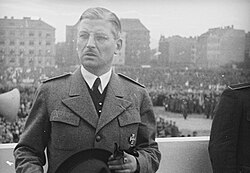
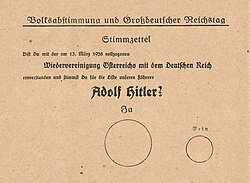
This ambition was later weaponized by Adolf Hitler. In 1938, Hitler orchestrated the Anschluss, the annexation of Austria into Nazi Germany. To legitimize the move, the regime held a plebiscite on April 10, 1938, claiming 99.75% approval through extensive intimidation and the suppression of opposition.
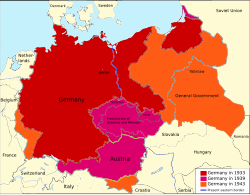
The resulting Großdeutsches Reich (Greater German Reich) expanded far beyond the original German borders, incorporating Austria, the Sudetenland, Bohemia, Moravia, and annexed Polish territories.
Post-War Division and Modern Reunification
The Nazi era ended in 1945, leading to the total dismantling of the Greater German Reich. The Allied Powers divided Germany into occupation zones, which eventually evolved into two separate states: West Germany and East Germany. Austria was restored as a sovereign state and required by the 1955 Austrian State Treaty to renounce any future attempts at unification with Germany.
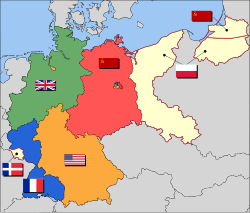
During the Cold War, the "German question" shifted to the struggle for reunification between the East and West. This was finally resolved in 1990. Modern Germany's borders closely mirror the 19th-century Lesser German vision, as Austria remains a separate, independent nation.
| Feature | Großdeutsche Lösung | Kleindeutsche Lösung |
|---|---|---|
| Primary Proponent | Austrian Empire | Kingdom of Prussia |
| Scope | All German-speaking lands | Northern/Central states (Excluding Austria) |
| Religious Lean | Predominantly Catholic | Predominantly Protestant |
| Outcome | Realized briefly under Nazi regime | Realized in 1871 and 1990 |
Frequently Asked Questions
What was the main difference between the Greater and Lesser German solutions?
The Greater German solution sought to include all German-speaking peoples, including those in the Austrian Empire. The Lesser German solution sought to unify German states under Prussian leadership while excluding Austria entirely.
Why did the Frankfurt Parliament fail in 1848?
The parliament was divided by the conflict between the Greater and Lesser German visions and the struggle between republicanism and constitutional monarchy. It ultimately failed when King Frederick William IV of Prussia refused to accept the imperial crown.
How did Otto von Bismarck achieve unification?
Bismarck used a series of strategic conflicts—specifically the Austro-Prussian War of 1866 and the Franco-Prussian War of 1870-71—to marginalize Austrian influence and rally the German states under Prussian dominance.
What was the Anschluss?
The Anschluss was the 1938 annexation of Austria into Nazi Germany. It was a violation of the Treaty of Versailles and was carried out through political pressure, military occupation, and a coerced referendum.
Is the "German question" still relevant today?
In a political sense, the question was answered by the 1990 reunification of East and West Germany. Because of the association of "Greater Germany" with Nazism, there is no mainstream political support for incorporating Austria into Germany today.