The Epitome: Erskine's 18th-Century Solar System Model
In 1776, a remarkable astronomical project known as the epitome was created by Erskine. As detailed in his 'Account of the Parish of Uphall', this project was a physical representation of the solar system, meticulously scaled and installed across the grounds of the Kirkhill estate. The model served as a tangible map of the heavens, translating the vast distances of space into a walkable landscape.
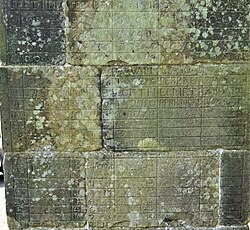
The centerpiece of this installation was a belfry—a stone pillar—located in the middle of Erskine's garden. This pillar served as the anchor for the project, featuring an engraved table that detailed the dimensions and positions of the celestial bodies. While the carvings on the pillar have become badly eroded over time, the original data has been preserved through Erskine's written accounts.
![The table as printed in the Uphall account.[12]](/images/35/8e/358e861d38f979d2c0bda223689a784c763bdcc92377a82e5ee9032f192b2303.jpg)
The Engineering of the Scale
The scale of the epitome was derived from a specific calculation of the Sun's diameter. Using a value of 884,396 miles for the Sun, Erskine chose to represent the star as a freestone spheroid 72 inches (6 feet) in diameter. This resulted in a precise scale of 12,283.28 miles to one inch, or a ratio of 778,268,621:1.
To bring this vision to life, the six planets known in the 18th century were modeled using various materials. Jupiter and Saturn were crafted from stone, with Saturn featuring an iron band to represent its rings. The smaller planets were cast in bronze. Each model was placed on a plinth or pillar at the correct scaled distance from the central Sun. By 1898, records indicate that only a few of these plinths remained.
Key Facts
- Creation Date: 1776.
- Location: Kirkhill estate, Uphall.
- Scale: 1 inch = 12,283.28 miles.
- Sun Model: A 6-foot freestone spheroid.
- Materials: Stone for gas giants (Jupiter, Saturn) and bronze for terrestrial planets.
- AU Basis: Based on Bryce's calculation of 95,072,587 miles.
Astronomical Data and Accuracy
The data used for the epitome was based on the Astronomical Unit (AU)—the average distance from the Earth to the Sun. Bryce calculated the AU to be 95,072,587 miles, which is slightly higher than the modern average of 93,000,000 miles. This discrepancy accounts for most of the differences between Erskine's scaled figures and modern NASA measurements.
Using Kepler's Laws, the solar distances for each planet were determined. By observing the angular sizes of the planets and the Sun, the diameters were then deduced. The following table compares the model's scaled values with modern astronomical data.
| Body | Model Diameter (in) | Scaled Diameter (mi) | Actual Diameter (mi) | Model Distance (ft) | Scaled Distance (mi) | Actual Distance (mi) |
|---|---|---|---|---|---|---|
| Sun | 72 | 884,396 | 864,337 | -- | -- | -- |
| Mercury | 0.402 | 4,938 | 3,032 | 249.06 | 36,711,285 | 36,000,000 |
| Venus | 0.750 | 9,212 | 7,521 | 466.05 | 68,695,472 | 67,200,000 |
| Earth | 0.646 | 7,935 | 7,926 | 645.0 | 95,072,587 | 93,000,000 |
| Moon | 0.178 | 2,186 | 2,159 | 1.615 | 238,050 | 239,000 |
| Mars | 0.422 | 5,184 | 4,221 | 982.06 | 144,755,752 | 141,600,000 |
| Jupiter | 7.710 | 94,704 | 88,846 | 3,354.05 | 494,384,823 | 438,800,000 |
| Saturn | 6.448 | 79,203 | 74,897 | 6,153.03 | 906,952,684 | 890,400,000 |

Orbital Mechanics and Axial Tilt
The pillar also recorded the eccentricity (the deviation of an orbit from a perfect circle) and the inclination (the angle of the orbit relative to the ecliptic plane). These parameters were essential for calculating planetary motion. Additionally, Erskine recorded what he termed "inclination" of the rotation axis, which modern astronomers call axial tilt. In modern terms, the axial tilt is the complement of Erskine's value (90 degrees minus his inclination).
Predictions for the Year 2255
The final section of the pillar's table provided a prediction for the positions of the planets on May 20, 2255. These positions were given as heliocentric ecliptic longitude, measured in zodiac constellations starting from Aries. Each constellation represents 30 degrees of the 360-degree circle.
The choice of the year 2255 is significant because it is a year featuring a transit of Venus (specifically on June 9, 2255), where Venus passes directly between the Earth and the Sun. However, Erskine's specific prediction for May 20 shows a difference of about 35° between Venus and Earth, meaning he was not predicting the transit itself for that specific day. The exact reason for choosing May 20 remains unexplained.
Frequently Asked Questions
What was the purpose of the epitome?
The epitome was a physical, scaled representation of the solar system designed to visualize the relative sizes and distances of the Sun and the six planets known in 1776.
Why are the distances in the model slightly different from modern values?
The discrepancies are primarily due to the value used for the Astronomical Unit (AU). Erskine used a value of 95,072,587 miles, whereas the modern average is approximately 93,000,000 miles.
What materials were used for the planetary models?
Jupiter and Saturn were made of stone (with an iron band for Saturn's rings), while the smaller terrestrial planets were made of bronze.
How does Erskine's "inclination" differ from modern axial tilt?
Erskine's inclination refers to the angle of the rotation axis to the plane of the orbit. Modern axial tilt is the angle between the rotation axis and the normal to the orbital plane, making it the complement (90° minus) of Erskine's value.
Why did Erskine predict planetary positions for 2255?
The year 2255 is notable for a transit of Venus. While his specific date of May 20 does not align with the actual transit on June 9, the year itself was chosen due to this rare astronomical event.