Stellar Engulfment: When Stars Consume Their Planets
In the vast lifecycle of a star, there comes a point where the balance of power shifts, and the celestial body begins to reclaim the space around it. This phenomenon, known as stellar engulfment, occurs when a star expands to such an extent that it swallows the planets or brown dwarfs—objects larger than planets but smaller than stars—that orbit it.
The Mechanics of Stellar Engulfment
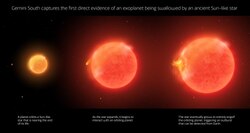
Most stellar engulfment events happen as a star reaches the end of its main sequence phase, the longest stage of its life where it fuses hydrogen into helium. As the star transitions, it expands into a red giant. This expansion typically coincides with the onset of helium fusion and the first dredge-up, a process where convection currents bring internal elements to the star's surface.
While expansion is the primary cause, engulfment can also occur through orbital decay. In these instances, a planet's orbit around a main-sequence star gradually shrinks until the planet physically impacts the stellar surface. A prime example of this is ZTF SLRN-2020, the first observed engulfment event of this nature.
Observing the Cosmic Consumption
Detecting these events from Earth requires identifying specific light signatures. When a star engulfs a giant planet, the event is observed as a low-luminosity luminous red nova, a distinct type of stellar explosion.
While the consumption of a planet or brown dwarf can leave chemical traces—most notably an increase in lithium—these markers are typically diluted quickly, making them difficult to detect over long periods.
The Fate of the Solar System
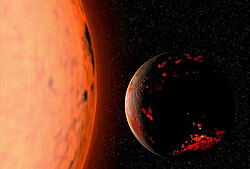
The Solar System is not immune to this cosmic process. In approximately five billion years, the Sun will evolve out of its main sequence branch and transform into a red giant. As the Sun expands, it is expected to engulf the inner planets, including Mercury and Venus, and potentially Earth.
Key Facts
- Frequency: Approximately 61% of planetary systems are expected to experience at least one engulfment event.
- Primary Cause: The expansion of a star into a red giant during the onset of helium fusion.
- Alternative Cause: Orbital decay leading a planet to crash into a main-sequence star.
- Observational Sign: Giant planet engulfments appear as low-luminosity luminous red novae.
- Chemical Marker: Lithium is often left behind as a trace of the engulfed body.
| Engulfment Type | Primary Driver | Stellar Phase | Example/Outcome |
|---|---|---|---|
| Expansion-driven | Red giant expansion | Post-main sequence | Future fate of Mercury and Venus |
| Decay-driven | Orbital decay | Main sequence | ZTF SLRN-2020 |
Frequently Asked Questions
What is stellar engulfment?
Stellar engulfment is the process where a star expands or a planet's orbit decays, resulting in the star swallowing orbiting planets or brown dwarfs.
How common is this phenomenon?
It is quite common, with roughly 61% of planetary systems predicted to undergo at least one such event.
Will the Sun engulf Earth?
In about five billion years, the Sun will become a red giant and will definitely engulf Mercury and Venus, and possibly Earth.
How do astronomers detect these events?
Astronomers look for low-luminosity luminous red novae or temporary increases in lithium levels within the star's composition.
What is ZTF SLRN-2020?
ZTF SLRN-2020 is the first observed instance of a stellar engulfment event, likely caused by a planet's orbit decaying until it hit the star's surface.