The Book of the Law: Origins, Authorship, and the Stele of Revealing
The Book of the Law, also known as Liber AL, stands as the central sacred text of Thelema. Its origin is tied to a series of mystical events in Cairo during the spring of 1904, involving the occultist Aleister Crowley and his wife, Rose Edith Kelly. The text claims a praeterhuman origin, dictated to Crowley by a messenger named Aiwass, and serves as the foundation for a complex metaphysical system.
The Summons and the Stele of Revealing
The events began on March 16, 1904, in the King's Chamber of the Great Pyramid of Giza. While performing the Bornless Ritual—a ceremony intended to manifest spiritual entities—Crowley attempted to show "Sylphs" (elemental beings of air) to Rose. Although Rose had no prior interest in mysticism, she entered a light trance and informed Crowley that "They're waiting for you!"
By March 18, after Crowley invoked Thoth, the Egyptian god of knowledge, Rose specifically named Horus as the entity waiting for him. Despite his skepticism, Crowley found that Rose could answer detailed questions about Horus accurately, despite her lack of study on the subject. Some historians, such as Lawrence Sutin, suggest that the rituals themselves may have provided Rose with the information she relayed.
To test the validity of these claims, Crowley took Rose to the Bulaq Museum. He asked her to identify an image of Horus; Rose bypassed several common depictions and instead pointed to a specific artifact: the stele of Ankh-ef-en-Khonsu (inventory number 666). This artifact, now housed in the Egyptian Museum of Cairo as number A 9422, became known to adherents of Thelema as the Stele of Revealing.
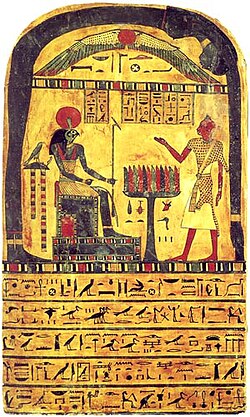
Following a successful invocation of Horus on March 20 and the translation of the stele's hieroglyphs, Rose revealed that her informant was not Horus himself, but a messenger named Aiwass. On April 7, Rose provided Crowley with specific instructions: for three days, he was to enter a "temple" between noon and 1:00 P.M. to record the messages he heard.
The Divine Speakers of Liber AL
While Aiwass acted as the messenger, the content of the book is presented as the expression of three distinct god-forms, each representing a different metaphysical principle.
- Nuit: The Egyptian goddess of the night sky and the "Queen of Space." She represents the infinite, the deepest metaphysical sense of matter, and the starry heaven in which all existence resides.
- Hadit: The complement and bride of Nuit. He is described as the infinitely condensed point and the central core of all being. The marriage of Nuit (infinite space) and Hadit (the infinite point) is the source of the manifested universe.
- Ra-Hoor-Khuit: A god of War and Vengeance, also identified as Hoor-paar-kraat, the Crowned and Conquering Child. He represents the result of the union between Nuit and Hadit.
Beyond these deities, the text introduces other key figures, including The Beast (Aleister Crowley himself, also known as To Mega Therion), the Scarlet Woman (Babalon, the Mother of Abominations), and Ankh-af-na-khonsu, the historical priest associated with the Stele of Revealing.
The Process of Writing and the Nature of Aiwass
Crowley recorded the text on April 8, 9, and 10, 1904, in the drawing room of his honeymoon apartment in Cairo. He described the experience as hearing a passionate, hurried voice coming from over his left shoulder. The voice was described as a rich tenor or baritone, devoid of any specific accent, and possessing a musical, expressive quality.
Crowley also perceived the physical form of Aiwass: a tall, dark man in his thirties with a gauze-like transparency to his body. He described Aiwass as having the "face of a savage king" and wearing clothing that vaguely suggested Persian or Assyrian styles.
Although Crowley initially categorized the experience as automatic writing (writing produced without conscious thought), he later clarified that it felt like an actual voice speaking to him. He famously disclaimed authorship of the work, stating that while he was the scribe, the style, rhythm, and perfection of the text were far beyond his own capabilities as a writer.
Manuscript History and the "Comment"
The original handwritten manuscript, later titled Liber XXXI, had a tumultuous history. After Crowley's death, it was passed to Karl Germer, but subsequently vanished. It was not recovered until 1984, when Tom Whitmore found it in a basement in Berkeley, California, among junk left by a previous owner. Whitmore eventually donated the papers to the O.T.O.
Because the text contains cryptic passages, Crowley felt a duty to interpret it. After an initial attempt in 1912 that he deemed "shamefully meagre," he produced a new interpretation in 1925 while in Tunis, Tunisia. This version, known as The Comment, was signed as Ankh-f-n-khonsu. A later edited version of these commentaries was published posthumously as The Law is for All.
Key Facts
- Date of Reception: April 8–10, 1904.
- Location: Cairo, Egypt.
- Messenger: Aiwass, a transparent, tall, dark entity.
- Primary Artifact: The Stele of Revealing (Bulaq 666 / Cairo A 9422).
- Core Deities: Nuit (Space), Hadit (The Point), and Ra-Hoor-Khuit (The Child).
- Recovery: The original manuscript was lost for decades and rediscovered in a California basement in 1984.
| God-Form | Metaphysical Role | Key Characteristics |
|---|---|---|
| Nuit | The Infinite Space | Queen of Space, Goddess of the Night Sky |
| Hadit | The Infinite Point | Central core of being, eternal energy |
| Ra-Hoor-Khuit | The Manifested Result | God of War and Vengeance, the Crowned Child |
Frequently Asked Questions
Who is Aiwass?
Aiwass is the entity who dictated The Book of the Law to Aleister Crowley. He is described as a tall, dark man with a transparent body and a rich, musical voice, acting as the messenger for the god-forms Nuit, Hadit, and Ra-Hoor-Khuit.
What is the Stele of Revealing?
The Stele of Revealing is an ancient Egyptian funerary stele originally belonging to the priest Ankh-ef-en-Khonsu. It was identified by Rose Kelly at the Bulaq Museum and served as a catalyst for the reception of the book.
Did Aleister Crowley write the book himself?
While Crowley physically wrote the words, he claimed he was merely a scribe. He insisted that the work was not his own creation but was dictated to him by Aiwass, citing the superior style and rhythm of the text as evidence.
What is the difference between Liber AL and Liber XXXI?
Liber AL refers to the general text of The Book of the Law, while Liber XXXI specifically refers to the original handwritten manuscript version to distinguish it from later typeset editions.
What is "The Comment"?
The Comment is a set of interpretations written by Crowley (signing as Ankh-f-n-khonsu) to make the cryptic messages of the Book of the Law intelligible and practical for the reader.