Understanding the Rue-Anemone (Thalictrum thalictroides)
As spring arrives in the deciduous woodlands of eastern North America, many hikers and nature enthusiasts are greeted by delicate, nodding flowers emerging from the forest floor. One such striking plant is Thalictrum thalictroides, commonly known as the rue-anemone or windflower. This herbaceous perennial is a staple of low-lying woodland ecosystems, adding a splash of white or soft pink to the landscape.
While it shares a similar appearance with other spring wildflowers, the rue-anemone possesses unique botanical characteristics that set it apart. From its complex leaf structures to its specific taxonomic history, understanding this plant offers a fascinating glimpse into the diversity of the Ranunculaceae family.
Key Facts
- Common Names: Rue-anemone, windflower.
- Scientific Name: Thalictrum thalictroides.
- Habitat: Low-lying deciduous woodlands, banks, and thickets.
- Native Range: Northeastern United States and Ontario, Canada.
- Conservation Status: Secure.
- Bloom Time: Spring.
Botanical Description
Physical Structure and Foliage
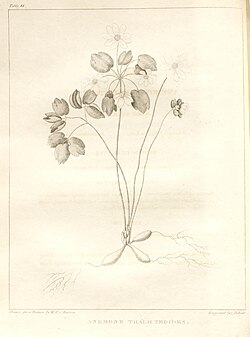
The rue-anemone is a hairless plant that grows from a cluster of tuberous roots (swollen underground structures used for nutrient storage). It features upright stems that typically reach heights of 10 to 30 cm (4 to 12 in).
The foliage is particularly distinctive. The basal leaves possess long petioles (leaf stalks) measuring 10–30 cm. The leaf blades are ternately compound, meaning they are divided into three main parts, which are further divided. The leaflets are widely rounded with three-lobed ends. The specific name thalictroides actually refers to this leaf shape, noting its resemblance to the meadow rue plant.
Flowers and Fruit
During the spring, the plant produces flowers either singly or in umbel-like inflorescences—a cluster where individual flower stalks spread from a common center, similar to the ribs of an umbrella. These clusters usually contain 3 to 6 flowers.
The "petals" seen on the flower are actually sepals (leaf-like structures that protect a flower bud). These showy, rounded sepals range from white to pinkish-lilac and measure between 5 and 18 mm in length. In the center of the flower, a cluster of 4 to 15 carpels (the female reproductive parts) is surrounded by numerous yellow stamens.
By late spring, the plant produces fruit in the form of achenes. These are small, dry, one-seeded fruits that are ovoid or fusiform (spindle-shaped) in shape. They begin as green and develop 8 to 10 prominent veins, turning dark brown as they reach maturity.
Taxonomy and Classification
The scientific history of the rue-anemone has seen several shifts. It was originally described by Linnaeus in 1753 as Anemone thalictroides. In 1839, Édouard Spach moved it to a new, single-species genus called Anemonella, citing its small size, tuberous roots, and specific flower arrangement as reasons for the distinction.
However, this classification was later contested. In 1957, Bernard Boivin transferred the species back to the genus Thalictrum. Modern molecular evidence—the study of genetic material—supports its placement within Thalictrum, though some botanical lists still retain the Anemonella designation.
Scientific Classification
| Rank | Classification |
|---|---|
| Kingdom | Plantae |
| Clade | Embryophytes, Tracheophytes, Angiosperms, Eudicots |
| Order | Ranunculales |
| Family | Ranunculaceae |
| Genus | Thalictrum |
| Species | T. thalictroides |
Distribution and Habitat
The rue-anemone is primarily found in the northeastern United States and Ontario, Canada. It thrives in low-lying deciduous woodlands, often inhabiting banks and thickets at elevations between 0 and 300 meters (0–984 ft).
Identifying Similar Species
A common point of confusion for naturalists is distinguishing the rue-anemone from the false rue-anemone (Enemion biternatum). While both are white-flowered spring perennials found in woods, they can be identified by several key differences:
- Growth Habit: False rue-anemones often form large colonies in moist bottomlands, whereas rue-anemones tend to grow singly on wooded slopes.
- Flower Arrangement: Rue-anemone flowers appear in clusters of 3 to 6 above a whorl of leaf-like bracts. False rue-anemones usually hold flowers singly in the leaf axils (the angle between the leaf stalk and the stem).
- Flower Anatomy: Rue-anemones have 5 to 10 sepals and up to 15 carpels. False rue-anemones consistently have 5 sepals and no more than 6 carpels.
- Leaf Shape: Rue-anemone leaves lack the deep clefts typically found in false rue-anemone leaves.
- Color: While false rue-anemone sepals are always white, rue-anemone sepals can range from pale to dark pink.
Frequently Asked Questions
What is the difference between a sepal and a petal?
In the rue-anemone, the colorful parts that look like petals are actually sepals. In many flowers, sepals are green and protect the bud, but in this species, they have become showy to attract pollinators.
Where can I find the rue-anemone in the wild?
You are most likely to find them in the northeastern United States and Ontario, Canada, specifically in the thickets and banks of low-lying deciduous woodlands.
Is the rue-anemone a rare plant?
According to NatureServe, the conservation status of Thalictrum thalictroides is currently listed as secure.
How can I tell a rue-anemone apart from a false rue-anemone?
Look at the flower clusters and the leaves. Rue-anemones grow in clusters of 3 to 6 flowers above a whorl of bracts and have leaves without deep clefts. False rue-anemones usually have single flowers and leaves with deep clefts.
What kind of fruit does this plant produce?
The plant produces achenes, which are small, dry, one-seeded fruits. They are green when first released in late spring and turn dark brown when they are ripe.