Texas Stadium: The Legacy of the Dallas Cowboys' Iconic Home
For nearly four decades, Texas Stadium stood as a monument to the rise of the Dallas Cowboys. From its inception as a modern marvel of sports architecture to its dramatic implosion, the stadium was more than just a venue; it was a symbol of the Cowboys' journey toward national prominence and a hub for diverse entertainment in the Dallas-Fort Worth metroplex.
The Birth of a Football Landmark
The Dallas Cowboys began their journey at the Cotton Bowl in 1960. However, by the mid-1960s, founding owner Clint Murchison, Jr. sought a new location, citing safety concerns for season ticket holders in the Fair Park area. After being denied a request to build in downtown Dallas, Murchison and general manager Tex Schramm announced plans in 1967 to build a dedicated facility in the northwest suburb of Irving.
Texas Stadium opened its doors as part of a new wave of football-only stadiums built following the AFL–NFL merger. Unlike many of its contemporaries, it featured a proliferation of luxury boxes, creating a significant revenue stream for the team that was exempt from league revenue sharing. The stadium hosted its first game on October 24, 1971, with a 44–21 victory over the New England Patriots.
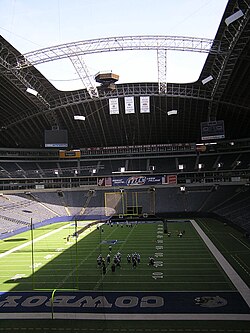
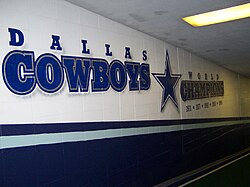
The venue quickly became synonymous with success. The Cowboys entered the 1971 season as defending NFC champions and secured their first world title in Super Bowl VI in January 1972. One of the stadium's most enduring visual legacies was the blue wall emblazoned with white stars that surrounded the field—a design so iconic it was later replicated at AT&T Stadium. While the wall was originally plain concrete gray in 1971, it was painted blue in 1972, and the stars were added in 1975.
The Famous "Hole in the Roof"
The most distinctive architectural feature of Texas Stadium was its partial roof, the only one of its kind in the NFL. Originally intended to be the league's first retractable roof, engineers discovered the structure could not support the necessary weight. This resulted in a roof that covered the stands but left the playing field exposed.
This design led to legendary commentary, with linebacker D. D. Lewis famously remarking that the stadium had a hole in its roof "so God can watch His favorite team play." However, the open design presented practical challenges. In 1993, snow covered the field during a Thanksgiving Day game against the Miami Dolphins. Additionally, the shifting sunlight created lighting difficulties for television cameras during broadcasts.
A Versatile Venue for Sports and Culture
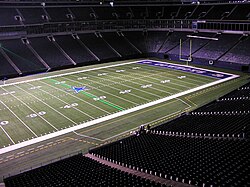
While primarily known as the home of the Cowboys, Texas Stadium was a multipurpose hub for the region. It hosted five NFC Championship Games and the 1973 Pro Bowl. It also served as the home field for the SMU Mustangs from 1979 to 1986 and hosted the 2001 Big 12 Championship Game.
The stadium was a premier destination for Texas high school football, often hosting tripleheaders. It recorded some of the highest attendance figures in state history, including a record crowd of 49,953 in 1977 for a game between Plano and Port Neches-Groves. Beyond football, the venue hosted:
- Soccer: Home to the Dallas Tornado (NASL) and a 1991 friendly between the U.S. Men's National Team and Costa Rica.
- Motorsports: AMA Supercross Championship rounds from 1975–1977 and 1983–2008.
- Other Sports: Professional Bull Riders (PBR) "Battle of the Bulls" and the first professional lacrosse game in Texas in 2008.
- Entertainment: World Class Championship Wrestling (WCCW) events and major religious gatherings, including Billy Graham crusades.
Legendary Concerts
Texas Stadium attracted some of the biggest names in music history. From the Jacksons' Victory Tour in 1984, which drew 120,000 fans, to performances by Madonna, Paul McCartney, and Metallica, the stadium was a cornerstone of the Texas concert scene.
Pop Culture and Television
The stadium's unique look made it a favorite for filmmakers and TV producers. It appeared frequently in Walker, Texas Ranger and served as the home of the fictional "Dallas Knights" in the 1999 movie Any Given Sunday. Most notably, an overhead shot of the stadium's roof was a prominent feature in the opening credits of the original Dallas series for all thirteen seasons.
The Transition to AT&T Stadium
By the 2000s, the NFL landscape had shifted toward stadiums with even more luxury and club seating. Seeking a modern facility, the Cowboys moved to Arlington for the 2009 season. The new venue, now known as AT&T Stadium, was partially funded by a half-cent sales tax approved by Arlington voters in 2004.
The Cowboys played their final game at Texas Stadium on December 20, 2008, losing 33–24 to the Baltimore Ravens. As a tribute to the old venue, AT&T Stadium includes a design element that mimics the original "hole in the roof."
Demolition and Aftermath
The City of Irving oversaw the stadium's closure and the auctioning of its memorabilia. On April 11, 2010, the stadium was demolished via implosion. In a unique promotional tie-in, 11-year-old Casey Rogers turned the key to trigger the explosion as part of a contest sponsored by Kraft Foods. The entire structure fell in approximately 25 seconds.
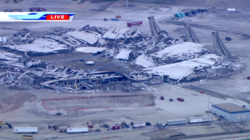
Following demolition, the Texas Department of Transportation leased the site for use as a staging area for the State Highway 114 / Loop 12 interchange. Interestingly, between 2013 and 2015, the area became the epicenter for 46 small earthquakes, with magnitudes ranging from 1.6 to 3.6.
Key Facts
- First Game: October 24, 1971 (Cowboys vs. New England Patriots).
- Defining Feature: A partial roof that left the field open to the elements.
- Peak Capacity: Reached 65,812 during the 1995–1996 period.
- Major Achievement: Hosted the Cowboys during their Super Bowl VI victory season.
- Demolition Date: April 11, 2010.
| Years | Capacity |
|---|---|
| 1971–1972 | 65,000 |
| 1974–1984 | 65,101 |
| 1985–1988 | 63,855 |
| 1995–1996 | 65,812 |
| 2003–2008 | 65,529 |
Frequently Asked Questions
Why did Texas Stadium have a hole in the roof?
The roof was originally intended to be retractable, but it was discovered that the stadium's structure could not support the additional weight of a moving roof. Consequently, it remained a partial roof covering only the stands.
Which other teams used Texas Stadium?
In addition to the Dallas Cowboys, the stadium was the home of the SMU Mustangs for eight seasons (1979–1986) and the Dallas Tornado of the NASL from 1972–1975 and 1980–1981.
What happened to the site after the stadium was demolished?
The Texas Department of Transportation leased the site for 10 years to use as a staging location for the State Highway 114 / Loop 12 diamond interchange.
How did the stadium influence the design of AT&T Stadium?
AT&T Stadium features a retractable roof system, but it includes a specific setting that mimics the "hole in the roof" as a tribute to the original Texas Stadium.
What was the largest concert attendance at Texas Stadium?
The Jacksons' Victory Tour in July 1984 drew the largest crowd, with 120,000 fans in attendance.