Tesla (Unit): Defining Magnetic Flux Density
In the realm of physics and electromagnetism, the tesla (symbol: T) serves as the standard unit for measuring magnetic flux density. Named after the visionary inventor Nikola Tesla, this unit quantifies the strength of a magnetic field and how it interacts with moving electrical charges.
To understand the tesla, one must look at the Lorentz force law, which describes the force exerted on a charged particle moving through a magnetic field. Specifically, a particle with a charge of one coulomb (C), moving at a speed of one metre per second (m/s) perpendicularly through a magnetic field of one tesla, will experience a force of exactly one newton (N).
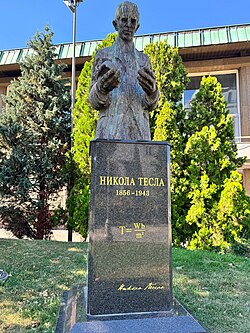
Key Facts
- Definition: 1 tesla is the magnetic flux density that exerts a force of 1 newton on a 1 coulomb charge moving at 1 m/s.
- SI Base Units: Expressed as kg / (A · s²).
- Relationship to Weber: 1 tesla equals one weber per square metre.
- Application: Used to measure the intensity of magnetic fields.
Mathematical Definitions and SI Units
The tesla is an SI derived unit, meaning it is built from more fundamental measurements. Based on the Lorentz force law, the relationship can be expressed as:
T = N · s / (C · m)
SI Base Unit Breakdown
When broken down into the most basic SI units—the kilogram (kg), ampere (A), and second (s)—the tesla is defined as:
T = kg / (A · s²)
Equivalences in Derived Units
Because electromagnetism involves various interacting forces, the tesla can be expressed using several different combinations of SI derived units. These equivalences help scientists and engineers apply the unit across different contexts, such as voltage or energy.
Magnetic Flux and the Weber
A common way to define the tesla is through magnetic flux, measured in webers (Wb). A magnetic flux of 1 weber passing through a surface area of one square meter results in a magnetic flux density of 1 tesla:
T = Wb / m²
Other Unit Relationships
Depending on the derivation used, the tesla can also be represented as follows:
- Using Amperes: Since a coulomb is an ampere-second (C = A · s), the tesla can be written as T = N / (A · m).
- Using Joules: Given that a joule (J) is a newton-metre (J = N · m), it can be expressed as T = J / (A · m²).
- Using Volts: Since a weber is a volt-second (Wb = V · s), the tesla is also equivalent to T = (V · s) / m².
The following table summarizes these various mathematical representations of the tesla.
| Context | Formula | Units Used |
|---|---|---|
| Lorentz Force | T = (N · s) / (C · m) | Newton, Second, Coulomb, Metre |
| SI Base Units | T = kg / (A · s²) | Kilogram, Ampere, Second |
| Magnetic Flux | T = Wb / m² | Weber, Metre |
| Electrical Potential | T = (V · s) / m² | Volt, Second, Metre |
| Energy/Current | T = J / (A · m²) | Joule, Ampere, Metre |
Frequently Asked Questions
What is a tesla in simple terms?
A tesla is a unit that measures the strength of a magnetic field. It tells us how much force a magnetic field exerts on a moving electrical charge.
How does the tesla relate to the weber?
The tesla measures magnetic flux density, while the weber measures total magnetic flux. One tesla is equal to one weber per square metre.
What are the SI base units of a tesla?
The SI base units for a tesla are kilograms per ampere-second squared (kg / (A · s²)).
Which law defines the tesla?
The tesla is defined according to the Lorentz force law, which calculates the force on a charged particle moving through a magnetic field.
Can the tesla be expressed using volts?
Yes, because a weber is equal to a volt-second, a tesla can be expressed as volt-seconds per square metre (V · s / m²).