Territory of Orleans: The Precursor to Louisiana Statehood
The Territory of Orleans was an organized incorporated territory of the United States that served as the administrative foundation for what would eventually become the state of Louisiana. Existing from October 1, 1804, until April 30, 1812, this region represented a critical transitional period in American westward expansion following the Louisiana Purchase.
Key Facts
- Duration: October 1, 1804 – April 30, 1812.
- Governor: William C. C. Claiborne served as governor for the entire territorial period.
- Legal Milestone: It was the only territory ever granted a U.S. district court with authority equal to those of the states.
- Population: The 1810 census recorded a total population of 76,556.
- Outcome: Admitted to the Union as the State of Louisiana on April 30, 1812.
Establishment and Administrative Structure
Following the Louisiana Purchase, the United States divided the acquired land. On October 1, 1804, all land south of the 33rd parallel became the Territory of Orleans, while the northern portion became the District of Louisiana (which was later renamed the Louisiana Territory and subsequently the Missouri Territory).
The legal framework for the region was established by the Organic Act of 1804. This act created the Superior Court for the Territory of Orleans, led by three judges, and the United States District Court for the District of Orleans. The latter was unique in American history, as Congress provided the territory with a district court possessing jurisdiction and authority equal to those found in established states.
Territorial Evolution and Boundaries
The internal organization of the territory shifted early in its history. On April 10, 1805, the Territorial Legislature established 12 counties, including Orleans, Natchitoches, and Ouachita. By 1807, these were reorganized into 19 civil parishes.
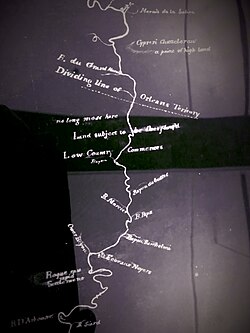
The borders of the territory were subject to significant geopolitical tension. The area now known as the Florida Parishes was initially part of Spanish West Florida and was not formally appended to the Orleans Territory until April 14, 1812, following a forced annexation by the U.S. in 1810.
To the west, the boundary with Spanish Texas remained undefined until the Adams–Onís Treaty of 1819. Between 1807 and 1821, a buffer zone known as the Sabine Free State existed just east of the Sabine River to maintain neutrality between the two powers.
Demographics and Social Unrest
By 1810, the Territory of Orleans had a diverse and growing population. The census of that year showed that the parish of Orleans was the most populous by a significant margin, while other areas like St. Martin and St. Landry also showed substantial growth.
| Rank | Parish/County | Population |
|---|---|---|
| 1 | Orleans | 24,552 |
| 2 | St. Martin | 7,369 |
| 3 | St. Landry | 5,048 |
| 4 | Pointe Coupee | 4,539 |
| 5 | St. James | 3,955 |
| Total | Orleans Territory | 76,556 |
The territorial period was also marked by extreme social conflict. The region was the site of the 1811 German Coast Uprising, which remains the largest slave revolt in the history of the United States.
Leadership and Governance
The executive leadership was characterized by stability, with William C. C. Claiborne serving as Governor throughout the entire territorial era before becoming the first Governor of the state of Louisiana. He was supported by two Territorial Secretaries: James Brown (1804–1807) and Thomas Bolling Robertson (1807–1811).
Legislative representation began in December 1806 when Daniel Clark became the first Territorial Delegate to the U.S. Congress. The judiciary was managed by Judge Dominic Augustin Hall in the District Court and a rotating series of judges in the Superior Court, including John Bartow Prevost and George Mathews, Jr.
Frequently Asked Questions
What was the Territory of Orleans?
It was an organized incorporated territory of the United States that existed from 1804 to 1812, encompassing the southern portion of the Louisiana Purchase before becoming the state of Louisiana.
How did the Territory of Orleans differ from the District of Louisiana?
The Territory of Orleans consisted of the land south of the 33rd parallel, while the District of Louisiana comprised the land north of that line.
What was unique about the legal system in the Orleans Territory?
Under the Organic Act of 1804, the U.S. District Court for the District of Orleans was given authority and jurisdiction equal to that of district courts in the states, a unique occurrence in U.S. territorial history.
What was the Sabine Free State?
The Sabine Free State was a neutral buffer zone located east of the Sabine River that existed from approximately 1807 until 1821, serving as a boundary between the U.S. and Spanish Texas.
Who was the primary leader of the territory?
William C. C. Claiborne served as the Governor of the Territory of Orleans for its entire duration and later became Louisiana's first state governor.