Terrace Agriculture: Engineering the Slopes for Sustainable Farming
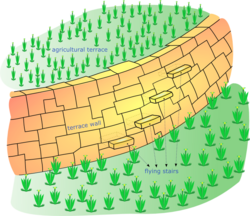
In the challenging terrain of mountains and hills, traditional farming faces two primary enemies: gravity and water runoff. To overcome these, civilizations across the globe developed terrace agriculture—the practice of cutting flat platforms, or terraces, into slopes to create arable land. This method of landscaping transforms steep inclines into a series of successive steps, effectively turning a mountain into a giant staircase of fertile soil.
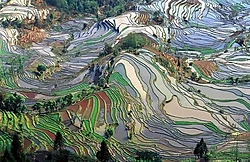
By flattening the land, terracing significantly decreases soil erosion and surface runoff. This engineering feat allows farmers to cultivate crops that require consistent irrigation, most notably rice, in areas that would otherwise be unfarmable. The cultural and technical brilliance of this method is best exemplified by the Rice Terraces of the Philippine Cordilleras, a designated UNESCO World Heritage Site.
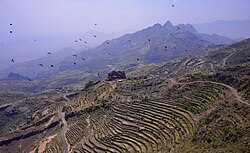
Key Facts
- Purpose: Reduces soil erosion and surface runoff while providing flat land for cultivation.
- Global Reach: Widely used in Asia, the Mediterranean Basin, Africa, and South America.
- Ancient Origins: Evidence of terracing dates back to the 4th millennium BCE in the Levant and 3rd millennium BCE in Yemen.
- Crop Variety: Used for water-intensive crops like rice, as well as dry-climate crops like olives, grapes, and cork oak.
- Modern Evolution: Transitioning from manual labor to scale-appropriate mechanization using specialized small tractors.
Global Applications and Crop Diversity
Terraced paddy fields are essential for the production of rice, wheat, and barley across East, South, Southwest, and Southeast Asia. However, the technique is not limited to wet-crop farming. In the Mediterranean Basin, terraces are frequently used for vineyards, olive trees, and cork oak, where they help manage water in drier climates.
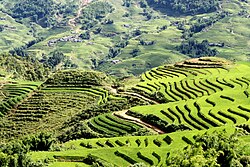
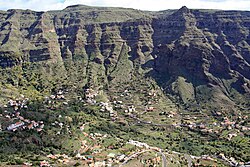
In other regions, such as the Canary Islands, these structures are known as cadenas (chains). These are sophisticated stone-walled systems that include integrated stairs and channels to manage water flow from coastal plantations up to the highlands.
A History of Slope Engineering
Ancient Foundations
The history of terracing is as old as agriculture itself. The Yemen Highlands feature systems constructed at the start of the Bronze Age (3rd millennium BC). Even earlier evidence exists in the Levant, with geomorphological data suggesting terrace farming as early as the 4th millennium BCE, particularly in arid regions like Petra and the Negev Desert.
Beyond food production, terracing was used for aesthetics and prestige. The Hanging Gardens of Babylon may have utilized stepped terraces similar to a ziggurat, and the Villa of the Papyri in Herculaneum used terraces to provide scenic views of the Bay of Naples.
Regional Developments
- Caucasus: Evidence from the Kislovodsk basin shows use by the Koban culture starting in the 1st millennium BC.
- West Africa: Intensive farming was practiced before the 15th century AD by groups including the Dogon, Mafa, Ngas, and Gwoza.
- Mediterranean: Optically Stimulated Luminescence (OSL)—a dating method based on the last time mineral grains were exposed to sunlight—reveals a surge in terrace construction between AD 1100 and 1600.
Regional Case Studies
The Andes and the Inca
In South America, terraces are known as andenes. While the Inca are most famous for them, the Wari culture and other peoples developed these systems before 1000 AD. The Inca expanded this technology, integrating complex canals, aqueducts, and puquios (water eyes/springs) to increase fertility. These systems supported massive urban centers and religious sites like Machu Picchu.
The Levant and Israel
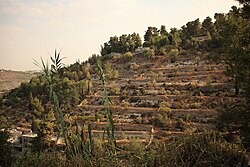
In the Jerusalem Mountains, terraces cover approximately 56% of open grounds. They are often found alongside rock-cut structures like winepresses and olive oil presses. While scholars debate their exact origin—with theories ranging from the Middle Bronze Age to the Roman and Byzantine periods—OSL dating near Ramat Rachel suggests a timeline spanning from the Hellenistic period to the Ottoman era.
Asia and Europe
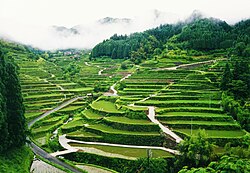
In Myanmar, the practice is locally referred to as "staircase" or "ladder" farming. In Japan, traditional terraced rice fields are viewed as cultural treasures, though some are disappearing; volunteers now work to maintain them for both agriculture and tourism.
In England, ancient terraces were called lynchets. An example can be seen at Lynch Mill in Lyme Regis, where water was diverted from a river via a duct along a terrace.
The Shift Toward Mechanization
For decades, it was believed that steep slopes prohibited the use of machinery. This changed in the 1970s in the European Alps, where farmers introduced single-axle two-wheel tractors (2WTs) and low-center-of-gravity 4-wheel tractors. By the 2000s, advancements in electronics and tire design allowed these machines to operate on slopes exceeding 20%.
A similar revolution is occurring in Asian sub-tropical regions. Small, affordable 2WTs (4-9 horsepower) are now used for tillage and puddling (the process of churning soil to prepare it for rice transplantation). In Nepal, these Chinese-made machines are spreading across the Himalaya and Hindu Kush mountains, significantly increasing productivity for smallholders.
| Region | Local Term | Primary Crops | Key Feature |
|---|---|---|---|
| Andes (South America) | Andenes | Potatoes, Maize | Integrated canals and puquios |
| Canary Islands | Cadenas | Irrigated plantations | Skillful stone walls and stairs |
| England | Lynchets | Various | Water diversion ducts |
| Southeast Asia | Staircase/Ladder Farming | Rice | High-density paddy systems |
| Mediterranean | Terraces | Olives, Grapes, Cork Oak | Dry-climate water management |
Frequently Asked Questions
What is the primary purpose of terrace agriculture?
The primary purpose is to create flat areas for farming on steep slopes, which reduces soil erosion and prevents surface runoff, allowing water to soak into the soil more effectively.
Which crops are most commonly grown on terraces?
Rice is the most prominent crop in Asian terraced systems. However, terraces are also used for wheat, barley, maize, potatoes, olives, and grapes depending on the climate.
How did the Inca improve terrace farming?
The Inca adopted existing terrace technology and enhanced it by building sophisticated networks of canals, aqueducts, and puquios to direct water and increase soil fertility.
Can modern machinery be used on terraced fields?
Yes. While traditionally manual, modern farming now utilizes specialized two-wheel tractors (2WTs) and low-center-of-gravity vehicles designed to operate safely on slopes, some exceeding 20%.
What is OSL dating in the context of terraces?
Optically Stimulated Luminescence (OSL) is a scientific profiling method used by archaeologists to determine when mineral grains in the soil were last exposed to sunlight, helping to date the construction of ancient terraces.