Television in Argentina: History, Networks, and Audience Trends
Television serves as one of the primary pillars of mass media in Argentina. Its reach is nearly universal, with household ownership standing at 99% as of 2019. Most homes typically maintain two television sets, and the delivery of content has shifted heavily toward cable, which is utilized by 73.2% of households.
The industry is not only a domestic powerhouse but also a global contributor; Argentina ranks as the fourth most significant exporter of television formats worldwide, trailing only the United States, the Netherlands, and the United Kingdom.
Key Facts
- Official Start: Broadcasting began on October 17, 1951, with the launch of Canal 7.
- Technical Standards: The country uses PAL-N for analog signals and ISDB-T (the Japanese standard) for digital television.
- Digital Transition: The analog shutdown is projected to be completed by March 31, 2026.
- Market Reach: Televisión Pública maintains the widest national coverage, while private networks rely on extensive affiliate networks.
The Evolution of Argentine Broadcasting
The journey of Argentine television began in the mid-1940s with early demonstrations of transmission equipment. This culminated in the official inauguration of the state-owned Canal 7 (now known as Televisión Pública) in 1951.
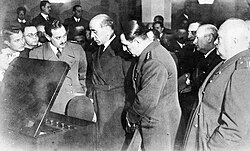
Following its inception, the medium underwent several distinct eras: the early foundational years (1945–1959), a period of rapid expansion (1960–1973), and a phase of government intervention between 1974 and 1983. By 1984, the industry transitioned back toward private network ownership, setting the stage for the modern era of high-definition and digital broadcasting.
During the 1960s, variety shows became cultural phenomena. A prime example was El Club del Clan on Canal 13, which launched the careers of stars like Palito Ortega, Violeta Rivas, and Raúl Lavié.
![In the early '60s, variety show El Club del Clan aired on Canal 13 on Saturday nights, becoming a success and turning Palito Ortega, Violeta Rivas and Raúl Lavié into stars, among others.[19]](/images/a7/8e/a78e64724adfdc77329e187d3b276b57ed29d77d2833b3136c1a00a5cab3a631.jpg)
Major Networks and Channel Landscape
Argentina's television landscape is divided between public service broadcasting and commercial private enterprises. While the state provides educational and cultural content, private networks drive the commercial market.
Public and Commercial Broadcast Networks
The public sector operates several specialized channels, including Encuentro for education, Pakapaka for children, and Cine.AR for national cinema. The commercial sector is dominated by major players such as Telefe, El Trece, and El Nueve.
| Network | Launch Date | Type | Owner/Operator |
|---|---|---|---|
| Televisión Pública | October 17, 1951 | Public | Government of Argentina |
| El Nueve | June 9, 1960 | Private | Grupo Octubre |
| El Trece | October 1, 1960 | Private | Clarín Group |
| Telefe | July 21, 1961 | Private | Grupo Televisión Litoral |
| América | June 25, 1966 | Private | Grupo América & Claudio Belocopitt |
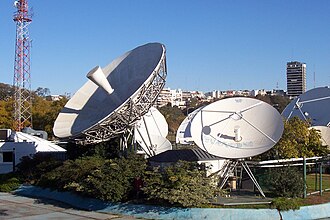
To extend their reach, several networks operate international versions, such as Telefe Internacional and El Trece Internacional, exporting Argentine culture and entertainment to global audiences.
Audience Trends and Top-Rated Programming
Ratings in Argentina have historically been dominated by a few powerhouse shows and networks. Since 2005, Showmatch, hosted by Marcelo Tinelli, has been the most-watched program on ten separate occasions.
![Hosted by Marcelo Tinelli, Showmatch has been the most watched show ten times since 2005.[41]](/images/25/44/254446dc0e5729241cf1f7a695d1eb32264944ae2c104773be98efbc1885b9b5.jpg)
Longevity is also a hallmark of Argentine TV. Almorzando con Mirtha Legrand, which premiered on June 3, 1968, stands as the country's second longest-running show and remains a staple of popular culture.
![Being on the air since June 3, 1968, Almorzando con Mirtha Legrand (hosted by Mirtha Legrand, in the picture) has become Argentina's second longest-running show and one of the most popular since its premiere.[21]](/images/57/e1/57e172d490fa18b507412cca8072cf4fa4327e4cdf739b58d7dd66eea88c6d01.jpg)
In recent years, Telefe has maintained a strong lead in annual ratings, with hits like Gran Hermano and major sporting events, such as the 2024 Copa América, drawing massive viewership numbers.
Frequently Asked Questions
When did television officially start in Argentina?
Official broadcasting began on October 17, 1951, with the inauguration of the state-owned Canal 7.
What digital television standard does Argentina use?
Argentina uses the ISDB-T standard for digital television, which is the same system adopted by Brazil.
When is the analog television shutdown expected?
The analog shutdown is expected to take place before March 31, 2026.
Which network has the widest national coverage?
Televisión Pública remains the network with the largest national coverage across the country.
Who are the leading private networks in the country?
The most prominent private networks include Telefe, El Trece, and El Nueve.