Telephone Switchboard History: From Manual Cords to Digital Systems
The evolution of the telephone switchboard is a journey from simple point-to-point connections to a sophisticated global network. Following the invention of the telephone in 1876, the earliest devices were rented in pairs, meaning a user could only communicate with the person at the other end of that specific line. However, the industry quickly realized that a central exchange—a hub where multiple lines could be connected—offered far greater utility.
In May 1877, the Holmes Burglar Alarm Company in Boston, Massachusetts, founded by Edwin T. Holmes, established the first central office and switchboard. This innovative setup served a dual purpose: providing security services for businesses and banks at night and operating as a telephone system during the day. These early instruments were manufactured by Charles Williams, a licensee of the Alexander Graham Bell company.
The Human Element: The Rise of the Operator
The role of the telephone operator underwent a significant demographic shift early in its history. In January 1878, the Boston Telephone Dispatch company initially hired boys to manage the switchboards, drawing from the success of boys in telegraphy. However, the boys' lack of patience and unacceptable behavior during live calls led the company to seek a different workforce. On September 1, 1878, Emma Nutt became the first woman hired as a telephone operator.
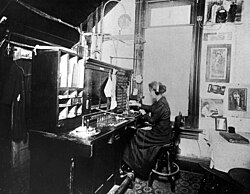
In small towns, the switchboard was often installed directly in the operator's home to ensure 24-hour availability. As the technology evolved, the New England Telephone and Telegraph Company introduced the first battery-operated switchboard in Lexington, Massachusetts, on January 9, 1894.
Scaling the System
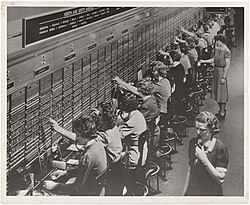
In large cities, early switchboards were massive, floor-to-ceiling installations. Operators originally used ladders to reach the higher jacks to connect calls. By the late 1890s, the volume of lines grew too large for this method. To solve this, Milo G. Kellogg developed the Divided Multiple Switchboard, which allowed teams of operators to work together on an "A board" and a "B board." These manual systems, often called "cordboards" by staff, remained the standard for women operators until the early 1970s.
The Transition to Automation and Long-Distance
As automatic dial service became common, switchboards transitioned into specialized roles. Before direct-dialing existed, subscribers had to contact a long-distance operator to place a toll call. In major cities, this was done via special numbers like 211 or 110; elsewhere, the local operator facilitated the connection.
The process for a long-distance call was complex. The originating operator would record the destination and ask the caller to hang up. Because trunks (the circuits connecting different cities) were limited, operators often had to route calls through intermediate cities if the direct path was busy. Once the destination was reached, an inward operator would coordinate with a local information operator to ring the final party and record the start time of the conversation.
Technological Advancements in the 20th Century
By the 1940s, the introduction of dial pulse and multi-frequency operator dialing allowed operators to use tandem trunks to dial area codes (NPA) and operator codes directly. For example, the New York City information operator was reached via 212-131.
By the 1960s, most subscribers could dial long-distance directly, but operators remained essential for specialized services, such as collect calls, person-to-person calls, and troubleshooting. If a customer heard a reorder tone (a fast busy signal indicating busy circuits or exchange problems), an operator could manually find an alternate route to complete the call.
The Digital Era and Consolidation
The 1970s and 1980s saw the replacement of cordboards with the Traffic Service Position System (TSPS). This system reduced human involvement; customers would dial a specific code (0+NPA+7 digits), and the operator would handle the specific service request before the TSPS automatically released the call.
This automation allowed telephone companies to close small local toll centers and consolidate services into large regional hubs. In the mid-1980s, the Bell Operating Companies (BOCs) introduced the Traffic Operator Position System (TOPS) to manage local and intraLATA (Local Access and Transport Area) traffic, taking over services previously managed by AT&T.
In the early 1990s, AT&T introduced the Operator Services Position System (OSPS), replacing TSPS with computer terminals for billing and call management. A key feature called Interflow allowed operators to answer calls from anywhere within their region. Eventually, Interflow was implemented nationwide, leading to the closure of nearly all AT&T operator offices. By 2004, only two offices remained: one in Houston, Texas, and one in Jacksonville, Florida.
Key Facts
- First Central Office: Established in May 1877 by the Holmes Burglar Alarm Company in Boston.
- First Female Operator: Emma Nutt, hired on September 1, 1878.
- Divided Multiple Switchboard: Devised by Milo G. Kellogg to handle increasing line volume in cities.
- Reorder Tone: A fast busy signal indicating that all circuits were busy or there was an exchange problem.
- Modern Consolidation: By 2004, AT&T had reduced its operator offices to just two locations in the US.
| Era/System | Primary Technology | Key Characteristic |
|---|---|---|
| Early Manual | Cordboards | Manual patching by operators using jacks and cords. |
| Divided Multiple | A and B Boards | Team-based operation to handle high-density city lines. |
| TSPS (1970s-80s) | Traffic Service Position System | Reduced operator involvement; automated call release. |
| TOPS (Mid-1980s) | Traffic Operator Position System | Managed intraLATA traffic for Bell Operating Companies. |
| OSPS (1990s) | Operator Services Position System | Computer terminals with Interflow for regional/national routing. |
Frequently Asked Questions
Why were women hired as telephone operators?
While boys were initially hired due to their experience with telegraphy, they were found to be impatient and behaved unacceptably during live telephone contact. Women, starting with Emma Nutt in 1878, were hired to provide a more professional and patient service.
What was a "reorder tone"?
A reorder tone is a fast busy signal. It typically indicated that all available circuits were busy or that there was a technical problem within the destination exchange.
How did long-distance calls work before direct dialing?
Subscribers contacted a long-distance operator who would record the destination and then manually find an available trunk circuit to the target city. An inward operator in that city would then coordinate with a local information operator to connect the call.
What was the impact of the Interflow system?
Interflow allowed operators to answer calls from anywhere within their region, regardless of their physical location. This technology eventually enabled AT&T to consolidate and close almost all of its operator offices across the United States.
What is the difference between TSPS and OSPS?
TSPS (Traffic Service Position System) was an early automated system that reduced operator involvement in call handling. OSPS (Operator Services Position System) was a later, computer-terminal-based system that integrated billing and allowed for nationwide call routing via Interflow.