Tamarix: The Resilient Salt-Tolerant Genus of Eurasia and Africa
Often referred to by common names such as tamarisk, salt cedar, or taray, the genus Tamarix represents a diverse group of flowering plants specifically adapted to the world's more arid environments. While its name is frequently confused with the edible tamarind or the American tamarack larch, the true Tamarix belongs to the family Tamaricaceae and is characterized by its remarkable ability to thrive in harsh, saline conditions.
Native to the drier regions of Eurasia and Africa, this genus comprises approximately 50 to 60 different species. These plants have evolved to occupy ecological niches that many other species find uninhabitable, particularly areas with high salt concentrations or alkaline soils.
Biological Characteristics and Appearance
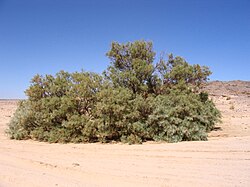
Members of the Tamarix genus vary in form, appearing as either evergreen or deciduous shrubs and trees. They typically grow to heights ranging from 1 to 18 meters (approximately 3 to 59 feet), often forming dense, impenetrable thickets. The largest member of the genus, Tamarix aphylla, is an evergreen tree capable of reaching the upper limit of 18 meters.
Adaptations to Salinity
One of the most defining features of Tamarix is its halophytic nature—the ability to grow in saline environments. These plants can tolerate soluble salt levels as high as 15,000 ppm and are well-suited to alkaline conditions. Their leaves are uniquely adapted; they are scale-like, measuring only 1–2 mm in length, and overlap along the stem in a manner similar to junipers. These leaves are frequently encrusted with salt secretions, a byproduct of the plant's specialized salt-management processes.
Flowering and Growth Cycles
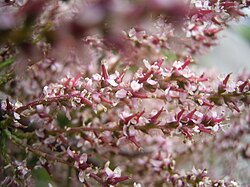
The genus is known for its striking floral displays. From March to September, pink to white flowers emerge in dense masses on spikes that measure 5–10 cm in length at the branch tips. Some species, such as T. aphylla, exhibit extended flowering periods that can last into November.
Ecological Impact and Invasive Behavior
While Tamarix species play vital roles in their native habitats, they have become a significant concern in North America. Introduced in the early 19th century as ornamental shrubs, windbreaks, and shade trees, they were later planted by the millions during the 1930s as part of the Great Plains Shelterbelt to combat soil erosion.
In the United States, these plants are often categorized as invasive. They can alter the local ecosystem in several ways:
- Soil Salinity: They increase the salt content of the soil.
- Soil Fertility: Studies have shown they can boost soil fertility in certain contexts.
- Competition: They can limit the growth of native species like Salix (willow) and Populus (poplar) by interfering with the trees' ability to form essential symbiotic relationships with arbuscular mycorrhizal fungi.
Interestingly, research from 2013 suggests a complex relationship with soil microbiota. In some instances, native plants like Elymus lanceolatus actually grew better in soil containing Tamarix-associated microbes, suggesting the presence of beneficial mycorrhizae (fungi that assist plant nutrient uptake).
Scientific Classification and Species Overview
| Rank | Classification |
|---|---|
| Kingdom | Plantae |
| Clade | Embryophytes, Tracheophytes, Angiosperms, Eudicots |
| Order | Caryophyllales |
| Family | Tamaricaceae |
| Genus | Tamarix L. |
Selected Species List
The genus contains a vast array of species, including but not limited to:
- Tamarix aphylla
- Tamarix chinensis
- Tamarix gallica
- Tamarix ramosissima
- Tamarix stricta
Key Facts
- Salt Tolerance: Can survive in soil with up to 15,000 ppm soluble salt.
- Growth Habit: Ranges from small shrubs to 18-meter evergreen trees.
- Leaf Structure: Small, scale-like leaves (1–2 mm) that often carry salt crusts.
- Native Range: Primarily Eurasia and Africa.
- North American Status: Often considered an invasive species due to its impact on native riparian ecosystems.
Frequently Asked Questions
Is Tamarix the same as Tamarind?
No. Tamarind is a leguminous tree grown for its edible pods, whereas Tamarix is a member of the Tamaricaceae family known for its salt tolerance.
What is the difference between Tamarix and Tamarack?
Tamarack refers to an American larch tree, which is biologically distinct from the Tamarix genus.
Why is Tamarix considered invasive in North America?
It is considered invasive because it can increase soil salinity and compete with native species like willow and poplar, often disrupting their natural symbiotic fungal relationships.
How do Tamarix leaves handle salt?
The plants are halophytes, meaning they can manage high salt levels. They often excrete salt onto their scale-like leaves, which can result in a visible salt encrustation.
When do Tamarix plants typically flower?
Most species flower between March and September, though some species like Tamarix aphylla can continue flowering as late as November.