Taffeta Fabric: History, Production, and Versatile Uses
Taffeta is a crisp, smooth, plain-woven fabric renowned for its structural integrity and distinct luster. Whether crafted from traditional silk or modern synthetics like nylon, polyester, acetate, or cuprammonium rayons, taffeta is prized for its ability to hold a shape without sagging or draping. This characteristic gives the cloth a stiff, starched appearance, making it a staple in high-fashion garment construction and interior design.
The term originates from the Persian word tāfta, meaning "silk" or "linen cloth," which entered Middle English via Old Italian and Old French. Today, it remains a favorite for creating voluminous silhouettes in ball gowns, wedding dresses, and corsets, as well as functional home accents like wallcoverings and curtains.
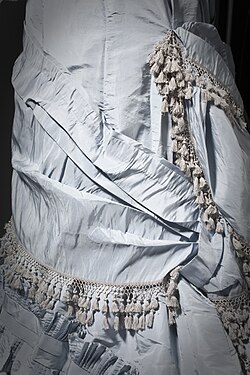
Key Facts
- Composition: Made from silk, nylon, polyester, acetate, or cuprammonium rayons.
- Structure: A plain weave that results in a stiff, non-sagging fabric.
- Silk Varieties: Available as yarn-dyed (stiff, used for evening wear) or piece-dyed (softer, used for linings).
- Global Production: Currently dominated by Indian mills, particularly in the Bangalore area.
- Historical Significance: Used in the first human lighter-than-air flights and early Byzantine luxury textiles.
Types of Silk Taffeta
Not all silk taffetas are created equal. The method of coloring the fabric significantly alters its texture and intended use:
- Piece-dyed taffeta: The fabric is woven first and then dyed. This process results in a softer material frequently used for garment linings.
- Yarn-dyed taffeta: The yarns are dyed before weaving, creating a much stiffer cloth ideal for structured evening dresses.
Historically, shot silk taffeta—a technique where different colored yarns are used for the warp and weft—was highly coveted in the Byzantine Empire and may have been the fabric known as purpura.
Production and Global Evolution
The production of taffeta has shifted geographically over the centuries. While it was first woven in France and Italy, and later in Japan until the 1950s, the center of production has moved toward South and East Asia.
France became famous for chiné (warp-printed taffeta) from the 18th century onward, a style often called "pompadour taffeta" in honor of Madame de Pompadour. In the modern era, India and Pakistan lead production. While handlooms were common for a long time, mechanical looms in the Bangalore area have dominated since the 1990s. China's Jiangsu province also produced fine silk taffetas between the 1970s and 1990s, though these were generally less flexible than Indian varieties.
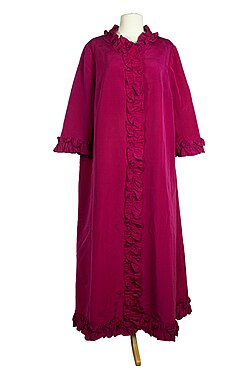
Diverse Applications Beyond Fashion
While primarily associated with luxury clothing, taffeta's unique properties have led to its use in surprising scientific and historical contexts:
Aviation and Science
On November 4, 1782, Joseph Montgolfier used taffeta to build a small, cube-shaped balloon. This experiment paved the way for the Montgolfier brothers to achieve the first known human flight in a lighter-than-air craft. In modern medicine, synthetic versions of taffeta have even been utilized to simulate the structure of human blood vessels.
Cultural and Linguistic Influence
Taffeta has left a mark on language and literature. The tabby cat earned its name in the 1600s due to its striped coat resembling "tabby," a specific type of striped silk taffeta. In the English Renaissance, the fabric was sometimes associated with prostitution, a connection appearing in several of William Shakespeare's plays, including All's Well That Ends Well, Henry IV, Part 1, Love's Labour's Lost, and Twelfth Night.
| Feature | Details |
|---|---|
| Common Materials | Silk, Nylon, Polyester, Acetate, Cuprammonium Rayon |
| Physical Properties | Crisp, smooth, stiff, holds shape, non-draping |
| Primary Uses | Ball gowns, wedding dresses, corsets, curtains, wallcoverings |
| Major Production Hubs | India (Bangalore), Pakistan, historically France, Italy, and Japan |
| Specialized Types | Yarn-dyed, Piece-dyed, Shot silk, Chiné (Pompadour) |
Frequently Asked Questions
What is the difference between yarn-dyed and piece-dyed taffeta?
Yarn-dyed taffeta is created by dyeing the threads before they are woven, resulting in a stiffer fabric used for evening wear. Piece-dyed taffeta is dyed after weaving, making it softer and more suitable for linings.
Why is taffeta used for ball gowns and wedding dresses?
Taffeta is chosen for these garments because it is a stiff cloth that holds its shape exceptionally well and does not sag, allowing designers to create structured, voluminous silhouettes.
How did taffeta contribute to the history of flight?
Joseph Montgolfier used taffeta to construct a small cube-shaped balloon in 1782, which served as a foundation for the Montgolfier brothers' subsequent experiments and the first human flight in a lighter-than-air craft.
What is "pompadour taffeta"?
Pompadour taffeta is another name for chiné, a type of warp-printed taffeta that was primarily produced in France starting in the 18th century.
Is taffeta always made from silk?
No. While silk is the traditional luxury material, taffeta can also be made from synthetic fibers such as nylon, polyester, acetate, or cuprammonium rayons.