Syria and the United Nations: A History of Diplomacy and Sovereignty
The relationship between Syria and the United Nations (UN) is a complex narrative of struggle for sovereignty, political evolution, and international cooperation. From its early efforts to join the organization while still under colonial rule to its current path of political transition, Syria's engagement with the UN reflects the broader shifts in Middle Eastern geopolitics over the last eight decades.
The Path to Independence
Syria's journey with the UN began before it achieved full independence. On February 17, 1945, Syrian President Shukri al-Quwatli met with British Prime Minister Winston Churchill in Cairo to request an invitation to the nascent United Nations. At the time, Syria was under French rule and excluded from the League of Nations, the UN's predecessor.
Following Syria's declaration of war on Nazi Germany on February 27, 1945, the nation received an official invitation to help form the UN. Prime Minister Fares al-Khoury led the Syrian delegation, signing the UN Charter and contributing to the legal committee that approved the UN flag.
Diplomacy became a critical tool for liberation when French forces attacked Damascus on May 29, 1945. Prime Minister al-Khoury used his position at the UN to denounce the French occupation, which had lasted since 1920. This pressure, combined with British intervention, led to negotiations for withdrawal. Despite French attempts to maintain a presence in Lebanon via the Anglo-French London Agreement, Syrian and Lebanese leaders insisted on full sovereignty.
The matter reached the UN Security Council on February 14, 1946. Following demands for an unconditional withdrawal, Britain oversaw the evacuation of French forces. Syria officially celebrated its first Independence Day on April 17, 1946.
Post-Independence and the United Arab Republic
As a sovereign member state, Syria's UN status shifted alongside its internal political changes. In 1958, Syria merged with Egypt to form the United Arab Republic (UAR), which functioned as a single UN Member State. This union lasted until October 13, 1961, when Syria restored its separate identity and individual UN membership. The UAR eventually became the Arab Republic of Egypt on September 2, 1971.
The Ba'athist Era and Civil Conflict
During the period of Ba'athist rule, Syria maintained a strategic, if often tense, relationship with the UN. President Nureddin al-Atassi was the first Syrian president to address the UN General Assembly following the June 1967 War.
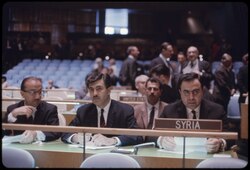
In later years, high-level diplomatic visits continued. In January 2009, UN Secretary-General Ban Ki-moon visited Damascus to meet with President Bashar al-Assad to discuss regional stability and the conflict in Gaza.
The outbreak of the Syrian civil war saw an intensification of UN involvement. A series of UN Special Envoys—including Kofi Annan, Lakhdar Brahimi, Staffan de Mistura, and Geir Otto Pedersen—traveled to Damascus to facilitate a political process, while various UN agencies provided essential humanitarian aid across the country.
Transition and Modern Engagement (2024–2026)
The fall of the Assad regime on December 8, 2024, marked a turning point in UN-Syria relations. UN Special Envoy Geir Otto Pedersen and Under-Secretary-General Tom Fletcher immediately visited Damascus to meet the new authorities, emphasizing the need for a Syrian-led political transition and expanded humanitarian aid.
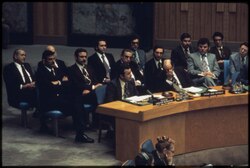
The year 2025 saw a surge in diplomatic activity. Foreign Minister Asaad al-Shaibani attended a Security Council session in New York on April 25, where a new Syrian flag was raised at the UN Headquarters. In September 2025, President Ahmed al-Sharaa addressed the General Assembly, the first Syrian president to do so in nearly sixty years.
Significant legal milestones followed. On November 6, 2025, the Security Council adopted Resolution 2799, removing President Ahmed al-Sharaa and Interior Minister Anas Khattab from the ISIL (Da'esh) and Al-Qaida Sanctions List, though China abstained from the vote.
By 2026, engagement reached unprecedented levels. On December 4, 2025, a UN Security Council delegation visited the People's Palace in Damascus—the first such visit since the Council's inception in 1945. This was followed by a briefing from Deputy Special Envoy Claudio Cordone in July 2026, reporting progress on the political transition.
The culmination of this renewed relationship occurred on July 25, 2026, when Secretary-General António Guterres visited Damascus. His itinerary included meetings with President al-Sharaa and Speaker Abdul Hamid al-Awak, as well as a visit to the United Nations Disengagement Observer Force (UNDOF) in the occupied Syrian Golan. Guterres also visited Sednaya Prison, describing the conditions as "horrific" and calling for support for survivors and the missing.
Key Facts
- Independence: Syria achieved independence from French rule on April 17, 1946, following UN Security Council intervention.
- Political Union: Syria was part of the United Arab Republic with Egypt from 1958 to 1961.
- Historic Visit: The first-ever UN Security Council delegation visit to Syria took place on December 4, 2025.
- Sanctions Removal: Resolution 2799 (Nov 2025) removed President Ahmed al-Sharaa and Minister Anas Khattab from ISIL/Al-Qaida sanctions lists.
- Recent Diplomacy: President Ahmed al-Sharaa became the first Syrian president in nearly 60 years to address the UN General Assembly in September 2025.
| Date | Event | Significance |
|---|---|---|
| Feb 1945 | Invitation to UN | Syria helps form the UN while under French rule. |
| Apr 17, 1946 | Independence Day | Full withdrawal of French forces. |
| 1958–1961 | United Arab Republic | Syria and Egypt act as a single UN member state. |
| Dec 8, 2024 | Fall of Assad Regime | Beginning of intensified UN engagement with new authorities. |
| Nov 6, 2025 | Resolution 2799 | Removal of key leaders from sanctions lists. |
| July 25, 2026 | Guterres Visit | First visit by a Secretary-General to Damascus. |
Frequently Asked Questions
How did the UN help Syria gain independence?
The UN provided a global platform for Syrian leaders to denounce French occupation. After the issue reached the Security Council in February 1946, Britain oversaw the unconditional evacuation of French forces, leading to independence in April 1946.
What was the United Arab Republic?
The United Arab Republic was a political union between Syria and Egypt that existed from 1958 to 1961. During this time, the two countries functioned as a single member state within the United Nations.
Who is Ahmed al-Sharaa?
Ahmed al-Sharaa is the Syrian President who took office following the fall of the Assad regime. He addressed the UN General Assembly in September 2025 and was removed from the ISIL/Al-Qaida Sanctions List via Resolution 2799.
What is UNDOF?
UNDOF stands for the United Nations Disengagement Observer Force, which operates in the occupied Syrian Golan to maintain the ceasefire between Israel and Syria.
What did Secretary-General Guterres report about Sednaya Prison?
During his July 2026 visit to Damascus, Secretary-General António Guterres described Sednaya Prison as "horrific" and called for increased support for survivors and efforts to locate missing persons.