Synaptic Long-Term Depression: Mechanisms Across Brain Regions
Synaptic plasticity is the biological process that allows the brain to change the strength of connections between neurons, a fundamental requirement for learning and memory. While Long-Term Potentiation (LTP) strengthens these connections, Long-Term Depression (LTD) is the process that weakens them. Far from being a simple reversal of LTP, LTD involves complex, region-specific molecular pathways that ensure the brain remains adaptable and prevents synaptic saturation.
Key Facts
- LTD is the long-lasting decrease in the efficacy of synaptic transmission.
- Calcium (Ca2+) levels in the postsynaptic cell act as a primary trigger for LTD induction.
- AMPA receptor internalization via endocytosis is a common final step that reduces synaptic sensitivity to glutamate.
- Mechanisms vary significantly across the hippocampus, cerebellum, striatum, and cortex.
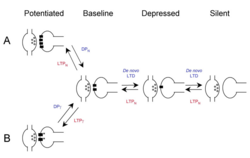
- LTD often works as a negative feedback system to balance the effects of LTP.
LTD in the Hippocampus
In the hippocampus, LTD primarily affects the synapses between the Schaffer collaterals and CA1 pyramidal cells. This process is triggered when Schaffer collaterals are stimulated at a low frequency (approximately 1 Hz) for an extended period, typically 10 to 15 minutes, resulting in depressed excitatory postsynaptic potentials (EPSPs).
The induction of LTD in the CA1 region depends on the magnitude of calcium influx through NMDA receptors (ionotropic glutamate receptors that allow ions to pass through a channel). Unlike LTP, which requires high calcium levels, LTD is induced by moderate rises in postsynaptic calcium. This threshold exists on a sliding scale; if a synapse has previously undergone LTP, the threshold for LTD is lowered, creating a negative feedback loop that maintains plasticity.
While LTP is driven by protein kinases, LTD is driven by calcium-dependent phosphatases. These enzymes dephosphorylate target proteins, triggering the internalization of AMPA receptors through clathrin-coated endocytosis, which reduces the cell's sensitivity to glutamate.
LTD in the Cerebellum
Cerebellar LTD occurs in Purkinje neurons, which receive input from both climbing fibers and parallel fibers. For LTD to occur, both fiber types must be activated simultaneously, ideally with parallel fibers firing a few hundred milliseconds before the climbing fibers.
The Role of Calcium and Signaling Pathways
The process involves two converging pathways. Parallel fibers release glutamate that activates both AMPA receptors (causing depolarization) and metabotropic glutamate receptors (mGluRs). The mGluRs activate phospholipase C (PLC), producing second messengers diacylglycerol (DAG) and inositol triphosphate (IP3). Simultaneously, climbing fibers trigger a massive influx of calcium through voltage-gated ion channels.
Together, DAG and IP3 enhance the calcium rise by releasing calcium from intracellular stores and activating protein kinase C (PKC). PKC then phosphorylates AMPA receptors, causing them to dissociate from scaffold proteins and be internalized, thereby depressing the Purkinje cell's response to parallel fiber input.
The MAPK Cascade
A critical signaling sequence known as the MAPK (Mitogen-Activated Protein Kinase) cascade also regulates cerebellar LTD. This involves a chain of dual phosphorylation: MAPKKK phosphorylates MAPKK, which in turn phosphorylates MAPK. This cascade, fueled by a positive feedback loop involving calcium and DAG, eventually leads to the removal of AMPA receptors from the membrane over a timescale of approximately 40 minutes.
LTD in the Striatum and Visual Cortex
The striatum exhibits diverse LTD mechanisms depending on the subregion. In the dorsal striatum, LTD at corticostriatal medium spiny neuron synapses requires high-frequency stimulation, postsynaptic depolarization, and the coactivation of dopamine D1 and D2 receptors, mGlu receptors, and endocannabinoids, notably without NMDA receptor activation.
In the prelimbic cortex of the striatum, three distinct forms of LTD exist:
- An NMDA-receptor dependent form similar to hippocampal LTD.
- A high-frequency stimulus form mediated by presynaptic mGlu receptors 2 or 3, reducing P/Q-type calcium channel involvement.
- An endocannabinoid-dependent form requiring mGlu receptors and 13 Hz stimulation, reducing presynaptic glutamate release.
In the visual cortex, LTD is linked to ocular dominance. In layers II and III, low-frequency stimulation triggers homosynaptic LTD (affecting only the stimulated input) via small calcium elevations and phosphatase activation. In layer V, however, LTD requires endocannabinoid signaling and presynaptic NR2B-containing NMDA receptors. Additionally, paired-pulse stimulation (PPS) can induce LTD in superficial layers when modulated by carbachol and norepinephrine, which act as gain controllers for the process.
LTD in the Prefrontal and Perirhinal Cortices
In the prefrontal cortex (PFC), the neurotransmitter serotonin facilitates LTD. Working with group I mGluR agonists, serotonin increases the internalization of AMPA receptors, a process thought to regulate cognitive and emotional functions.
In the perirhinal cortex, LTD is believed to increase the storage capacity for recognition memory. Two distinct mechanisms have been identified: one involving NMDA and group I/II mGlu receptors that manifests 24 hours after stimulation, and another involving acetylcholine and kainate receptors that occurs much earlier, within 20 to 30 minutes.
Summary of LTD Mechanisms by Region
| Region | Primary Trigger/Stimulus | Key Molecular Mediators | Primary Effect |
|---|---|---|---|
| Hippocampus (CA1) | Low frequency (~1 Hz) | NMDA receptors, Phosphatases | AMPA receptor internalization |
| Cerebellum | Parallel + Climbing fiber coactivation | mGluRs, PKC, MAPK cascade | AMPA receptor internalization |
| Striatum (Dorsal) | High frequency + Depolarization | D1/D2 receptors, Endocannabinoids | Reduced synaptic efficacy |
| Visual Cortex (Lyr V) | Low frequency | Endocannabinoids, NR2B-NMDA | Homosynaptic depression |
| Prefrontal Cortex | Serotonin + mGluR agonist | AMPA receptor internalization | Cognitive/Emotional regulation |
Frequently Asked Questions
What is the difference between LTP and LTD?
Long-Term Potentiation (LTP) increases the strength of a synapse, while Long-Term Depression (LTD) decreases it. Both are forms of synaptic plasticity essential for brain function.
How does calcium determine whether LTP or LTD occurs in the hippocampus?
The concentration of calcium in the postsynaptic cell is the deciding factor. High levels of calcium typically trigger LTP, whereas moderate rises in calcium levels induce LTD.
What role do AMPA receptors play in LTD?
AMPA receptors mediate fast excitatory transmission. In most forms of LTD, these receptors are phosphorylated or signaled for internalization (removed from the membrane), which makes the postsynaptic neuron less responsive to glutamate.
Why is the timing of fiber activation important in the cerebellum?
For optimal LTD induction in Purkinje cells, parallel fibers should be activated a few hundred milliseconds before climbing fibers to maximize the calcium release and signaling required for the process.
How does LTD contribute to motor skill storage?
In the striatum, LTD in GABAergic neurons is proposed to lead to a long-term decrease in inhibitory effects on the basal ganglia, which influences how motor skills are stored and executed.