Syllable Structure: The Building Blocks of Human Speech
In the study of phonology—the branch of linguistics concerned with the systematic organization of sounds—the syllable serves as a fundamental unit of organization. Often described as the "building blocks" of words, syllables allow us to segment continuous speech into manageable, rhythmic units. For instance, the word ignite can be divided into two distinct syllables: ig and nite.
While syllables are present in virtually every human language, they remain a complex subject for linguists. There is no single, precise definition that applies to every known language, and even native speakers may occasionally disagree on where one syllable ends and another begins. Despite this complexity, the shift from pictographic writing to syllabic writing—seen as early as 2800 BC in the Sumerian city of Ur—is considered one of the most significant advancements in the history of human communication.
Key Facts
- A syllable typically consists of a nucleus (usually a vowel), which may be preceded by an onset and followed by a coda.
- The combination of the nucleus and the coda is known as the rime.
- Open syllables end in a vowel, while closed syllables end in a consonant.
- Syllable weight can be categorized as light, heavy, or superheavy depending on the complexity of the nucleus and coda.
- Syllabic writing predates alphabetic writing by several centuries.
The Anatomy of a Syllable
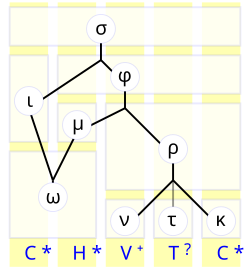
To understand how speech is organized, linguists use a framework to segment the components of a syllable (represented by the symbol σ). This structure is generally viewed as right-branching, meaning the components are grouped hierarchically toward the end of the unit.
Onset, Nucleus, and Rime
The standard segmentation of a syllable includes three primary segments:
- Onset (ω): The consonant or consonant cluster at the beginning of a syllable. In some languages, the onset is obligatory; in others, it is optional or restricted.
- Rime (ρ): The right-hand portion of the syllable, which is further divided into the nucleus and the coda.
- Nucleus (ν): The central part of the syllable, usually a vowel (monophthong, diphthong, or triphthong) or a syllabic consonant. The nucleus is the obligatory core of almost every syllable.
- Coda (κ): The consonant or consonant cluster that follows the nucleus.

Variations in Segmentation
While the onset-nucleus-coda model is common, different linguistic traditions describe these structures differently. In Sinitic languages (such as Chinese), the structure is often described using initials and finals. An initial (ι) acts as the optional onset (excluding semivowels), while the final (φ) encompasses the medial, nucleus, and coda.

In some traditional descriptions of languages like Cree and Ojibwe, the syllable is viewed as left-branching. In this model, the onset and nucleus group together to form a "body" or "core," which stands in contrast to the coda.

Syllable Weight and Complexity
Linguists often discuss syllable weight, a metaphor derived from how components branch in a tree diagram. A heavy syllable typically features a branching rime—either a closed syllable ending in a consonant or a syllable with a branching nucleus (such as a long vowel or diphthong).
Complexity varies wildly across the globe. For example, Japanese and many Sino-Tibetan languages generally avoid consonant clusters at the beginning or end of syllables. In contrast, English allows up to three consonants in an onset and up to four in a coda. Some languages even distinguish superheavy syllables, which contain both a branching nucleus and a branching rime, or a coda consisting of two or more consonants.

| Term | Definition | Example (English) |
|---|---|---|
| Open Syllable | Ends in a nucleus (vowel) | glue, pie |
| Closed Syllable | Ends in a coda (consonant) | cup, in |
| Onset | Initial consonant(s) | str in strength |
| Nucleus | The central peak (vowel/consonant) | æ in cat |
| Coda | Final consonant(s) | kts in texts |
Suprasegmental Features
Beyond the individual sounds, syllables can carry suprasegmental features. These are properties that extend over more than one segment, such as:
- Stress: The emphasis placed on certain syllables within a word.
- Tone: The use of pitch to distinguish meaning, common in many languages.
- Accent: The placement of emphasis, which can be categorized by its position relative to the end of a word (e.g., antepenult, penult, or ultima).

Frequently Asked Questions
What is the difference between an open and a closed syllable?
An open syllable is one that ends in a nucleus (usually a vowel), such as the word "pie." A closed syllable ends in a coda (a consonant), such as the word "cup."
Can a consonant act as a nucleus?
Yes. While the nucleus is most often a vowel, some languages use syllabic consonants to serve as the peak of a syllable. An example in English is the /l/ sound in the second syllables of "bottle" and "fiddle."
What are the components of a rime?
The rime is the part of the syllable that consists of the nucleus and the optional coda. In poetry, the rime is the part of the syllable typically used to create rhymes.
Do all languages allow consonant clusters?
No. The complexity of clusters varies significantly. Some languages, like Japanese, do not allow consonant clusters at the beginning or end of syllables, whereas English allows relatively complex sequences.
What is a null onset?
A null onset occurs when a syllable begins directly with a nucleus without any preceding consonant. Some languages forbid null onsets, meaning every word must begin with a consonant.