Swedish Football Association: Governing the Beautiful Game in Sweden
The Svenska Fotbollförbundet (SvFF), known in English as the Swedish Football Association, serves as the primary governing body for football across Sweden. Based in Solna, the SvFF is responsible for the administration, promotion, and organization of the sport, overseeing everything from grassroots community play to the elite national teams. With a democratic philosophy summarized by the motto "one club in every village, football for all," the association ensures that football remains accessible to all citizens.
As a founding member of both FIFA (Fédération Internationale de Football Association) and UEFA (Union of European Football Associations), the SvFF holds a prestigious position in the global football community, representing Sweden's interests on the international stage.
Key Facts
- Founded: 18 December 1904 in Stockholm.
- Headquarters: Solna, Sweden.
- Current President: Simon Åström (elected 22 March 2025).
- Affiliations: Founding member of FIFA and UEFA; affiliated with the Swedish Sports Confederation (RF).
- Reach: Supported by 24 district organizations, with over a million members (as of 2009).
- Major Leagues: Allsvenskan (Men) and Damallsvenskan (Women).
History and Evolution
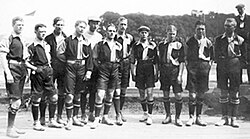
The roots of organized football in Sweden date back to the first national championship in 1896. However, the formal structure began to take shape in 1903 with the formation of the Riksidrottsförbundet, which initially managed both football and hockey (which referred to bandy at the time). By 1904, Sweden became one of the seven founding nations of FIFA.
The organization officially adopted the name Svenska Fotbollförbundet in 1906 and was formally voted into FIFA in 1907. Sweden played its first international match on 12 July 1908, securing an 11–3 victory over Norway in Gothenburg.
Interestingly, the SvFF's early influence extended beyond football; it administered organized bandy until 1925 and introduced ice hockey to Sweden in 1920, two years before the Swedish Ice Hockey Association was established.
League Structure and Competitions
The SvFF operates a single pyramid league system. While the central association manages the elite tiers, 24 regional district organizations handle youth football and lower-tier leagues (Division 4 for men and Division 3 for women and below).
Men's and Women's Leagues
The association organizes a comprehensive hierarchy of competitions to ensure a pathway from amateur to professional play.
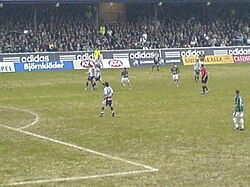
- Men's Football: The top flight is the Allsvenskan (Tier 1), followed by the Superettan (Tier 2), and various divisions ranging from Division 1 down to Division 5 and the Folksam utvecklingsserie.
- Women's Football: The premier league is the Damallsvenskan (Tier 1), followed by Elitettan (Tier 2), and various divisions including Norrettan and Söderettan (Tier 3) and Division 2 (Tier 4).
Cups and Youth Development
Beyond league play, the SvFF manages the Svenska Cupen for both men and women, as well as specialized junior competitions such as the Juniorallsvenskan, Pojkallsvenskan, CANAL+-cupen (Junior Boys), and Cup Kommunal (Junior Girls).
International Achievements and Honors
Sweden has a storied history of success in international tournaments, with both the men's and women's teams achieving significant milestones.
| Competition | Men's Achievements | Women's Achievements |
|---|---|---|
| FIFA World Cup | Runners-up (1958), 3rd Place (1950, 1994) | Runners-up (2003), 3rd Place (1991, 2011, 2019, 2023) |
| Olympic Games | Winners (1948), 3rd Place (1924, 1952) | Runners-up (2016, 2020) |
| UEFA European Championship | U-21 Winners (2015), Runners-up (1992) | Winners (1984), Runners-up (1987, 1995, 2001) |
| UEFA Youth Championships | U-17 3rd Place (2013) | U-19 Winners (1999, 2012, 2015), U-17 Runners-up (2013) |
Administration and Infrastructure
The SvFF is headquartered in Solna. From 1999 to 2012, the association owned the Råsunda Stadium. Since 2012, the SvFF has been the lead partner in the consortium that owns the Friends Arena, where its offices are currently located.
To celebrate excellence in the sport, the association hosts the Swedish Football Association Football Gala every November. Since 2005, this event has awarded the Guldbollen to the best male player and the Diamantbollen to the best female player.
The leadership of the SvFF has seen recent transitions. Following the tenure of Karl-Erik Nilsson (2012–2023) and former Prime Minister Fredrik Reinfeldt, Simon Åström was elected President on 22 March 2025.
Frequently Asked Questions
What is the motto of Swedish football?
The motto is "one club in every village, football for all," which reflects the association's commitment to a democratic and inclusive sports structure.
Which leagues are the top tiers for men and women in Sweden?
The Allsvenskan is the top-tier league for men, and the Damallsvenskan is the top-tier league for women.
Who is the current President of the Swedish Football Association?
Simon Åström was elected President on 22 March 2025.
What are the Guldbollen and Diamantbollen?
These are prestigious awards presented annually at the Swedish Football Association Football Gala; the Guldbollen is for the best male player and the Diamantbollen is for the best female player.
How is the Swedish football league system organized?
It is a single pyramid system where the SvFF manages the elite top leagues, while 24 district organizations manage youth football and the lower-tier regional leagues.