Swahili: The Linguistic Bridge of East Africa
Swahili, known natively as Kiswahili, is one of the most influential languages in sub-Saharan Africa. Serving as a vital link between diverse ethnic groups, it has evolved from a coastal tongue into a global language of diplomacy, trade, and culture. From the bustling streets of Nairobi to the shores of Zanzibar, Swahili facilitates communication for millions across the East African region and beyond.
The language belongs to the Niger-Congo family, specifically the Bantu branch. While its grammatical core is firmly rooted in Bantu structures, its vocabulary reflects a rich history of international trade and cultural exchange.
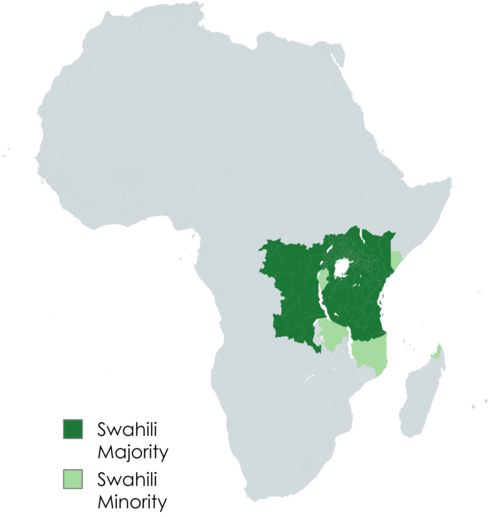
Key Facts
- Speakers: Estimated between 60 million and 150 million, with some estimates reaching 200 million.
- Official Status: Official language in Tanzania, Kenya, Uganda, Rwanda, and the Democratic Republic of the Congo (where it is a national language).
- Etymology: The name "Swahili" is derived from the Arabic word sawāḥil, meaning "coasts."
- Influence: Approximately 40% of its vocabulary is derived from Arabic.
- Global Reach: Recognized by the African Union, the East African Community, and SADC.
Origins and Linguistic Composition
Swahili emerged as a lingua franca—a bridge language used by people who do not share a native tongue—along the East African coast. Its development was heavily influenced by the interaction between Bantu-speaking peoples and traders from the Middle East and Asia.
The linguistic makeup of Swahili is a testament to this cosmopolitan history. While the structure remains Bantu, the lexicon is a blend of several languages:
| Source Language | Approximate Percentage |
|---|---|
| Arabic (mainly Omani) | 40% |
| English | 4.6% |
| Portuguese | 0.9% – 1.0% |
| Hindustani | 0.7% – 3.9% |
| Persian | 0.4% – 3.4% |
| Malagasy | 0.2% – 0.4% |
Writing Systems and Evolution
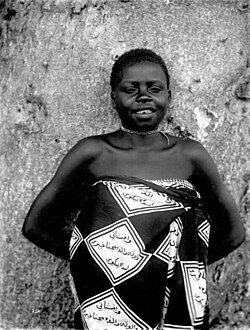
Historically, Swahili was written using the Arabic script, a system known as Swahili Ajami. This script was used for centuries in poetry, trade records, and religious texts.
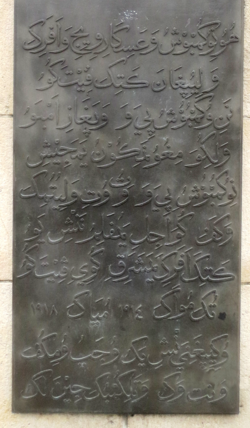
During the colonial era, Christian missionaries and colonial administrators introduced the Latin alphabet. Today, the Latin script is the primary writing system used for education, government, and media across East Africa.
![Although originally written with the Arabic script, Swahili is now written in a Latin alphabet introduced by Christian missionaries and colonial administrators. The text shown here is the Catholic version of the Lord's Prayer.[39]](/images/ca/d1/cad1287d6e93a3e16c065213862571cfbc9826b444648670eb66d5149b6d5860.jpg)
Despite the dominance of the Latin script, the Arabic influence remains visible in cultural artifacts and historical documents.
Grammar and Structure
One of the most distinctive features of Swahili is its complex system of noun classes. Unlike English, which uses gender (masculine/feminine), Swahili categorizes nouns based on semantic properties. For example, there are specific classes for people, trees, tools, and abstract concepts.
These classes dictate the agreement (concord) of the sentence; adjectives and verbs must change their prefixes to match the class of the noun they refer to. This creates a rhythmic and highly structured linguistic flow.
Dialects and Variations
While Standard Swahili is used in official capacities, numerous dialects exist. Some are mutually intelligible, while others are distinct enough to be considered separate languages. Notable variations include:
- Coastal Dialects: Including those from Mombasa and Lamu.
- Regional Variations: Such as Congo Swahili and Bravanese.
- Urban Slang: Sheng, a vibrant youth slang in Nairobi that blends Swahili with English and other local languages.
Cultural Heritage and Literature
Swahili has a profound tradition of both oral and written literature. From the intricate poetry of Dada Masiti and Shaaban bin Robert to the modern works of Euphrase Kezilahabi, the language has been used to express deep philosophical and political ideas.
The oral tradition is particularly rich in proverbs and riddles, which serve as tools for moral instruction and intellectual play. For example, the proverb "Paka akiondoka, panya hutawala" (When the cat goes away, the rat is king) mirrors similar sentiments found in other global cultures.

Frequently Asked Questions
Is Swahili a dialect of Arabic?
No. Swahili is a Bantu language belonging to the Niger-Congo family. While it has borrowed a significant amount of vocabulary from Arabic (about 40%), its grammar and structure are entirely Bantu.
Where is Swahili spoken most?
It is most prominent in Tanzania and Kenya, but it is also spoken in Uganda, Rwanda, the Democratic Republic of the Congo, Mozambique, and parts of Somalia.
What is the difference between Swahili and Kiswahili?
"Swahili" is the English name for the language, while "Kiswahili" is the endonym—the name used by native speakers themselves.
How is Swahili written today?
The majority of Swahili is now written using the Latin alphabet. However, the Arabic script (Ajami) was used historically and is still found in some traditional and religious contexts.
What is Sheng?
Sheng is an urban-based youth slang primarily spoken in Nairobi, Kenya. It is a hybrid language that mixes Swahili with English and other local languages.