Sustainability: Balancing Environmental, Social, and Economic Dimensions
Derived from the Latin sustinere—meaning to hold up, bear, or endure—sustainability is fundamentally the ability of a system to continue over a long period of time. In contemporary discourse, it describes a state where the environment, economy, and society coexist in a way that ensures their long-term survival. While often used interchangeably with sustainable development, a subtle distinction exists: sustainability is typically viewed as the long-term goal, whereas sustainable development refers to the specific processes and pathways used to achieve that goal.
The concept guides decision-making across all levels of human organization, from global treaties and national policies to corporate strategies and individual lifestyle choices.
Key Facts
- Three Pillars: Modern sustainability generally integrates environmental, social, and economic dimensions.
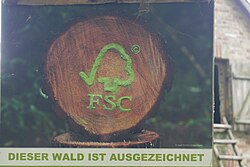
- Historical Roots: The concept originated in 18th-century German forestry (Nachhaltigkeit) to ensure a continuous supply of timber.
- Decoupling: A critical economic goal where economic growth is separated from environmental degradation.
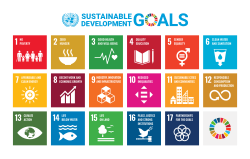
- Global Framework: The UN Agenda 2030 outlines 17 Sustainable Development Goals (SDGs) to balance the three dimensions of sustainability.
- Measurement: Sustainability is tracked via indicators, benchmarks, audits, and certifications like Fairtrade and Organic.
The Evolution of Sustainability
From Forestry to Global Ecology
The origins of sustainability can be traced back to Hans Carl von Carlowitz (1645–1714), who applied the principle to forestry. In his 1713 work Silvicultura oeconomica, he argued for the conservation and replanting of timber to ensure a continuous, sustainable use of the resource. This early form of sustainable forest management focused on the long-term responsible use of a single natural resource.
The transition from specific resource preservation to a broader environmental philosophy occurred in the 20th century. A pivotal shift was marked by Ernst Basler's 1972 book, which expanded the scope of sustainability to the preservation of all environmental resources to sustain future generations.
The Three Dimensions of Sustainability
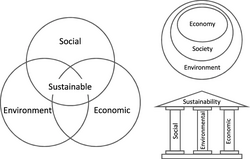
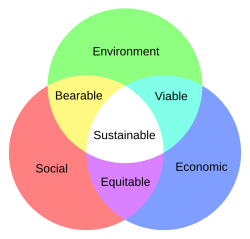
Modern sustainability is often visualized through different conceptual models. The most common is the three-pillar approach, which balances the environment, society, and economy.
- Environmental Sustainability: The central dimension focusing on the systems that support life on Earth. It addresses critical issues such as climate change, biodiversity loss, and the preservation of natural ecosystems.
- Social Sustainability: Focuses on maintaining the well-being of human society, ensuring equity, and protecting social foundations.
- Economic Sustainability: Concerns the ability of an economy to support a defined level of economic production indefinitely.
Hierarchical and Integrated Models
While the three pillars are often seen as equal, some scholars propose a nested hierarchy. In this view, the economy and society are entirely contained within and constrained by the limits of the environment. This suggests that without a healthy planet, neither a functioning society nor a stable economy can exist.
![The diagram with three nested ellipses indicates a hierarchy among the three dimensions of sustainability: both economy and society are constrained by environmental limits.[47]](/images/1b/e3/1be3b6915e2ae53902089fabc1889ad7046d6888e3c78a19556400b8ff17ef3e.webp)
Economic Challenges and the Concept of Decoupling
The intersection of economic growth and environmental preservation is a point of significant academic debate, often categorized as weak sustainability versus strong sustainability. The primary tension lies in the trade-off between achieving universal prosperity and maintaining strict environmental conservation.
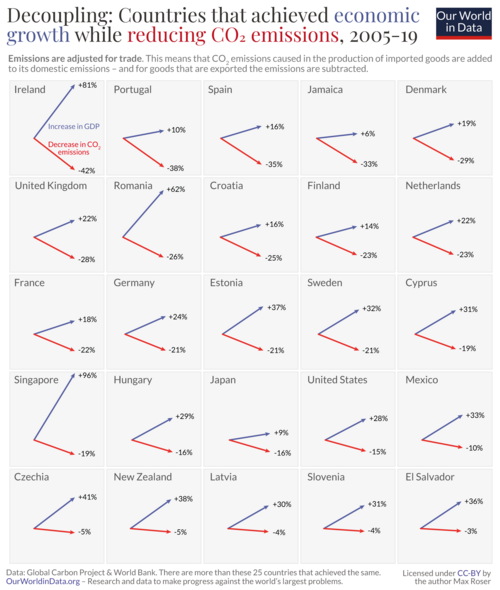
To resolve this, experts advocate for decoupling. Decoupling occurs when an economy continues to grow while its environmental impact—such as pollution and resource consumption—decreases. This means using fewer resources per unit of output. One practical application of this is the circular economy, which replaces the traditional "take, make, waste" linear model with a system of reuse and recycling.

Measuring Sustainability
Because sustainability is complex, contextual, and dynamic, measuring it is challenging. There is no single, fixed definition for sustainability indicators, but several tools have emerged:
- Certification Systems: Labels such as Organic and Fairtrade provide standardized benchmarks for sustainable production.
- Accounting Frameworks: The Triple Bottom Line approach expands traditional accounting to include social and environmental impacts alongside financial profit.
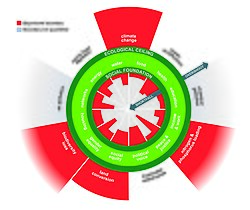
- Global Indices: The UN's "Circles of Sustainability" method and the "Doughnut model" help visualize where ecological ceilings are overshot or social foundations are unmet.
![Urban sustainability analysis of the greater urban area of the city of São Paulo using the 'Circles of Sustainability' method of the UN and Metropolis Association[90]](/images/51/7e/517efec4281732c9a56a0a465c2506b6045a3230d756ed977b2de5a677e3e514.jpg)
| Framework | Primary Focus | Key Characteristic |
|---|---|---|
| Three Pillars | Balance | Equal weight to Environment, Society, and Economy. |
| Nested Hierarchy | Dependence | Economy and Society exist within Environmental limits. |
| Circular Economy | Resource Flow | Eliminates waste via a closed-loop system. |
| Agenda 2030 (SDGs) | Global Targets | 17 goals with 169 targets for worldwide implementation. |
Frequently Asked Questions
What is the difference between sustainability and sustainable development?
Sustainability is generally viewed as the long-term goal or the desired state of the world, while sustainable development refers to the specific processes, pathways, and actions taken to reach that state.
What is the "Triple Bottom Line"?
The Triple Bottom Line is an accounting framework that encourages organizations to measure their success not just by financial profit, but also by their impact on people (social) and the planet (environmental).
What does "decoupling" mean in an economic context?
Decoupling is the effort to separate economic growth from environmental degradation. It involves increasing economic output while simultaneously reducing the amount of resources used and the pollution generated.
Who first introduced the concept of sustainability?
The concept of Nachhaltigkeit (sustainability) was introduced by Hans Carl von Carlowitz in 1713 in the context of sustainable forestry to ensure that timber resources were not exhausted.
What are the UN Sustainable Development Goals (SDGs)?
The SDGs are a collection of 17 interlinked global goals established by the United Nations in the 2015 Agenda 2030. They aim to balance economic, social, and environmental sustainability on a global scale.