Supreme Court of Justice of the Nation
The Supreme Court of Justice of the Nation (Spanish: Corte Suprema de Justicia de la Nación, or CSJN) serves as the highest court of law in Argentina. Established on January 15, 1863, this institution acts as the final arbiter of legal disputes, ensuring that the laws of the land align with the Argentine Constitution.
As a last resort tribunal, the Court's rulings are final and cannot be appealed. One of its most critical functions is the interpretation of the constitution; the Court possesses the authority to overturn laws passed by Congress if they are deemed unconstitutional.
Key Facts
- Established: January 15, 1863.
- Location: Palacio de Justicia, Buenos Aires.
- Composition: 5 authorized positions.
- Appointment: Nominated by the President and confirmed by a two-thirds majority of the Senate.
- Term Limit: Judges serve until age 75, with possible five-year extensions.
- Current President: Horacio Rosatti (since October 1, 2021).
Headquarters and Architecture
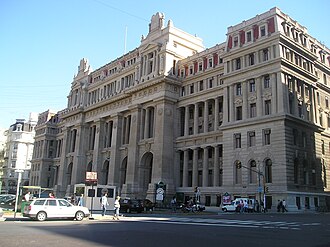
The Court is headquartered in the Palacio de Justicia, located in the San Nicolás neighborhood of Buenos Aires. This area is widely known as "Tribunales" due to the presence of the palace. Designed by French architect Norbert Maillart in 1906 and inaugurated in 1910, the building underwent various aesthetic and logistical updates until 1942.
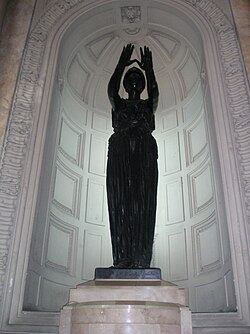
The palace is home to several significant monuments, including the sculpture Justice by Rogelio Yrurtia and a monument to José de San Martín by Luis Perlotti.
Historical Evolution and Political Influence
Throughout the 20th century, the Argentine judicial system often struggled with a lack of autonomy from the executive branch. The Court's history reflects the country's political volatility, including periods of military rule and democratic transitions.
Early 20th Century and Military Coups
Following the 1930 military coup by José Félix Uriburu, the Court recognized the new authorities, setting a precedent for the officialization of constitutional ruptures. During the presidency of Juan Perón, the Court approved decrees that had not been voted on by Congress. By 1947, Perón initiated trials against three judges, leaving only one of the previous magistrates in place.
Instability and Reorganization
The 1955 Revolución Libertadora saw the deposition of all five magistrates. Subsequent administrations, including those of Arturo Frondizi and Arturo Illia, attempted to alter the Court's composition. In 1973, an ad hoc tribunal was formed consisting of five Peronist judges who lacked traditional judicial careers. Following the 1976 military coup, the Court accepted the objectives of the "National Reorganization Process," a period marked by state repression and the disappearance of 30,000 people.
Expansion and Modernization
Under President Carlos Menem in 1989, the Court was expanded from five to nine members. However, this expansion was criticized for lacking transparency, as the Senate approved the new justices in a secret seven-minute session.
The 1994 Reform and the 2003 Decree
The 1994 constitutional reform modified the nomination process, requiring a two-thirds majority of present Senate members for approval rather than an absolute majority. This era also introduced key legal protections: amparo (protection of constitutional rights), hábeas corpus (protection against unlawful detention), and hábeas data (right to access and correct personal data).
A pivotal shift occurred in 2003 via decree 222/03. This reform mandated that candidates for the Supreme Court be presented by the Executive Branch with their resumes made public. This allows NGOs, academic groups, and citizens to discuss and scrutinize nominees for three months before they are presented to the Senate.
Human Rights and the Amicus Curiae
The Court formalized the amicus curiae process, allowing third parties to submit written arguments to defend the general interest. This was instrumental in the 2005 Caso Simon ruling, which declared that forced disappearances were crimes against humanity, effectively bypassing previous amnesty laws.
Recent Discoveries: Nazi Propaganda Archives
In May 2025, while organizing archives for a national museum, the Court discovered materials linked to the Nazi regime. These documents, sent from the German Embassy in Tokyo in 1941 via the steamship Nan-a-Maru, were intended to spread fascist ideology in Argentina and South America. President Horacio Rosatti ordered their preservation for historical analysis.
Summary of Current Leadership
| Justice | Role | Nominated By | Start Date | Retirement Date |
|---|---|---|---|---|
| Horacio Rosatti | President | Mauricio Macri | June 29, 2016 | August 11, 2031 |
| Carlos Rosenkrantz | Vice President | Mauricio Macri | August 22, 2016 | October 28, 2033 |
| Ricardo Lorenzetti | Minister | Néstor Kirchner | December 12, 2004 | September 19, 2030 |
Frequently Asked Questions
How are Supreme Court judges appointed in Argentina?
Judges are nominated by the President of the Nation and must be confirmed by a two-thirds majority of the members of the Senate present during a session convened for that purpose.
What is the term limit for a Supreme Court justice?
Justices serve until they reach the age of 75. At that point, the President and Senate may grant an additional five-year term, which can be repeated indefinitely.
Can a Supreme Court ruling be appealed?
No. The Supreme Court of Justice of the Nation functions as a last resort tribunal, meaning its decisions are final and cannot be appealed to any other body.
How can a justice be removed from office?
Justices can only be removed through a juicio político (political trial/impeachment process). This is initiated by the Chamber of Deputies and carried out by the Senate, exclusively on the grounds of improper behavior.
What is the significance of the 2003 reform?
The 2003 reform increased transparency by requiring the public disclosure of nominees' resumes and allowing for public and professional scrutiny before the Senate votes on the appointment.