Understanding Sunlight: From Solar Radiation to Life on Earth
Sunlight is much more than just the bright light we see during the day. It is a complex form of electromagnetic radiation emitted by the Sun that serves as the fundamental energy source for our planet. While we often use the term "light" to describe the visible portion of this radiation, scientifically, sunlight encompasses a broad spectrum of energy, including invisible infrared and ultraviolet rays.

When this radiation reaches Earth, it interacts with our atmosphere, creating the phenomenon we call daylight. Depending on atmospheric conditions, sunlight can be experienced as direct sunshine—a combination of bright light and radiant heat—or as diffused light when it is scattered by clouds or reflected off objects.
Key Facts

- Travel Time: It takes approximately 8.3 minutes for sunlight to reach Earth from the Sun's surface.
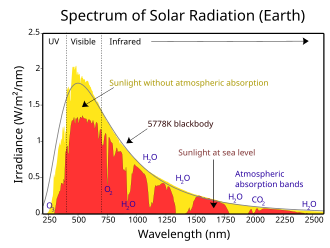
- Energy Composition: At Earth's surface, sunlight is roughly 52–55% infrared, 42–43% visible, and 3–5% ultraviolet.
- Biological Role: Sunlight is essential for photosynthesis, the process plants use to convert light into chemical energy.
- Health Impact: Ultraviolet (UV) radiation is necessary for Vitamin D3 synthesis but also acts as a mutagen.
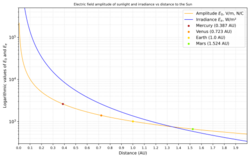
- Solar Intensity: The intensity of sunlight varies across the solar system, being significantly stronger on Mercury and much dimmer on Neptune or Pluto.
The Composition of the Solar Spectrum
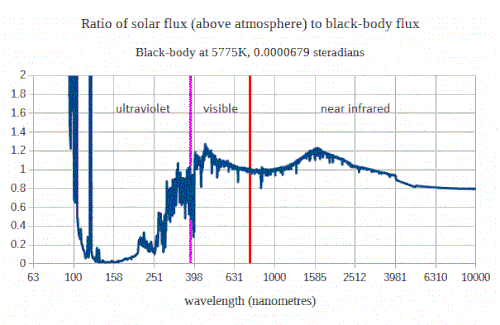
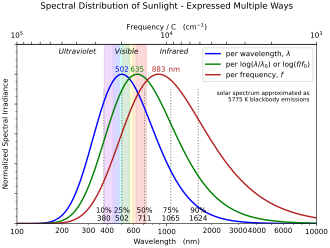
Sunlight is not a single type of energy but a mixture of different wavelengths. The vast majority of the radiation (about 98.7%) striking our atmosphere falls within the range of 200 nm to 4000 nm. This spectrum is generally categorized into several key regions:
Visible and Infrared Light
The visible spectrum (roughly 400 nm to 700 nm) is the portion perceptible to the human eye. Beyond this lies the infrared range, which humans typically perceive as warmth. Scientists divide infrared into sub-categories based on wavelength: Infrared-A (700 nm to 1,400 nm) and Infrared-B (1,400 nm to 3,000 nm).
Ultraviolet and Extreme Radiation
Ultraviolet (UV) radiation falls below the 400 nm wavelength. While the solar corona produces extreme UV and X-rays, these represent only a tiny fraction of the Sun's total power output. At the top of Earth's atmosphere, UV makes up about 8% of the radiation, much of which is biologically damaging short-wave UV.
Measuring Solar Intensity and Irradiance
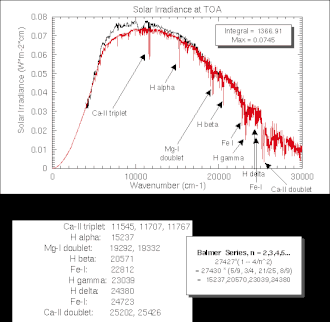
The amount of solar energy reaching a specific area is known as irradiance. This value is not constant; it fluctuates based on the Earth's distance from the Sun. Because Earth's orbit is elliptical, we are closer to the Sun in January (perihelion) and farther away in July (aphelion). This causes the energy received in January to be about 3.3% higher than the annual average.
At a distance of 1 astronomical unit (AU)—the average Earth-Sun distance—the extraterrestrial solar radiation is approximately 1,367 W/m². Once this reaches the Earth's surface, the direct sunlight at the zenith (the point directly overhead) is about 1,050 W/m², while the total amount (including indirect light) is roughly 1,120 W/m².
Solar Intensity Across the Solar System
The intensity of sunlight drops significantly as you move away from the Sun. Below is a summary of the solar radiation levels at different planets:
| Planet | Distance (AU) | Maximum Radiation (W/m²) | Minimum Radiation (W/m²) |
|---|---|---|---|
| Mercury | 0.3075 | 14,446 | 6,272 |
| Venus | 0.7184 | 2,647 | 2,576 |
| Earth | 0.9833 | 1,413 | 1,321 |
| Mars | 1.382 | 715 | 492 |
| Jupiter | 4.950 | 55.8 | 45.9 |
| Saturn | 9.048 | 16.7 | 13.4 |
| Uranus | 18.38 | 4.04 | 3.39 |
| Neptune | 29.77 | 1.54 | 1.47 |
Atmospheric Effects and Human Perception
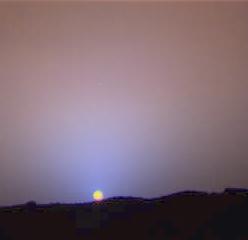
The Earth's atmosphere acts as a filter. Rayleigh scattering in the upper atmosphere causes blue wavelengths to dominate when sunlight is indirect, which is why the sky appears blue. In the lower atmosphere, water vapor, ozone, and dust can absorb specific wavelengths, altering the light that reaches the ground.
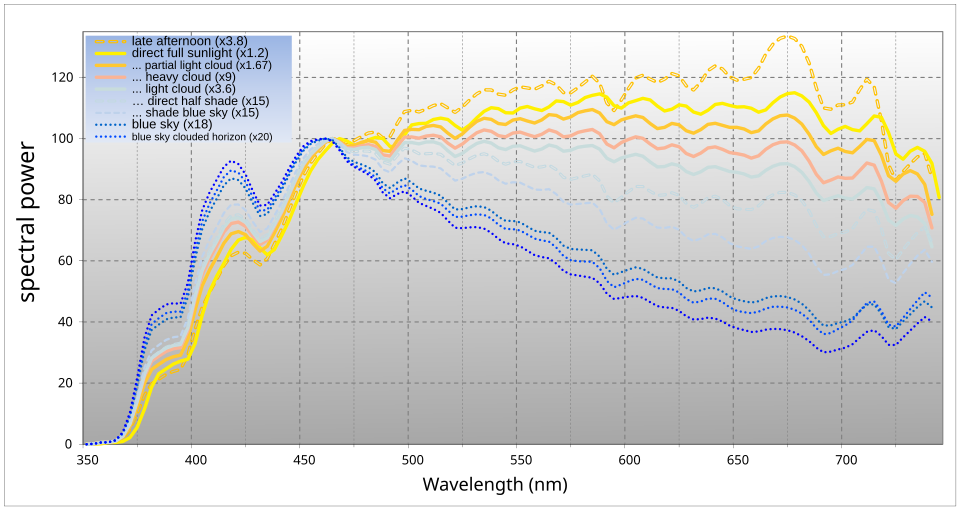
For humans, sunlight provides high luminous efficacy. Direct sunlight provides an illuminance of approximately 98,000 lux on a perpendicular surface at sea level. This efficiency means that using sunlight for illumination heats a room significantly less than traditional incandescent lighting.


Sunlight has also been a profound influence on human culture and art, captured in various forms of expression throughout history.



Frequently Asked Questions
How long does it take for sunlight to reach Earth?
It takes approximately 8.3 minutes for sunlight to travel from the surface of the Sun to the Earth.
What is the difference between sunlight and sunshine?
Sunlight refers to the electromagnetic radiation emitted by the Sun. Sunshine is a term used when direct solar radiation is not blocked by clouds, resulting in a combination of bright light and radiant heat.
Is all sunlight considered "light"?
There is conflicting convention on this. While many use "light" to refer specifically to the visible portion of the spectrum, some definitions include the entire range of solar radiation, including infrared and ultraviolet.
How does sunlight affect human health?
Sunlight has both positive and negative effects. It is essential for the synthesis of Vitamin D3 in the body, but ultraviolet radiation can also act as a mutagen, potentially leading to health issues.
Why is sunlight dimmer on other planets?
The intensity of solar radiation decreases as the distance from the Sun increases. For example, Mars receives significantly less radiation than Earth, and planets like Neptune receive very little.