Sugarcane: History, Production, and Global Economic Impact
Sugarcane is a tall, perennial grass belonging to the genus Saccharum and the family Poaceae. Known for its stout, jointed stalks, this plant is the primary source of the world's sucrose, a sugar that accumulates in the stalk's internodes. Ranging from 2 to 7 meters in height, sugarcane is not only a cornerstone of the global food industry but also a vital resource for energy and industrial materials.
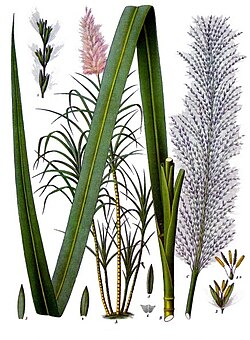
Key Facts
- Origin: Native to New Guinea.
- Global Scale: The world's largest crop by production quantity.
- Market Share: Accounts for 79% of global sugar production.
- Leading Producer: Brazil produces approximately 38% to 40% of the world's total.
- Composition: Mature stalks consist of 63–73% water, 12–16% soluble sugars, and 11–16% fiber.
The History and Diffusion of Sugarcane
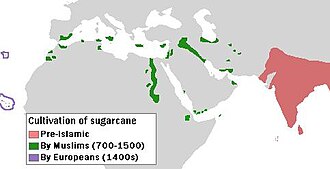
Originally domesticated in New Guinea, sugarcane was an ancient crop for Papuan and Austronesian peoples. Through the navigation of Austronesian sailors, the plant spread to Island Melanesia, Polynesia, and Madagascar during prehistoric times. By 500 BC, trade routes had introduced the crop to India and subsequently to Southern China.
![Map showing centers of origin of Saccharum officinarum in New Guinea, S. sinensis in southern China and Taiwan, and S. barberi in India; dotted arrows represent Austronesian introductions[18]](/images/08/b6/08b66e1891583fe509164cee81ef013df962146db1a3118e867ba072d1f02000.png)
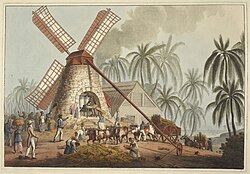
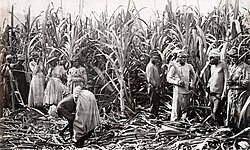
Between the sixth and fourth centuries BC, Persians and Greeks encountered the plant in India, noting that these "reeds" yielded honey without the need for bees. As the crop moved across the Mediterranean and North Africa, sugar transitioned from a rare, expensive spice to a widely traded commodity. By the 18th century, massive plantations were established across the Caribbean, South America, and the Pacific islands. This expansion drove significant human migrations, including both indentured servitude and the forced importation of enslaved people to meet labor demands.
Cultivation and Biological Characteristics
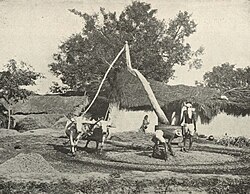
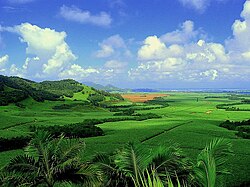
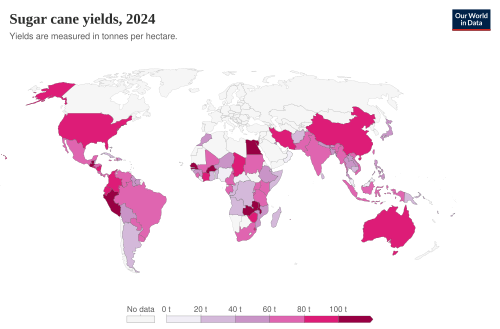
Sugarcane thrives in tropical and subtropical regions. While the average annual yield is between 60 and 70 tonnes per hectare, high-management practices can push this figure up to 180 tonnes. In experimental plots in Brazil, yields have reached as high as 280 tonnes per hectare.
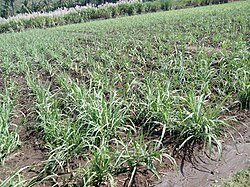
The majority of commercial cultivars are complex hybrids, as all sugarcane species can interbreed. Saccharum officinarum and its hybrids account for roughly 70% of the sugar produced globally. The success of a harvest depends on a precise combination of soil properties, climatic conditions, and the timing of the cut.
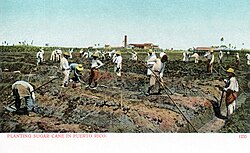
Global Production Statistics
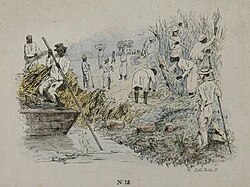
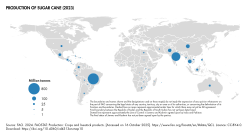
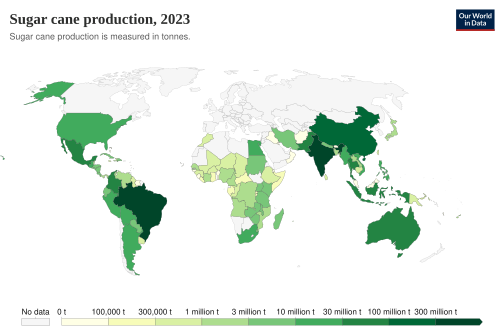
In 2020, global production reached 1.9 billion tonnes. The Americas lead the world in production, accounting for 52% of the total. In 2022, the global total was 1.922 billion tonnes, with a few nations dominating the market.
![World production of primary crops by main commodities[11]](/images/aa/0e/aa0ee005e7944f71771724456200366f3848ba98ec6167452a3e0284f95465ed.webp)
| Country | Production (Million Tonnes) | World Share (%) |
|---|---|---|
| Brazil | 724.4 | 37.69% |
| India | 439.4 | 22.86% |
| China | 103.4 | 5.38% |
| Thailand | 92.1 | 4.79% |
| Pakistan | 88.0 | 4.58% |
Processing and Industrial Applications
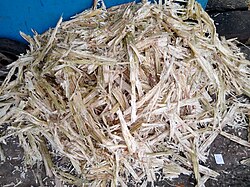
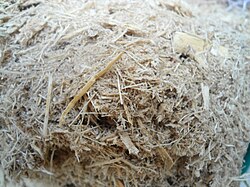
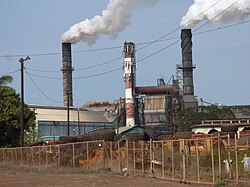
The processing of sugarcane involves extracting the juice from the stalks, which is then refined into brown or white sugar crystals. A significant byproduct of this process is bagasse—the residual dry fiber left after juice extraction.
Uses of Bagasse
- Energy: Burned in boilers and kilns to produce steam and electricity.
- Manufacturing: Used to create paper, paperboard, and reconstituted panelboard.
- Agriculture: Utilized as agricultural mulch.
- Chemicals: Serves as a raw material for various chemical productions.
Bioenergy and Ethanol
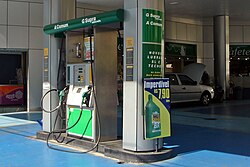
Beyond sugar, sugarcane is a primary feedstock for ethanol. In countries like Brazil, cane ethanol is a common alternative to gasoline. Furthermore, the electricity generated from bagasse is a critical energy source for rural populations in producing nations. For example, technologies in Mauritius can produce over 100 kWh of electricity per tonne of bagasse.
Sugarcane as Food and Drink

Freshly squeezed sugarcane juice is consumed as a beverage and contains essential nutrients, including Vitamin B6, Folate, and various minerals. It provides approximately 58 kcal per 100 grams.
Sugarcane is also the base for numerous distilled spirits and traditional drinks, including:
- Rum: Fermented and distilled juice or molasses.
- Aguardiente: A distilled liquor from Spain and Portugal.
- Guaro: A Latin American distilled liquor.
- Sidhu: A traditional South Asian wine made from juice or molasses.
Frequently Asked Questions
Where did sugarcane originate?
The strongest evidence indicates that Saccharum officinarum was originally domesticated in the New Guinea area.
What is bagasse and how is it used?
Bagasse is the dry fibrous residue remaining after sugarcane juice is extracted. It is primarily used as fuel for boilers to generate steam and electricity, but it is also used in paper production and as agricultural mulch.
Which country is the largest producer of sugarcane?
Brazil is the world's leading producer, accounting for approximately 38% to 40% of global production.
Can sugarcane be used for fuel?
Yes, sugarcane is used to produce ethanol, a biofuel used as an alternative to gasoline, and its bagasse is burned to generate electricity.
What is the difference between sugarcane and sugar beets?
While both are used for sugar production, sugarcane is a tall perennial grass grown in tropical regions, whereas sugar beets are root crops. Sugarcane accounts for 79% of the world's sugar production.