Studs Terkel: The Voice of Ordinary Americans
Louis "Studs" Terkel was far more than a writer or a broadcaster; he was a dedicated chronicler of the human spirit. Through his pioneering work in oral history—the collection and study of historical information using sound recordings of interviews—Terkel gave a platform to the unsung heroes and common citizens of the United States. From the depths of the Great Depression to the battlefields of World War II, Terkel captured the authentic voice of the American experience.
Key Facts
- Full Name: Louis Terkel (known professionally as Studs Terkel).
- Major Achievement: Won the 1985 Pulitzer Prize for General Nonfiction for The Good War.
- Career Span: Active from 1934 until his death in 2008.
- Signature Style: Specialized in oral histories of common people across various socioeconomic backgrounds.
- Radio Legacy: Hosted The Studs Terkel Program on WFMT Chicago for 45 years (1952–1997).
- Education: Held a PhB and a J.D. from the University of Chicago.
Early Life and Influences
Born in New York City on May 16, 1912, to Russian Jewish immigrants Samuel and Anna Terkel, Louis moved to Chicago at age eight. His worldview was profoundly shaped by his parents' rooming house, the Wells-Grand Hotel, which served as a crossroads for people from all walks of life. Terkel often credited the diverse conversations in the hotel lobby and the nearby Bughouse Square for his deep understanding of social interaction and humanity.
Despite earning a law degree from the University of Chicago in 1934 and being admitted to the Illinois Bar in 1935, Terkel eschewed a legal career. Driven by a passion for the arts and storytelling, he pursued interests in hotel concierge work and theater.
A Multifaceted Career in Media
Terkel's professional journey began with the Works Progress Administration's Federal Writers' Project, where he explored various radio roles, including news announcing, scriptwriting, and voice acting. This versatility led him to the "Chicago School of Television," where he starred in Studs' Place, an unscripted drama about a Chicago diner owner.
His most enduring media contribution was The Studs Terkel Program, which aired daily on 98.7 WFMT from 1952 to 1997. Over four and a half decades, he interviewed an eclectic array of figures, including Martin Luther King Jr., Bob Dylan, Leonard Bernstein, and Frank Zappa.
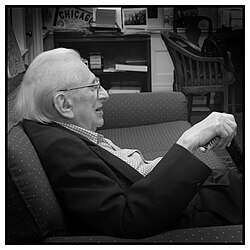
The Origin of the Nickname
The name "Studs" was born out of necessity during a theatrical production. To distinguish Louis Terkel from another actor also named Louis, the director nicknamed him after Studs Lonigan, a character from James T. Farrell's trilogy that Terkel was reading at the time.
Master of Oral History
Terkel's literary career was defined by his ability to listen. He moved beyond traditional historical narratives to document the lived experiences of ordinary people. His first book, Giants of Jazz, was published in 1956, but it was his subsequent oral histories that cemented his legacy.
- Division Street: America (1967): Explored the human spirit within the American metropolis.
- Hard Times (1970): A comprehensive look at the Great Depression, featuring voices from prison inmates to the wealthy.
- Working (1974): An acclaimed study of how people feel about their daily labor.
- The Good War (1984): A Pulitzer Prize-winning account of World War II told by those who lived it.
Beyond writing, Terkel was a scholar-in-residence at the Chicago History Museum and an occasional actor, notably playing reporter Hugh Fullerton in the film Eight Men Out.
Later Years and Activism
In his later years, Terkel remained a vocal advocate for civil liberties. In 2006, he joined a federal lawsuit against AT&T Inc. to prevent the National Security Agency from accessing customer telephone records without a court order, citing his own experience of being blacklisted during the McCarthy era.
Even in his 90s, Terkel remained resilient. In 2005, at age 93, he underwent successful open-heart surgery. He continued to write and speak until the end of his life, publishing his memoir Touch and Go in 2007. He passed away in his Chicago home on October 31, 2008, at the age of 96.
Summary of Legacy and Honors
| Award/Honor | Year | Significance |
|---|---|---|
| Pulitzer Prize for General Nonfiction | 1985 | Awarded for The Good War |
| National Humanities Medal | 1997 | Awarded by President Bill Clinton |
| George Polk Career Award | 1999 | Recognition of lifelong journalistic excellence |
| Order of Lincoln | 2004 | Highest honor from the State of Illinois |
| Dayton Literary Peace Prize | 2006 | Lifetime Achievement Award |
Frequently Asked Questions
What is Studs Terkel best known for?
Studs Terkel is best known for his pioneering work in oral history, specifically his books that document the experiences of ordinary Americans during the Great Depression and World War II, and his long-running radio program in Chicago.
Which book won Studs Terkel the Pulitzer Prize?
He received the Pulitzer Prize for General Nonfiction in 1985 for his book The Good War: An Oral History of World War Two.
How did he get the nickname "Studs"?
The nickname was given to him by a theater director to distinguish him from another actor named Louis. It was inspired by the character Studs Lonigan from a trilogy by James T. Farrell.
What was the focus of his radio program?
The Studs Terkel Program, which aired on WFMT for 45 years, focused on wide-ranging interviews with a diverse array of guests, from world-famous musicians and activists to everyday citizens.
What was Terkel's view on religion?
Terkel described himself as an agnostic, which he humorously referred to as being a "cowardly atheist" during a 2004 interview.