String Trimmer Design and Operation
A string trimmer is a versatile landscaping tool designed to manage grass and woody plants where traditional mowers cannot reach. At its core, the device relies on a simple physical principle: centrifugal force. As the trimmer hub spins at high speeds, the flexible line stiffens, becoming rigid enough to slice through vegetation upon impact.
How String Trimmers Work
The cutting mechanism consists of a nylon line wound onto a reel. When the motor rotates the reel, the line extends horizontally. The operator controls the cutting height by adjusting the angle of the tool, allowing for precise trimming right down to ground level. The speed of the spinning hub is managed via a trigger-activated throttle located on the handle.
While round-section nylon line is effective for standard grass and light plants, more powerful cutters often use extruded monofilament lines. These lines feature shapes, such as a star profile, which allow them to slash through larger woody plants or small shrubs by girdling them effectively. This specialized design reduces the need for solid disks when tackling tough vegetation.
Types of Trimmer Heads
Depending on the model, the method of delivering the cutting line varies. The two most common systems are bump feed and fixed line.
Bump Feed and Auto-Feed Systems
In a bump feed system, the line is hand-wound onto a reel before use. As the line wears down or breaks, the operator knocks the reel against the ground, triggering a release mechanism that extends more line. Newer "auto-feed" models automate this process, using a small cutter to ensure the line length remains optimal for effective swinging.
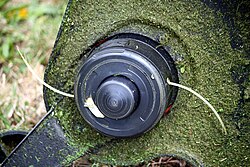
Fixed-Line Systems
Fixed-line trimmers utilize pre-cut line inserts rather than a wound spool. The user manually feeds these pre-cut pieces into specific slots in the head. This design is often considered easier to troubleshoot and feed than the bump feed alternative.
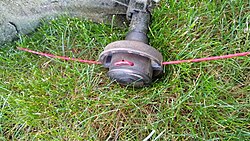
Power Sources and Configurations
String trimmers are engineered differently based on their power source. Internal combustion engine models typically place the engine at the opposite end of the shaft from the cutting head. In contrast, electric trimmers usually house the motor directly within the cutting head. Some industrial versions are integrated into heavy machinery and powered by hydraulic motors.
For specialized tasks, such as vertical cutting, the entire machine can be tilted, or the head can be adjusted to different angles. To protect the operator, the head includes a safety shield on the user side.
Comparing Trimmer Types
| Feature | Gasoline Powered | Electric Powered | Brush Cutters (Large) |
|---|---|---|---|
| Power | High maximum power | Moderate power | Very high power |
| Mobility | Complete mobility | Limited (unless battery) | High (often with harness) |
| Weight | Heavier | Lighter | Heaviest |
| Cutting Tool | Monofilament line | Monofilament line | Metal blades or line |
Key Facts
- Centrifugal force is what makes the flexible nylon line rigid enough to cut.
- Extruded star-shaped lines are used for cutting or girdling small shrubs.
- Bump feed mechanisms release line by hitting the reel on the ground.
- Fixed-line heads use pre-cut inserts for easier troubleshooting.
- Brush cutters are heavy-duty trimmers that often use metal blades for thick roadside weeds.
- Gasoline models offer more power but cause more vibration and muscle fatigue.
Frequently Asked Questions
What is the difference between a string trimmer and a brush cutter?
While both are used for clearing vegetation, brush cutters are larger, more powerful machines designed for thick roadside grass and weeds. They often utilize straight or circular metal blades instead of nylon line and may include a harness to distribute the weight across the user's shoulders.
How does a bump feed system work?
A bump feed system allows the operator to extend more cutting line by knocking the trimmer reel against the ground, which activates a release mechanism to replace worn or broken line.
Why use a star-shaped line instead of a round one?
Extruded shapes, like a star, help the line slash through material more effectively, making it possible to cut or girdle larger woody plants and small shrubs without needing a solid disk.
What are the downsides of gasoline-powered trimmers?
Gasoline trimmers are generally heavier than electric models, require refueling, and produce significant vibration, which can lead to increased muscle fatigue and reduced maneuverability.
Can string trimmers be used for vertical cutting?
Yes, vertical cutting is possible by tilting the entire machine or by adjusting the trimmer head to different angles, depending on the specific model's design.