Counterweights: Engineering Balance Across Mechanical Systems
In the world of physics and engineering, stability is often a matter of balance. A counterweight is a mass used to offset the weight of another object, allowing a system to move more efficiently, remain stable, or maintain a specific position. From the simple mechanics of a desk lamp to the theoretical heights of a space elevator, counterweights are essential for managing gravity and centrifugal forces.
Key Facts
- Counterweights reduce the energy required by motors to lift heavy loads.
- In rotating machinery, they minimize vibrations caused by imbalances.
- They can be used to maintain tension in cables via centrifugal force.
- Common materials include concrete for heavy construction and adjustable metal weights for precision instruments.
Mechanical Applications of Counterweights
Heavy Lifting and Construction
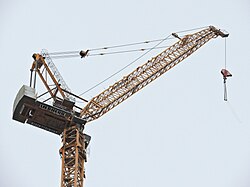
In modern construction, the tower crane serves as a primary example of a balance crane. These structures feature a horizontal boom balanced asymmetrically across a tower. While the long arm handles the lifting gear, the shorter machinery arm houses the motors, electronics, and heavy concrete counterweights to prevent the crane from tipping.
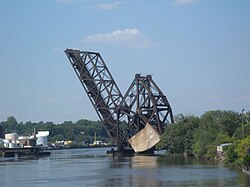
Similarly, other infrastructure such as bascule bridges, drawbridges, and vertical-lift bridges utilize counterweights to move massive sections of roadway with minimal effort.
Transportation and Elevators
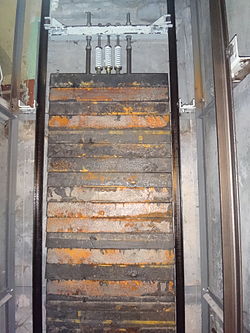
Traction elevators (non-hydraulic systems) use a heavy counterweight to balance the elevator carriage. Specifically, the counterweight equals the weight of the carriage plus 40-50% of its rated capacity. This configuration ensures the motor lifts significantly less weight, increasing ascending acceleration and decreasing descending acceleration to save power. Both the carriage and counterweight use wheels on rails to ensure a smooth ride.
Rotating Systems and Precision Tools
Counterweights are not always about lifting; often, they are about stability. In piston engines, counterweights on the crankshaft (the shaft that converts linear piston motion into rotation) reduce vibrations caused by imbalances in the rotating assembly.
For precision timing, a mechanical wind-up metronome uses an adjustable weight on a spindle. Moving the weight to a higher marking decreases the tempo, while moving it lower increases the speed.
Specialized and Theoretical Uses
The Trebuchet
The trebuchet is a siege engine consisting of five main parts: a beam, counterweight, frame, guide chute, and sling. Gravity pulls the counterweight down from a platform, pivoting the beam. This force allows the sling to complete the necessary arc to release a projectile accurately.
The Space Elevator Concept
A space elevator is a proposed structure for transporting materials from a celestial body's surface into space. The most common design involves a cable stretching from Earth to geostationary orbit with a counterweight at the outer end.
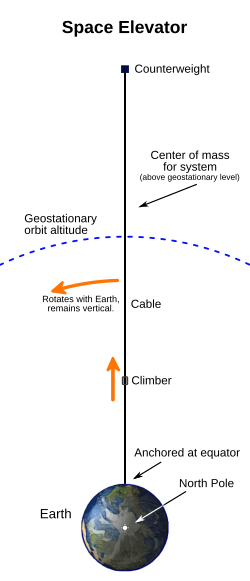
The counterweight ensures the cable remains taut by utilizing centrifugal force—the apparent outward force experienced by an object moving in a circle—generated by Earth's rotation. This force counters the gravitational pull on the lower sections of the cable.
Proposed forms for this counterweight include a captured asteroid, a space station or dock positioned beyond geostationary orbit, or simply an extension of the cable itself.
Summary of Counterweight Applications
| Application | Primary Purpose | Mechanism |
|---|---|---|
| Traction Elevator | Energy Efficiency | Balances carriage weight + 40-50% capacity |
| Tower Crane | Structural Stability | Concrete weights on the machinery arm |
| Crankshaft | Vibration Reduction | Balances rotating assembly mass |
| Space Elevator | Cable Tension | Centrifugal force via outer mass |
| Trebuchet | Projectile Launch | Gravitational pull pivots the beam |
Frequently Asked Questions
How does a counterweight help an elevator motor?
By balancing the weight of the carriage and a portion of its capacity, the motor does not have to lift the full weight of the load, which reduces the amount of power required for operation.
What happens if a tower crane lacks counterweights?
Without the concrete counterweights on the machinery arm, the horizontal boom would be unbalanced, causing the crane to tip toward the side carrying the lifting gear.
How is a metronome's speed adjusted?
The speed is adjusted by moving a weight along a spindle; moving the weight higher decreases the tempo, while moving it lower increases it.
What could serve as a counterweight for a space elevator?
Potential options include a captured asteroid, a spaceport or station located past geostationary orbit, or an extension of the cable itself.
Why are counterweights used in engines?
They are placed on crankshafts to reduce vibrations that occur due to imbalances in the rotating assembly of piston engines.