Stone Tools: The Evolution of Prehistoric Lithic Technology
For the vast majority of human history, stone was the primary material used to shape the world. From the earliest hominins to the dawn of agriculture, stone tools provided the essential means for survival, allowing early ancestors to hunt, process food, and build shelter. Because stone is highly resistant to natural degradation, these artifacts serve as a cornerstone of prehistoric archaeology, offering a durable record of cognitive and cultural evolution.
Stone tools generally fall into two categories: knapped stone, which is shaped by striking the material, and ground stone, which is polished through abrasion. The craft of creating knapped tools is known as flintknapping.
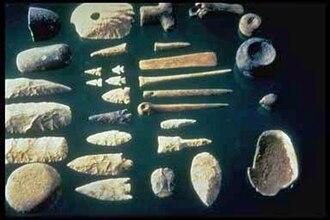
Key Facts
- Oldest Tools: The Lomekwi site in Kenya has yielded tools dated to 3.3 million years ago.
- Materials: Knapped tools use cryptocrystalline materials like flint, obsidian, and chert; ground tools use coarser materials like basalt and jadeite.
- Lithic Reduction: The process of splitting stone to create tools, ranging from simple flakes to complex standardized blades.
- Technological Modes: Grahame Clark proposed a sequence of five "Modes" to describe the progression of lithic technology.
- Neolithic Shift: Around 10,000 BC, polished ground stone tools became vital for large-scale forest clearance and farming.
The Science of Lithic Reduction
The creation of knapped tools relies on a process called lithic reduction. This involves removing flakes from a lithic core using a hammerstone or other hard fabricator. Depending on the goal, a flintknapper might simply produce sharp flakes or work the core into a preform—a rough version of the final tool.
Advanced techniques include soft hammer flaking and pressure flaking to refine edges. More sophisticated strategies produce standardized blades, which are then fashioned into specialized tools such as scrapers, knives, sickles, and microliths (tiny stone components used in composite tools).
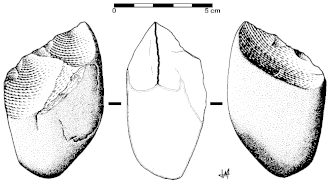
The Evolutionary Timeline of Stone Tools
In 1969, Grahame Clark proposed an evolutionary sequence of lithic technologies, categorized as Modes 1 through 5. While these modes generally follow a chronological order, the timeline varied by region; for instance, Mode 1 persisted in Europe long after Mode 2 became dominant in Africa.
Pre-Mode I: The Earliest Evidence
Recent discoveries have pushed the origin of tool use back significantly. In Kenya, tools from the Lomekwi site date to 3.3 million years ago, predating the genus Homo by roughly one million years. These may have been created by Australopithecus afarensis or Kenyanthropus platyops. Similarly, in Dikika, Ethiopia, animal bone fossils showing stone-tool cut marks date to approximately 3.3 million years ago.
Mode I: The Oldowan Industry
The Oldowan Industry represents the first widely recognized tool tradition, appearing around 2.9 million years ago in Kenya and 2.6 million years ago in Ethiopia. Initially used by Homo habilis and later inherited by Homo erectus, these simple choppers and flakes spread from Africa into Eurasia, reaching Java by 1.8 million years ago and Northern China by 1.6 million years ago.
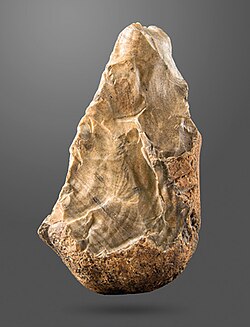
Mode II and III: Acheulean and Mousterian
As cognitive abilities evolved, tools became more complex. The Acheulean industry introduced bifacial tools, such as the iconic handaxe, which were worked on both sides for greater symmetry and utility.
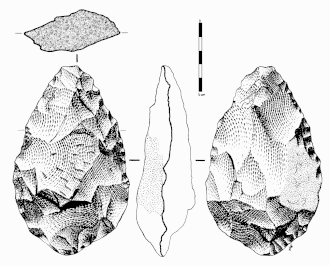
The subsequent Mousterian industry utilized the Levallois technique, a method of preparing a core specifically to strike off a flake of a predetermined size and shape, greatly increasing efficiency.
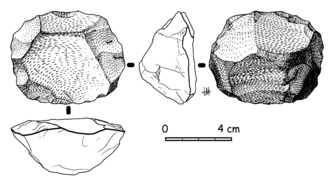
Mode IV and V: Aurignacian and Microlithic Industries
Between 50,000 and 10,000 years ago, the Aurignacian culture shifted toward the production of long, thin blades. This was exponentially more efficient than previous flake techniques. Eventually, Mode V emerged, characterized by microliths—small, standardized stone pieces used as inserts for arrows or other composite weapons.
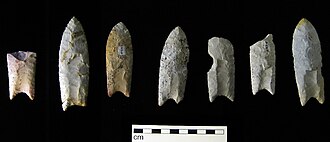
The Neolithic Revolution and Ground Stone
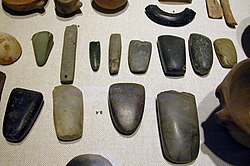
Beginning around 10,000 BC (though appearing earlier in Japan), humans began producing ground stone tools. Unlike knapped tools, these were made from larger-grained materials like basalt, jadeite, and greenstone, which are too coarse for flaking. These tools were created through a labor-intensive process of grinding the stone against an abrasive surface, often using water as a lubricant.
Polished axes and adzes were critical for the Neolithic transition to agriculture, as they allowed for the widespread clearance of forests. These objects often became items of high value, traded over long distances and sometimes buried as venerated objects in barrows.
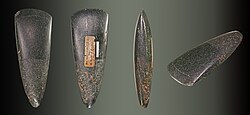

Summary of Lithic Technologies
| Industry/Mode | Primary Technique | Key Tool Types | Approximate Period |
|---|---|---|---|
| Oldowan (Mode 1) | Simple flaking | Choppers, sharp flakes | 2.9 – 1.7 Ma |
| Acheulean (Mode 2) | Bifacial knapping | Handaxes | Lower Palaeolithic |
| Mousterian (Mode 3) | Levallois (prepared core) | Standardized flakes | Middle Palaeolithic |
| Aurignacian (Mode 4) | Blade production | Long blades, scrapers | 50,000 – 10,000 years ago |
| Microlithic (Mode 5) | Miniaturization | Microliths, composite tools | Mesolithic |
| Neolithic | Grinding and Polishing | Polished axes, celts, querns | From 10,000 BC |
Frequently Asked Questions
What is the difference between knapped and ground stone?
Knapped stone is created by striking a material (like flint or obsidian) to flake off pieces, while ground stone is shaped by rubbing the material against an abrasive surface to polish and smooth it.
Who made the oldest known stone tools?
The oldest tools (3.3 million years old) predate the genus Homo. They may have been made by Australopithecus afarensis or Kenyanthropus platyops.
What was the Levallois technique?
The Levallois technique is a sophisticated method of preparing a stone core so that a single, precisely shaped flake can be struck off, allowing for more standardized tool production.
Why were polished axes important in the Neolithic period?
Polished axes had greater mechanical strength than knapped tools, making them essential for clearing forests to create land for crop and livestock farming.
What are microliths?
Microliths are very small stone tools, often trapezoidal, that were designed to be embedded into wooden or bone handles to create composite tools like arrows.