Steady-State Theory: The Alternative to the Big Bang
For decades, the scientific community was locked in a profound debate over the origin and nature of our universe. While the Big Bang theory eventually became the dominant scientific consensus, the steady-state model once stood as its primary rival. This theory proposed a universe that, despite expanding, remained fundamentally unchanged over time.
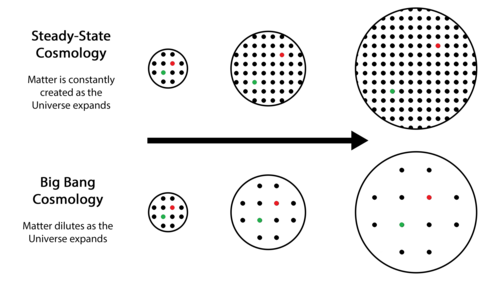
At its core, the steady-state model relies on the perfect cosmological principle. This principle suggests that the observable universe looks the same from any location and at any point in time. While a static universe (one that does not expand) would also satisfy this principle, astronomical observations confirmed that space is indeed expanding. To reconcile expansion with a constant appearance, the steady-state model proposed the continuous creation of matter to fill the gaps left by expanding galaxies, ensuring the density of the universe remained constant.
Key Facts
- Core Concept: The universe has no beginning or end and maintains a constant density through the continuous creation of matter.
- Key Proponents: Developed significantly by Hermann Bondi, Thomas Gold, and Fred Hoyle in 1948.
- Primary Rival: The Big Bang theory, which posits a finite age and an evolving universe.
- Current Status: Rejected by most modern cosmologists due to contradictory observational evidence.
- Defining Principle: The perfect cosmological principle, stating the universe is homogeneous in both space and time.
The History of the Cosmological Debate
The journey toward understanding the universe began with Edwin Hubble's observations of cosmological expansion. Early theoretical models, such as Albert Einstein's 1917 static universe, were eventually found to be unstable. Father Georges Lemaître advanced the precursor to the modern Big Bang theory, suggesting the universe had a finite age and evolved through cooling and expansion.
In contrast, the steady-state model emerged as a way to avoid a "beginning." While Albert Einstein had considered a steady-state expanding model in a 1931 manuscript, he ultimately abandoned it. The theory gained prominence in 1948 through the influential work of Hermann Bondi, Thomas Gold, and Fred Hoyle, building on earlier ideas proposed by figures like William Duncan MacMillan.
Observational Tests and the Decline of the Model
Between the 1940s and 1960s, the astrophysical community was divided. However, as observational technology improved, the steady-state model faced three critical challenges.
Counts of Radio Sources
In the 1950s and 60s, astronomers discovered that bright radio sources, such as quasars (extremely luminous active galactic nuclei) and radio galaxies, were only found at great distances. Because light takes time to travel, these distant objects represent the universe in its distant past. The Big Bang theory predicted this evolution, but the steady-state model predicted these objects should be distributed evenly throughout the universe, including near our own galaxy. By 1961, statistical surveys provided strong evidence against the steady-state view.
The X-ray Background
Gold and Hoyle suggested that newly created matter would form dense regions that radiate and cool, creating pressure gradients and emitting plasma. However, research by Gould and Burbidge in 1963 showed that the thermal bremsstrahlung radiation (radiation produced by the acceleration of a charged particle) from such plasma would far exceed the X-rays actually observed in space. This suggested that thermal instability was not a viable mechanism for forming galaxies in a steady-state universe.
The Cosmic Microwave Background (CMB)
The definitive blow came in 1964 with the discovery of the cosmic microwave background radiation. This faint glow of light fills the universe and was a direct prediction of the Big Bang's hot, dense origin. Steady-state proponents argued it was light from ancient stars scattered by galactic dust, but the CMB's extreme uniformity and its near-perfect black-body spectrum (a theoretical spectrum of an ideal radiator) made the dust theory untenable.
| Feature | Big Bang Theory | Steady-State Theory |
|---|---|---|
| Age of Universe | Finite age | Infinite (no beginning/end) |
| Matter Density | Decreases as space expands | Remains constant |
| Evolution | Universe changes over time | Universe looks the same always |
| Matter Creation | Created at the start | Continuous creation |
| CMB Explanation | Remnant heat from early stage | Scattered starlight (disproven) |
Quasi-Steady State Cosmology (QSS)
In 1993, Fred Hoyle, Geoffrey Burbidge, and Jayant V. Narlikar proposed the Quasi-Steady State model to address the flaws of the original theory. Instead of a smooth continuous creation, QSS suggests "minibangs" or pockets of creation occurring over time. To explain the origin of light elements, they evoked the evaporation of Planck particles—hypothetical black holes where the Schwarzschild radius equals the Compton wavelength.
Despite these modifications, mainstream cosmologists, including Ned Wright, have pointed out significant discrepancies between QSS and actual astronomical observations, leaving the model marginalized in modern science.
Frequently Asked Questions
What is the perfect cosmological principle?
It is the assertion that the universe is homogeneous and isotropic not only in space (looking the same from every location) but also in time (looking the same at any epoch).
Why is the continuous creation of matter necessary in the steady-state model?
Because the universe is expanding, the existing matter would naturally dilute, decreasing the density. Continuous creation ensures that new matter replaces the gaps, keeping the density constant.
How did the Cosmic Microwave Background (CMB) disprove the theory?
The CMB is a uniform, black-body radiation that indicates the universe was once in a hot, dense state. The steady-state model could not explain this uniformity or the specific spectrum of the radiation through scattered starlight.
Who were the primary architects of the steady-state theory?
The most influential papers were published in 1948 by Hermann Bondi, Thomas Gold, and Fred Hoyle.
What are "minibangs" in Quasi-Steady State cosmology?
Minibangs are localized pockets of matter creation that occur periodically throughout the universe, proposed as a way to update the steady-state model to fit newer observations.