State of Mexico: A Hub of Culture, History, and Industry
The State of Mexico (Spanish: Estado de México) is a powerhouse of population and economic activity, serving as a vital ring around the national capital. While often confused with the country itself, this state is a distinct administrative entity with a rich tapestry of indigenous roots, colonial history, and modern industrialization. From the towering peaks of volcanoes to the bustling streets of its massive municipalities, it represents a critical intersection of Mexico's past and future.
Key Facts
- Population: 16,992,418 (2020), the highest of any Mexican state.
- Capital: Toluca de Lerdo.
- Largest City: Ecatepec de Morelos.
- Highest Point: Popocatépetl volcano, reaching 5,500 meters (18,000 ft).
- Economy: A total GDP of MXN 2.577 trillion (US$128.2 billion) as of 2022.
- HDI: 0.802, categorized as very high.
Historical Evolution
The state's history is marked by pivotal conflicts that shaped the modern Mexican nation. During the Mexican War of Independence, Miguel Hidalgo y Costilla marched through the region in 1810, leading to the Battle of Monte de las Cruces on October 30, 1810. Although Hidalgo emerged victorious, he famously chose not to advance into Mexico City, altering the course of the revolution.

Later, during the Mexican Revolution, the southwest region became a stronghold for Zapatistas. The state was a center for political negotiation, hosting the Convention of Generals and Revolutionary Governors in Toluca twice in 1915. This era culminated in the 1917 constitution, which reorganized the state into 118 municipalities and sixteen districts.

Geography and Regional Organization
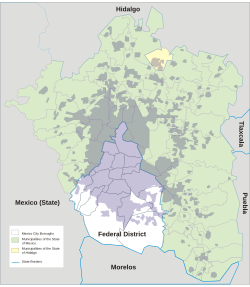
Bordering Mexico City, the state is characterized by diverse ecosystems and dramatic topography. Its most prominent landmark is the Popocatépetl volcano, the highest point in the state.

The landscape varies from the dense forests of La Marquesa National Park to the fertile valleys of Bravo.


Administratively, the state is divided into 125 municipalities grouped into 20 distinct regions. This structure allows for the management of a territory that ranges from highly urbanized zones to rural highlands.

Demographics and Urbanization
The State of Mexico is the most populous state in the country. Much of this population is concentrated in the Greater Mexico City metropolitan area, where cities like Ecatepec de Morelos and Nezahualcóyotl have grown into massive urban centers.
The region is also home to diverse indigenous groups, most notably the Mazahua people, who have a significant presence both in the state and within Mexico City due to migration patterns.
![Mazahua woman in Mexico City. The Mazahuas originate in the State of Mexico and are a prevalent cliché about the indigenous peoples in Mexico City[56] due to their high migration elsewhere[57]](/images/41/51/4151f9d94a07aed186f734153c9b7f2588d74f1b1ebe5f8158652578d22b4fc6.jpg)
Education and Infrastructure
Education is a cornerstone of the state's development. It boasts the second-largest school system in Mexico, with approximately 15,000 schools serving over three million students. The Universidad Autónoma del Estado de México (UAEM) is the premier institution of higher learning, offering 48 majors and maintaining an enrollment of over 100,000 students.
Transportation Networks
To support its massive population, the state utilizes an extensive transport network including 9,723 km of highways. The Ferrocarril Suburbano, a commuter rail line launched in 2008, provides a critical link between downtown Mexico City and northern municipalities such as Tultitlán and Tlalnepantla.

Air travel is facilitated by several airports, including the Toluca International Airport and the Felipe Ángeles International Airport, the latter of which plays a key role in relieving congestion from the capital's main hub.
Culture and Tourism
The state is a treasure trove of archaeological and artistic sites. From the ancient ruins of Teotenango and Malinalco to the vibrant glasswork of the Cosmovitral, the region blends prehistoric mystery with modern art.


Religious and colonial history are also evident in sites like Ozumba, which features 16th-century murals depicting child martyrs.

| Category | Detail |
|---|---|
| Capital | Toluca de Lerdo |
| Total Area | 22,351 km² |
| Population (2020) | 16,992,418 |
| GDP (2022) | US$128.2 billion |
| Administrative Units | 125 Municipalities |
| Highest Peak | Popocatépetl (5,500m) |
Frequently Asked Questions
What is the difference between the State of Mexico and Mexico City?
The State of Mexico (Estado de México) is a sovereign state within the Mexican federation, while Mexico City is the national capital. The State of Mexico completely surrounds Mexico City on three sides, and many people live in the state but work in the capital.
Which is the largest city in the State of Mexico?
Ecatepec de Morelos is the largest city in the state, followed by Ciudad Nezahualcóyotl and Naucalpan de Juárez.
What is the role of the UAEM in the state?
The Universidad Autónoma del Estado de México (UAEM) is the state's primary public university, providing higher education to over 100,000 students across 48 different majors.
How does the Ferrocarril Suburbano help commuters?
The Ferrocarril Suburbano is a commuter rail system that connects the northern municipalities of the State of Mexico directly to downtown Mexico City, reducing travel time and traffic congestion.
Who are some notable people from the State of Mexico?
Notable figures include the poet and philosopher Sor Juana Inés de la Cruz, the King of Texcoco Nezahualcoyotl, and former Mexican President Enrique Peña Nieto.