State of Buenos Aires: The Secessionist Republic of 1852–1861
The State of Buenos Aires (Spanish: Estado de Buenos Aires) was a short-lived but influential secessionist republic that existed between 1852 and 1861. Born from the political turmoil following the overthrow of the Argentine Confederation government in the Province of Buenos Aires, this entity operated as an independent state with its own government, currency, and constitution for nearly a decade.
While it was never explicitly recognized as a sovereign nation by the Argentine Confederation, the State of Buenos Aires functioned autonomously, maintaining its own diplomatic relations and managing its own economy until its eventual reunification with Argentina following the Battle of Pavón in 1861.
Key Facts
- Duration: September 11, 1852, to December 12, 1861.
- Government Type: Unitary republic.
- Capital: Buenos Aires.
- Key Figures: Bartolomé Mitre, Pastor Obligado, and Valentín Alsina.
- Population: 248,498 (according to the 1855 census).
- Currency: Peso moneda corriente.
- Defining Event: The 1854 Constitution established its internal and external sovereignty.
Historical Background and Secession
The roots of the State of Buenos Aires lay in deep-seated regionalism. Following the wars of independence, Argentina struggled with national unity, often split between centralists and federalists. For years, the Province of Buenos Aires acted as a semi-independent state during various civil wars.
The political landscape shifted dramatically after the 1852 Battle of Caseros, which saw the deposition and exile of the powerful leader Juan Manuel de Rosas. Justo José de Urquiza, the Governor of Entre Ríos, was granted head-of-state powers via the Palermo Protocols. However, this sparked resistance in Buenos Aires, where leaders feared the loss of local control—specifically over the Buenos Aires Customs, the city's primary source of revenue.
Tensions peaked on September 11, 1852, when a coup d'état overthrew the provisional administration of Governor José Miguel Galán. Led militarily by General José María Pirán and ideologically by Dr. Valentín Alsina and Colonel Bartolomé Mitre, this revolt formally established the State of Buenos Aires as a separate entity from the Argentine Confederation.
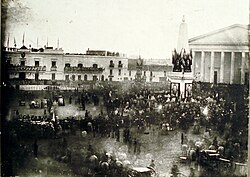
The Constitution and Sovereignty
On April 12, 1854, the State promulgated its own constitution, drafted by Dalmacio Vélez Sársfield. This document consisted of 178 articles divided into eight parts, explicitly defining the polity as the Estado de Buenos Aires.
The constitution asserted that Buenos Aires would freely exercise its sovereignty both internally and externally until it chose to delegate that power to a federal government. Interestingly, while it claimed sovereignty, Article 6 acknowledged the existence of a broader Argentine republic by granting citizenship to individuals born in other provinces.
Territorial Claims
The State's territorial definitions were vague, though it claimed land extending to the foothills of the Andes and included Martín García Island. A point of contention remained the navigation of rivers; unlike the Confederation's constitution, the State of Buenos Aires did not specify that its rivers were open to all nations, a move criticized by legal scholar Juan Bautista Alberdi.
International Recognition and Diplomacy
Despite the conflict with the Argentine Confederation, the State of Buenos Aires successfully sought recognition from several foreign powers. The United States, while officially recognizing the Confederation, found its commercial interests tied to Buenos Aires. In 1854, the U.S. accredited James A. Peden as minister resident to the State, negotiating treaties of friendship and commerce.
Other nations followed suit, establishing diplomatic ties or sending consuls, including:
- Paraguay: Established relations in 1855 under Carlos Antonio López.
- Brazil, Portugal, and the Kingdom of Sardinia: Sent diplomatic representatives.
- European States: Consuls were accredited from France, Sweden, Norway, Denmark, and the Free City of Hamburg.
Even the Argentine Confederation maintained a pragmatic relationship with the State. On January 8, 1855, the two parties signed a convention to cooperate on postal services, customs, the extradition of criminals, and joint military efforts against Indian raids.
Governance and Public Development
Under the leadership of Governor Pastor Obligado (1853–1858), the State underwent significant modernization. Obligado launched an ambitious public works program that introduced the city's first running water system and gas lamps. He also focused on education, establishing a network of primary schools and the institution that would become the Colegio Nacional de Buenos Aires.
Economic reforms included the regulation of emphyteusis (a form of land tenure), where land was sold at a rate of 16,000 silver pesos per square league. The state also established a national mint and provided subsidies to boost industry and commerce. A major milestone in infrastructure occurred on August 30, 1857, with the inauguration of the first line of the Buenos Aires Western Railway, designed by British engineer William Bragge.
| Category | Details |
|---|---|
| Political Status | Secessionist Unitary Republic |
| Key Dates | Secession: 1852 | Constitution: 1854 | Reunification: 1861 |
| Major Infrastructure | First Argentine rail line (1857), gas lamps, running water |
| Diplomatic Ties | USA, Brazil, Paraguay, France, and others |
| Final Conflict | Battle of Pavón (1861) |
Reunification
The separation ended following a series of military conflicts, most notably the Battle of Cepeda (1859) and the Battle of Pavón (1861). After the victory at Pavón, the State of Buenos Aires rejoined the Argentine Confederation on December 12, 1861. Bartolomé Mitre, who had served as governor, continued his leadership role in the newly reunified Argentine Republic.
Frequently Asked Questions
Why did Buenos Aires secede from the Argentine Confederation?
The secession was primarily driven by regionalism and a desire to maintain control over the Buenos Aires Customs, which provided the bulk of the region's revenue, as well as resistance to the central authority of Justo José de Urquiza.
Was the State of Buenos Aires recognized internationally?
Yes. Despite the Confederation's objections, the State of Buenos Aires established diplomatic relations and signed treaties with several countries, including the United States, Brazil, and Paraguay.
What were the major achievements of the State of Buenos Aires?
The State implemented significant urban modernization, including the first gas lighting and running water in the city, the creation of a public primary school system, and the launch of the first Argentine railway line in 1857.
How did the State of Buenos Aires eventually rejoin Argentina?
Reunification occurred after the Battle of Pavón in 1861, which led to the formal reintegration of the State into the Argentine Republic on December 12, 1861.
Who were the primary leaders of the State of Buenos Aires?
Key figures included Valentín Alsina, who provided ideological leadership; Pastor Obligado, who oversaw major public works; and Bartolomé Mitre, who led the military and political efforts toward the end of the secession.