Stanley: The Southernmost Capital of the Falkland Islands
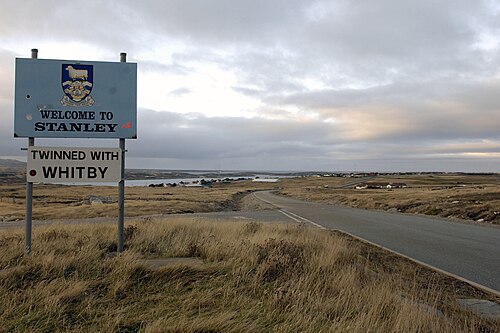
Perched on a north-facing slope of East Falkland, Stanley (also known as Port Stanley) serves as the vibrant capital of the Falkland Islands. As the primary hub for commerce, governance, and transport, it is home to the vast majority of the territory's residents. In June 2022, the settlement was formally awarded city status during the Platinum Jubilee Civic Honours, cementing its role as the southernmost capital of a self-governing state or territory.
According to the 2021 census, Stanley has a population of 2,974, which represents approximately 81% of the total population of the Falkland Islands. The city is a critical political center, represented by five of the eight elected members of the Legislative Assembly.
Key Facts
- Established: 1843 (became capital in July 1845).
- Population: 2,974 (2021 Census).
- Status: Awarded city status in June 2022.
- Geography: Located on East Falkland; the southernmost capital of a self-governing territory.
- Climate: Historically a tundra climate, characterized by cool summers and strong westerlies.
History and Evolution
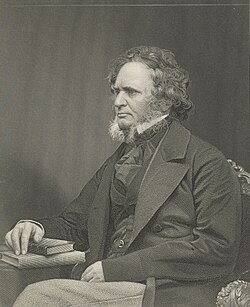
The settlement of Stanley began in 1843 and was named after Lord Stanley, the Secretary of State for War and the Colonies. To bolster the defense and development of the new settlement, 30 married Chelsea Pensioners were settled there in 1849.
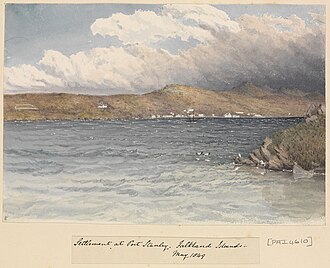
The city's early years were marked by geological instability. In 1879 and 1886, landslides triggered by excessive peat cutting destroyed portions of the town. A particularly severe event on November 29, 1878, saw a massive moving mass of peat divide the town in two, leaving boats as the only means of transport between the separated sections.
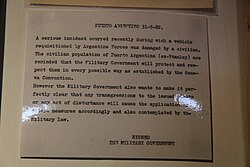
During the Second World War, Stanley Harbour was used to intern Jeffrey Hamm, a member of the British Union of Fascists who had moved to the islands to teach. Later, the city became a focal point of the Falklands War in 1982. Occupied by Argentine troops for approximately ten weeks, the city was renamed "Puerto Argentino." The conflict left Stanley with significant damage from both the occupation and British naval shelling, which resulted in three civilian deaths. Following the British victory, the surrounding areas were heavily mined, and some minefields remain today.
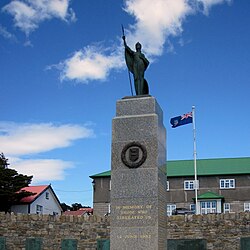
Since 1982, Stanley has experienced significant growth, expanding by more than a third in size. This development has been driven largely by the expansion of the tourism and fishing industries.
Infrastructure and Local Attractions
Stanley is the primary shopping center for the archipelago and the central hub for the road network of East Falkland. The city offers a blend of colonial history and modern amenities, including four pubs, 11 hotels and guesthouses, and three restaurants.
Notable landmarks include:
- Government House: Built in 1845, serving as the residence of the Governor.
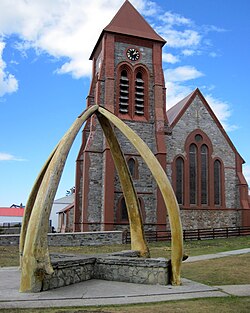
- Christ Church Cathedral: The southernmost Anglican cathedral in the world.
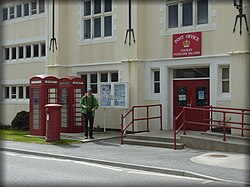
- Falkland Islands Museum: A center for local history and culture.
- The Whalebone Arch: A prominent local landmark.
For recreation, the city features an 18-hole golf course and the Stanley Racecourse, which has hosted annual horse racing meetings every December 26 and 27 for over a century.
Education and Transport
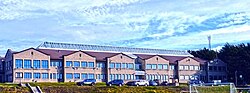
The city provides comprehensive education through the Stanley Infant & Junior School (serving children aged 4 to 11) and the Falkland Islands Community School (serving students aged 11 to 16).
Transport is managed via Stanley Airport for internal flights and connections to Antarctica. While flights to Argentina ceased after the 1982 war, a weekly service to Punta Arenas, Chile, began in 1993, operating out of RAF Mount Pleasant. Civilian contractors also operate twice-weekly flights between Mount Pleasant and the United Kingdom.
Climate and Environment
Stanley's climate is characterized by relatively stable temperatures throughout the year and strong westerly winds. While it historically fell under the tundra climate classification (ET) due to mean temperatures below 10°C in the warmest month, recent trends show a warming pattern.
Precipitation is evenly distributed across the year, averaging 544 mm. The city experiences significant frost, occurring on more than one in three nights, and snow is common during winter, though light snowfall can occur year-round. Temperature extremes range from a record low of −11.1°C to a high of 26.1°C.
| Metric | Winter (July) | Summer (January) | Annual Average |
|---|---|---|---|
| Mean Daily Max (°C) | 5.1 | 14.1 | 9.8 |
| Mean Daily Min (°C) | −1.2 | 5.1 | 2.0 |
| Avg Precipitation (mm) | 41 | 63 | 544 |
| Avg Relative Humidity (%) | 90 | 78 | 83 |
Frequently Asked Questions
Why is Stanley called Port Stanley?
While the official name is Stanley, it is frequently referred to as Port Stanley, particularly in British reports and historical contexts. This follows the naming convention of other local settlements like Port Howard.
When did Stanley become a city?
Stanley was formally awarded city status on June 14, 2022, as part of the Platinum Jubilee Civic Honours for Queen Elizabeth II.
What is the significance of the whalebone arch?
The whalebone arch is one of the city's most recognizable landmarks and a popular attraction for tourists visiting the capital.
How does the climate in Stanley compare to other places?
Stanley's daytime temperatures are similar to the Northern Isles of Scotland, though its nights are generally colder. It is located at a similar distance from the equator as cities like London or Bristol, but remains much chillier due to its southern latitude and marine effects.
What happened to Stanley during the 1982 conflict?
Stanley was occupied by Argentine forces for about ten weeks and renamed Puerto Argentino. The city suffered damage from the occupation and British naval shelling before the Argentines surrendered without fighting occurring within the town itself.