Stanley Fischer: A Legacy of Global Financial Leadership
Stanley Fischer is a distinguished economist whose career spans the highest echelons of international finance and public policy. From steering global institutions to managing national economies during periods of extreme volatility, Fischer has established himself as a pivotal figure in modern central banking.
Key Facts
- World Bank: Served as Chief Economist from 1988 to 1990.
- IMF: First Deputy Managing Director from 1994 to 2001.
- Bank of Israel: Governor from 2005 to 2013.
- Federal Reserve: Vice Chair from 2014 to 2017.
- Recognition: Received "A" ratings from Global Finance magazine for four consecutive years (2009–2012).
Early Leadership in Global Institutions
Fischer's trajectory in public policy began with significant roles at the world's most influential financial bodies. He served as the Chief Economist of the World Bank from January 1988 to August 1990, providing critical economic guidance on a global scale.
Following this, he transitioned to the International Monetary Fund (IMF), where he held the position of First Deputy Managing Director from September 1994 to August 2001. His influence extended beyond official roles; by the end of 2001, he joined the Group of Thirty, a prestigious financial advisory body based in Washington D.C.
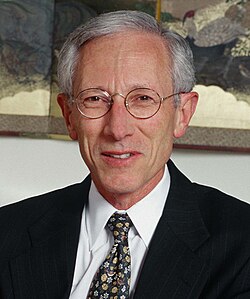
Before returning to public service, Fischer entered the private sector as an executive at Citigroup from February 2002 to April 2005. During his tenure, he held several high-ranking titles, including Vice Chairman, President of Citigroup International, and Head of the Public Sector Client Group.
Governing the Bank of Israel
In January 2005, the Israeli cabinet appointed Fischer as the Governor of the Bank of Israel, following recommendations from Prime Minister Ariel Sharon and Finance Minister Benjamin Netanyahu. This appointment was a homecoming of sorts, as Fischer had previously served as a U.S. government adviser helping to implement Israel's 1985 Economic Stabilization Plan.
Fischer officially assumed the role on May 1, 2005, and was later sworn in for a second term on May 2, 2010. During this period, he became an Israeli citizen while maintaining his U.S. citizenship.
Economic Performance and Crisis Management
Under Fischer's leadership, the Bank of Israel achieved remarkable operational success. In 2010, the IMD's World Competitiveness Yearbook ranked the Bank of Israel first among all central banks for its efficient functioning.
Fischer earned widespread acclaim for his strategic management of the Israeli economy during the 2008 financial crisis. Notably, in September 2009, the Bank of Israel became the first central bank in the developed world to raise interest rates. His performance was consistently recognized by Global Finance magazine, which awarded him an "A" rating on its Central Banker Report Card from 2009 through 2012.
Despite his success and popularity, Fischer stepped down as Governor on June 30, 2013, halfway through his second term. Earlier, in 2011, he had applied to be the IMF managing director, but was ineligible because he was 67 years old, exceeding the IMF's age limit of 65.
Vice Chair of the U.S. Federal Reserve
In January 2014, President Barack Obama nominated Fischer to serve as the Vice Chair of the Federal Reserve, the central bank of the United States. President Obama highlighted Fischer's decades of expertise and leadership at the IMF and the Bank of Israel as the primary drivers for his nomination.
The U.S. Senate confirmed his appointment to the Board of Governors on May 21, 2014, and confirmed him as Vice Chair on June 12, 2014. In this role, he succeeded Janet Yellen, who had moved up to become the Chair of the Federal Reserve. Fischer served in this capacity until mid-October 2017, when he resigned for personal reasons, eight months prior to the end of his term in June 2018.
Career Summary
| Period | Organization | Role |
|---|---|---|
| 1988–1990 | World Bank | Chief Economist |
| 1994–2001 | International Monetary Fund | First Deputy Managing Director |
| 2002–2005 | Citigroup | Vice Chairman / President of Citigroup International |
| 2005–2013 | Bank of Israel | Governor |
| 2014–2017 | U.S. Federal Reserve | Vice Chair |
Frequently Asked Questions
Why was Stanley Fischer unable to become the IMF Managing Director in 2011?
Fischer was barred from the position because the IMF stipulates that a new managing director must be no older than 65; at the time of his application, Fischer was 67.
What was Fischer's role in Israel's economy before becoming Governor?
Before his governorship, Fischer served as a U.S. government adviser and helped implement the 1985 Economic Stabilization Plan in Israel.
How did the Bank of Israel perform under Fischer's leadership?
The bank was ranked first among central banks for efficient functioning by the IMD's World Competitiveness Yearbook in 2010, and Fischer received "A" ratings from Global Finance magazine for four consecutive years.
When did Stanley Fischer leave the Federal Reserve?
Fischer resigned from his position as Vice Chair of the Federal Reserve in mid-October 2017 for personal reasons.
Did Stanley Fischer give up his U.S. citizenship to lead the Bank of Israel?
No, while he became an Israeli citizen to serve as Governor, he did not renounce his U.S. citizenship.