Stanford University: A Legacy of Innovation and Academic Excellence
Founded in 1885 by Leland and Jane Stanford, Stanford University is a premier private research university located in Stanford, California. Guided by its motto, "Die Luft der Freiheit weht" ("The wind of freedom blows"), the institution has evolved from a visionary grant into a global powerhouse of education, research, and entrepreneurship.
The university is renowned for its sprawling 8,180-acre campus and its symbiotic relationship with the surrounding tech ecosystem, effectively serving as a cornerstone for the development of modern technology.
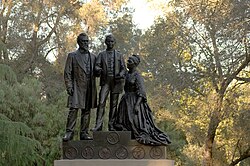
Key Facts
- Established: 1885 by Leland and Jane Stanford.
- Endowment: $40.8 billion (2025).
- Campus Size: 8,180 acres in Stanford, California.
- Student Population: 17,529 students (Fall 2023), comprising 7,841 undergraduates and 9,688 postgraduates.
- Global Standing: Consistently ranked among the top 5 universities globally by ARWU, QS, and THE.
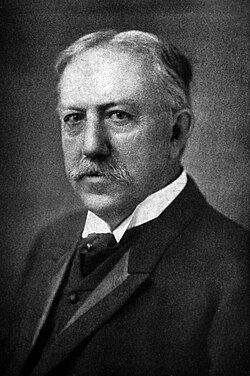
- Academic Leadership: Led by President Jonathan Levin and Provost Jenny Martinez.
Campus Landmarks and Architecture
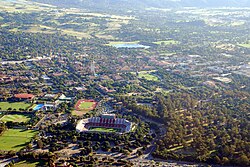
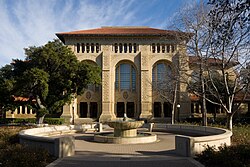
The Stanford campus is a blend of historic architecture and cutting-edge facilities. At its heart lies the Main Quad and the Stanford Memorial Church, reflecting the university's foundational heritage.
![Center of the campus in 1891[44]](/images/f2/f8/f2f8fb2949a8013fd595353c273660abaa4350e3fb1051b2884a61330c7b74c5.jpg)
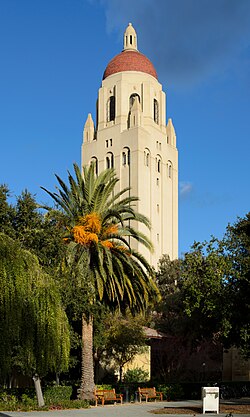
One of the most prominent structures is Hoover Tower, standing at 285 feet (87 m), which was inspired by the cathedral tower at Salamanca in Spain. For those interested in science and exploration, "The Dish"—a radio telescope with a 150-foot diameter—overlooks the main campus from the foothills.
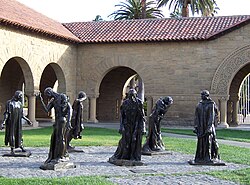
The campus also serves as an open-air gallery, featuring bronze statues by Auguste Rodin, including the Burghers of Calais, and the original Golden Spike on display at the Cantor Arts Center.
Academic Excellence and Admissions

Stanford is recognized globally for its rigorous academic standards and selective admissions process. The university maintains a highly competitive environment, with admit rates for first-time freshmen often hovering below 5%.
| Year | Applicants | Admits | Admit Rate | Enrolled | SAT Range |
|---|---|---|---|---|---|
| 2022 | 56,378 | 2,075 | 3.7% | 1,736 | 1500 - 1570 |
| 2021 | 55,471 | 2,190 | 3.9% | 1,757 | 1420 - 1570 |
| 2020 | 45,227 | 2,349 | 5.19% | 1,607 | 1420 - 1550 |
| 2019 | 47,498 | 2,062 | 4.34% | 1,701 | 1440 - 1550 |
| 2018 | 47,452 | 2,071 | 4.36% | 1,697 | 1420 - 1570 |
| 2017 | 44,073 | 2,085 | 4.73% | 1,703 | 1390 - 1540 |
The university's commitment to research is evidenced by its faculty, which includes 22 current Nobel Prize laureates (with 58 affiliates in total as of 2022), 6 Turing Award winners, and 174 members of the National Academy of Sciences.

The Engine of Silicon Valley
Stanford's influence extends far beyond the classroom. The university is often cited as the "Father of Silicon Valley" due to the immense number of tech giants founded by its faculty and alumni. This culture of entrepreneurship—the act of starting and managing a new business—has led to the creation of some of the world's most influential companies.
Notable companies with deep Stanford roots include:
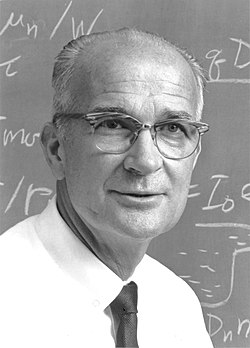
- Hewlett-Packard (1939): Co-founded by William R. Hewlett and David Packard.
- Google (1998): Co-founded by Larry Page and Sergey Brin.
- Nvidia (1993): Co-founded by Jensen Huang.
- Instagram (2010): Co-founded by Kevin Systrom and Mike Krieger.
- Netflix (1997): Co-founded by Reed Hastings.
Student Life and Culture
Life at Stanford is characterized by a vibrant mix of academic intensity and unique traditions. Students navigate the expansive campus primarily via bicycles, reflecting the university's scale and the students' need for efficiency.

The university's spirit is epitomized by the Stanford Tree (the unofficial mascot) and the Leland Stanford Junior University Marching Band, known for their contemporary musical arrangements and high-energy performances.
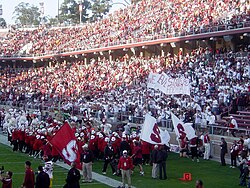
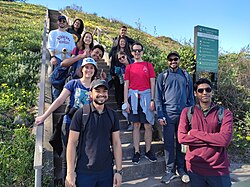
The student body is diverse, with Asian students making up 29%, White students 23%, Hispanic students 17%, and non-resident foreign nationals 13% of the population.
Frequently Asked Questions
What is the motto of Stanford University?
The motto is "Die Luft der Freiheit weht," which translates from German to "The wind of freedom blows."
How selective is Stanford's undergraduate admission?
Stanford is extremely selective; for the 2022 cycle, the admit rate was 3.7%, with 2,075 students admitted out of 56,378 applicants.
Which major tech companies were founded by Stanford alumni or faculty?
Many global leaders were founded by Stanford affiliates, including Google, Hewlett-Packard, Nvidia, Netflix, Yahoo!, LinkedIn, and Instagram.
What is the size of the Stanford campus?
The main campus is a large suburban area covering 8,180 acres (3,310 hectares).
Who are the current leaders of the university?
The university is currently led by President Jonathan Levin and Provost Jenny Martinez.