St. Charles College: The Legacy of Charles Carroll of Carrollton
The history of St. Charles College is inextricably linked to one of the most influential figures of the American Revolution: Charles Carroll of Carrollton. A man of immense wealth and conviction, Carroll was the only Catholic to vote for independence and sign the Declaration of Independence for Maryland. His commitment to his faith and his country eventually paved the way for the establishment of a landmark educational institution in Maryland.
Carroll spent much of his later life between Annapolis and his family estate, Doughoregan Manor, in what is now Howard County. Beyond his political achievements, he was a proponent of progress, notably helping to lay the first stone of the Baltimore and Ohio Railroad on July 4, 1828. However, his most enduring spiritual legacy began with a piece of land known as Marys Lott.
The Founding of the College
The origins of the college date back to 1784, when Carroll purchased Marys Lott, a 75-acre farm, from Jacob Burgoon, a French immigrant and shoemaker. For years, Sulpician priests—members of a society of priests dedicated to the education of clergy—including the future Archbishop Ambrose Maréchal, were frequent guests at Doughoregan Manor. While the Sulpicians initially requested land for a minor seminary (a preparatory school for those intending to enter the priesthood), Carroll initially refused, unwilling to divide his ancestral patrimony.
The turning point came in 1830 through the persuasion of Carroll's granddaughter, Emily Caton MacTavish. She suggested that he donate land he had acquired during his own lifetime rather than his inherited estate. Carroll agreed, donating 253 acres, including Marys Lott. The institution was incorporated on February 3, 1830, and named "St. Charles" in honor of its benefactor.
Growth and Architectural Grandeur
Construction began in 1831, resulting in a massive structure 367 feet long with 15.5-foot ceilings, featuring advanced gas lighting and radiant heat for the era. The college officially opened its doors on October 31, 1848, led by President Father Oliver Jenkins, Deacon Edward Caton, and an initial cohort of four students.
As the institution grew, so did its campus. Two wings were added in 1859, and construction began on "Our Lady of the Angels Chapel." Modeled after the Sainte-Chapelle in Paris, this lavish chapel was completed in 1866 following delays caused by the American Civil War. By 1878, further expansions allowed the college to accommodate 190 students.
By its 50th anniversary in 1898, the college was a sprawling, park-like campus situated near the historic National Road, the first federally sponsored interstate route connecting Baltimore to the western states.
Catastrophe and Relocation
On March 16, 1911, a devastating fire started in the chapel cellar and completely destroyed the college. While all 200+ faculty and students escaped without injury, the loss was catastrophic: thousands of priceless books, manuscripts, and sacred vestments were incinerated.
The ruins were cleared, and salvageable materials were moved to Catonsville, where the college was rebuilt. Only the ruins of the 1906 Recreation Hall remained at the original site.
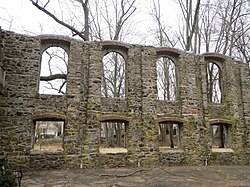
Following the fire, the Carroll family heirs sought the return of the land. The property was eventually purchased by William Phillip Brendel, who established Brendel Manor Park (also known as Gospel Park) in 1942. Over the decades, the land transitioned from a fairground to a Christian Identity community and finally into a suburban housing development. Today, the ruins of the original recreation hall and laundry are located within the Terra Maria Community.
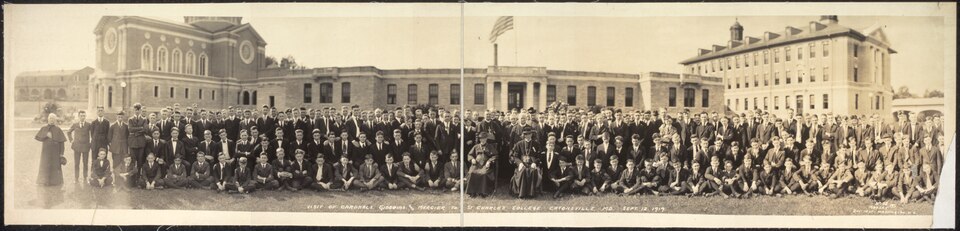
The Final Transition
The later years of the institution saw significant restructuring. In 1969, the high school department closed, and the junior college merged with St. Mary's Seminary and University. The second campus was renamed "St. Mary's Seminary College" and expanded its programs to include ecumenical participation.
The era of the college finally ended in 1977 when the property was sold to Erickson Retirement Communities, Inc. The site is now known as the Charlestown Retirement Community.
Key Facts
- Founder: Charles Carroll of Carrollton, the only Catholic signer of the Declaration of Independence.
- Established: Incorporated February 3, 1830.
- Original Site: 253 acres including the former "Marys Lott" farm.
- Major Disaster: A total-loss fire occurred on March 16, 1911.
- Architectural Highlight: Our Lady of the Angels Chapel, inspired by the Sainte-Chapelle in Paris.
- Current Status: The original site is now the Charlestown Retirement Community.
| Year | Event |
|---|---|
| 1830 | College incorporated and land donated by Charles Carroll. |
| 1848 | First building completed; college opens with four students. |
| 1866 | Completion of Our Lady of the Angels Chapel. |
| 1911 | Campus destroyed by fire; relocation to Catonsville. |
| 1969 | High school closes; merger with St. Mary's Seminary. |
| 1977 | College closes; property sold for retirement community. |
Frequently Asked Questions
Who was Charles Carroll of Carrollton?
He was a signer of the Declaration of Independence for Maryland, one of the wealthiest men in the Americas at the time, and the only Catholic to sign the document.
What happened to the original St. Charles College campus?
The original campus was destroyed by a fire in 1911. The land was later developed into Brendel Manor Park and eventually the Terra Maria Community and Charlestown Retirement Community.
What was the purpose of St. Charles College?
It was established as a minor seminary, which is a preparatory school for students intending to enter the priesthood.
Where is the college located today?
The institution as a standalone college no longer exists; its programs merged with St. Mary's Seminary and University, and its final campus property became the Charlestown Retirement Community.
What architectural inspiration was used for the chapel?
Our Lady of the Angels Chapel was designed as an imitation of the Sainte-Chapelle in Paris.