Sphecidae: The Biology and Classification of Thread-Waisted Wasps
The Sphecidae are a cosmopolitan family of wasps belonging to the suborder Apocrita. Commonly known as thread-waisted wasps, this group includes well-known insects such as sand wasps and mud daubers. These wasps are recognized for their distinct narrow waists and their specialized roles as predators within their ecosystems.
Historically, the name Sphecidae was applied to a much broader group of wasps. However, scientific revisions revealed that the original grouping was paraphyletic—meaning it did not include all the descendants of a common ancestor. Consequently, many former subfamilies have been reassigned to the family Crabronidae to ensure a more accurate evolutionary classification.
Key Facts
- Common Names: Includes sand wasps, mud daubers, and thread-waisted wasps.
- Diet: All species are predatory and parasitoidal.
- Nesting: Varies from soil burrows and pre-existing cavities to structures made of mud or resin.
- Reproduction: Most practice mass provisioning, where all food for the larvae is provided before the egg is laid.
- Distribution: Cosmopolitan (found worldwide).
Biology and Behavior
The biological diversity within the Sphecidae is significant. While most are solitary, some members of the Sceliphrinae subfamily exhibit rudimentary forms of sociality. Similarly, some species within the Sphecinae subfamily are known to rear multiple larvae within a single, large brood cell.
Their nesting habits are equally varied. Some species dig simple burrows in the soil, while others utilize existing cavities. A few specialized genera construct free-standing nests using mud or resin.
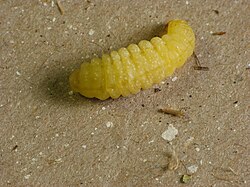
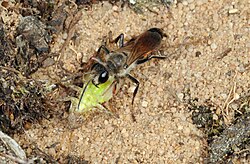
As parasitoids, Sphecidae target a wide range of prey to sustain their offspring. Depending on the species, prey may include spiders, various dictyopterans (such as cockroaches and termites), orthopteroids (such as grasshoppers), and the larvae of Lepidoptera (butterflies and moths) or other Hymenoptera.
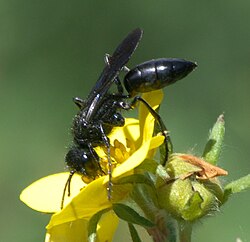
Phylogeny and Classification
Recent phylogenomic research, notably by Sann et al. (2018), has reshaped our understanding of the superfamily Apoidea. This research demonstrates that both bees (Anthophila) and the Sphecidae emerged from within the former Crabronidae. Because the original Crabronidae was paraphyletic, it has been split into several smaller families.
The current definition of Sphecidae (sensu stricto) is a monophyletic clade, meaning it consists of an ancestral species and all its descendants. This refined family is divided into four primary subfamilies:
Ammophilinae
This subfamily includes genera such as Ammophila, Podalonia, and Eremnophila.
Chloriontinae
This subfamily is represented by the genus Chlorion.
Sceliphrinae
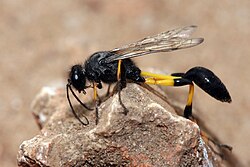
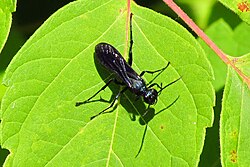
Known for their mud-nesting habits, this group includes Sceliphron and Chalybion.
Sphecinae
This subfamily includes the genus Sphex and Isodontia.
Taxonomic Summary
The following table summarizes the current classification of the Sphecidae family.
| Subfamily | Example Genera |
|---|---|
| Ammophilinae | Ammophila, Podalonia, Eremnophila, Eremochares, Hoplammophila, Parapsammophila |
| Chloriontinae | Chlorion |
| Sceliphrinae | Sceliphron, Chalybion, Dynatus, Penepodium, Podium, Trigonopsis |
| Sphecinae | Sphex, Isodontia, Palmodes, Prionyx, Chilosphex, Stangeella |
Frequently Asked Questions
What is the difference between Sphecidae sensu lato and sensu stricto?
Sensu lato refers to the broad, historical definition of the family which included many groups now moved to Crabronidae. Sensu stricto refers to the current, restricted definition that forms a monophyletic clade.
What is mass provisioning?
Mass provisioning is a reproductive strategy where the adult wasp collects and stores all the food (prey) required for the larva's development in the nest before laying the egg.
What do Sphecidae wasps eat?
Adults typically feed on nectar, but as parasitoids, they hunt spiders, orthopteroids, dictyopterans, and other insect larvae to provide food for their young.
Are all thread-waisted wasps in the Sphecidae family?
No. While many are, recent taxonomic changes have moved several groups of digger wasps formerly in Sphecidae into the family Crabronidae or other newly established families.