Spanish Peseta: A History of Spain's Former Currency
Before the adoption of the euro, the peseta served as the official currency of Spain, reflecting the nation's turbulent political shifts and economic evolution over more than a century. From its origins in the 19th century to its final days as legal tender in 2002, the peseta was more than just a medium of exchange; it was a cultural icon with its own unique language of nicknames and symbols.
The term "peseta" derives from the Catalan word peceta, meaning "little piece." While often mistakenly linked to the Spanish peso, the term was used colloquially as early as 1737 to describe a coin worth 1/5 of a peso. It was officially introduced as the national currency in 1868, initially pegged to the standards of the Latin Monetary Union, which defined its value as 4.5 grams of silver or 0.290322 grams of gold.
Key Facts
- ISO Code: ESP (ESA before 1981).
- Subunit: 100 céntimos (withdrawn from circulation in 1983).
- Conversion Rate: 1 Euro = 166.386 Pesetas.
- Central Bank: Bank of Spain (Banco de España).
- Legal Tender End Date: March 1, 2002.
- Mint: Fábrica Nacional de Moneda y Timbre.
The Evolution of Coinage
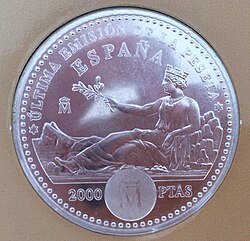
Spanish coinage underwent numerous transformations, shifting materials based on economic necessity and political regime. Early decimal coinage featured copper, bronze, and silver. Interestingly, the 5 and 10 céntimo coins earned the nicknames perra chica (small dog) and perra gorda (fat dog) because citizens mistook the image of a lion for a dog.
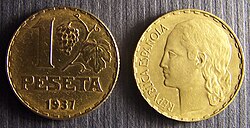
During the Spanish Civil War (1936–1939), precious metals were withdrawn in favor of copper-nickel. This era saw a proliferation of local issues, with various districts like Menorca and Euskadi minting their own denominations. A notable coin from this period was the brass 1 peseta, known as La Rubia (The Blonde) due to its gold-colored alloy.
The Franco Era and Democratic Transition
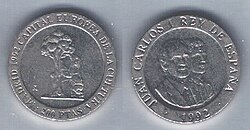
Following the Civil War, coins featuring the portrait of Francisco Franco were issued starting in 1947. Upon the restoration of democracy under King Juan Carlos, these portraits were replaced. The 1982 FIFA World Cup sparked a major redesign, introducing football-themed imagery across several denominations and the introduction of the 2 peseta coin, which featured a map of Spain.
Final Coin Specifications
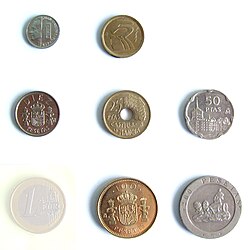
By the late 1990s, the peseta had evolved into a highly standardized system. The 50 peseta coin introduced a distinct flower shape, a design element that later influenced the 20-cent euro coin.
| Value | Euro Equiv. | Diameter | Weight | Composition |
|---|---|---|---|---|
| Pta 1 | €0.01 | 14 mm | 0.55 g | Aluminium |
| Pts 5 | €0.03 | 17.5 mm | 3 g | Aluminum-bronze |
| Pts 10 | €0.06 | 18.5 mm | 4 g | Copper-nickel |
| Pts 25 | €0.15 | 19.5 mm | 4.25 g | Aluminum-bronze |
| Pts 50 | €0.30 | 20.5 mm | 5.60 g | Copper-nickel |
| Pts 100 | €0.60 | 24.5 mm | 9.25 g | Aluminum-bronze |
| Pts 200 | €1.20 | 25.5 mm | 10.5 g | Copper-nickel |
| Pts 500 | €3.01 | 28 mm | 12 g | Aluminum-bronze |
Banknotes and Paper Currency
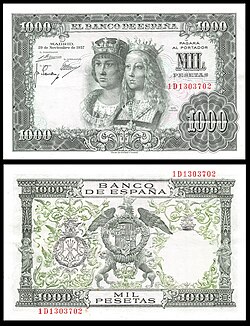
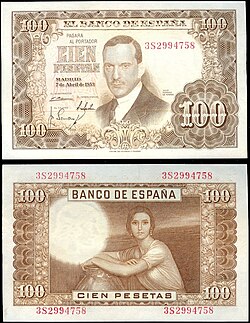
The Bank of Spain began issuing notes in 1874. Over time, inflation forced the introduction of higher denominations. While the 1,000 peseta note was the ceiling for a century, the 5,000 peseta note was introduced in 1976, followed by the 10,000 peseta note in 1987.
The final series of banknotes, introduced in 1992, focused on the Spanish discoveries in the Americas. These notes featured figures such as Christopher Columbus and Hernán Cortés.
Transition to the Euro
The transition from the peseta to the euro occurred in two stages. On January 1, 1999, the euro was introduced as a non-cash currency for accounting and electronic transfers. Physical euro coins and notes entered circulation on January 1, 2002, at which point the peseta ceased to be legal tender.
The fixed exchange rate was set at 166.386 pesetas per 1 euro. Although the currency was replaced in 2002, the Bank of Spain allowed the exchange of old notes and coins until June 30, 2021.
Frequently Asked Questions
What was the exchange rate from pesetas to euros?
The official fixed exchange rate was 1 euro = 166.386 Spanish pesetas.
What does the word "peseta" actually mean?
It comes from the Catalan word peceta, which means "little piece," referring to a coin.
What were the common nicknames for peseta denominations?
Common nicknames included real (0.25 Pta), pela (1 Pta), duro (5 Pts), talego (1,000 Pts), and kilo (1,000,000 Pts).
When did the peseta stop being legal tender?
The peseta lost its status as legal tender in Spain and Andorra on March 1, 2002.
Can pesetas still be exchanged for euros?
No. The Bank of Spain ceased the exchange of peseta notes and coins on June 30, 2021.