Spanish Flu: The Devastating 1918 Pandemic
The Spanish flu was one of the deadliest pandemics in human history, occurring between February 1918 and April 1920. Caused by an H1N1 influenza A virus, this global health crisis infected an estimated 500 million people—roughly one-third of the world's population at the time. Unlike typical seasonal flu, which primarily affects the very young and very old, this pandemic was noted for its high mortality rate among healthy young adults.
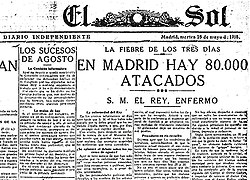
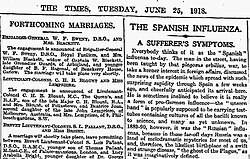
Despite its name, the pandemic did not originate in Spain. The term "Spanish influenza" arose because Spain remained neutral during World War I; while warring nations censored news of the sickness to maintain morale, Spanish media reported freely on the outbreak, including the illness of the Spanish King.
Key Facts
- Pathogen: Strains of A/H1N1 influenza virus.
- Timeline: February 1918 to April 1920.
- Estimated Infections: Approximately 500 million people.
- Death Toll: Generally accepted between 25 and 50 million, with some estimates ranging from 17 to 100 million.
- Index Case: Suspected to have emerged in Haskell County, Kansas, in January 1918.
- Case Fatality Rate: Estimated between 2% and 10%.
The Progression of the Pandemic
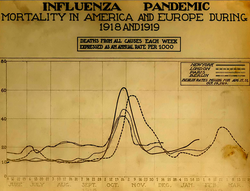
The pandemic did not strike all at once but occurred in several distinct waves, each with varying levels of severity.
The First Wave (Early 1918)
The initial wave was relatively mild. It began in early 1918, with early cases identified in the United States. While it spread quickly, the mortality rate was not yet at its peak.
The Deadly Second Wave (Late 1918)
The second wave, occurring in late 1918, was the most lethal. This period saw a massive spike in deaths globally, particularly in October and November. The virus had likely mutated into a more virulent form, causing severe respiratory distress and rapid death.
![Three pandemic waves: weekly combined flu and pneumonia mortality, United Kingdom, 1918–1919[236]](/images/00/6e/006e49c27333dd8a17344eff2018bf40e362fcb67fdcced36516ecc3a9ecab58.gif)
The Third and Fourth Waves (1919–1920)
A third wave occurred in 1919, and a final, smaller fourth wave persisted into early 1920. While less devastating than the second wave, these periods continued to strain public health systems in cities like Chicago and across Japan.
Epidemiology and Pathology
The 1918 pandemic was characterized by a unique mortality age-distribution. While seasonal flu typically follows a U-shaped curve (killing the very young and very old), the Spanish flu exhibited a W-shaped curve, showing a high number of deaths among adults aged 20 to 40.
![Difference between the flu mortality age-distributions of the 1918 pandemic and normal epidemics – deaths per 100,000 persons in each age group, United States, for the interpandemic years 1911–1917 (dashed line) and the pandemic year 1918 (solid line)[235]](/images/b0/e8/b0e886c56acfa0c34ff530e973b7f348b095684d6ece4e750d0dead79505c720.png)
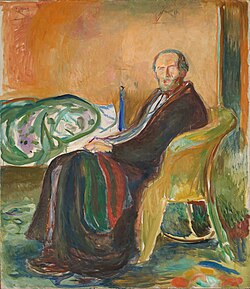
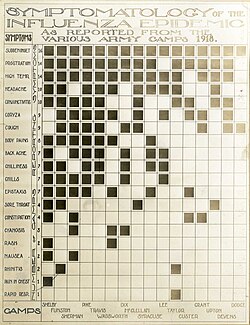
Symptoms often began with standard flu-like signs but could rapidly progress to severe pneumonia. In many cases, bacterial pneumonia—a secondary infection—was the primary cause of death. The virus was highly contagious, with a reproduction number (the average number of people one infected person infects) estimated at 1.80.
Public Health Responses and Management
![An article naming wealthy socialites for violating city law banning public gatherings, Chicago Tribune, October 19, 1918. Named violators include Joan Pinkerton Chalmers, daughter of Pinkertons private police founder Allan Pinkerton.[105]](/images/56/e1/56e170681448a5299fb569100dc6582e4871e1e4573af3b3423fbce6e9d9e397.png)
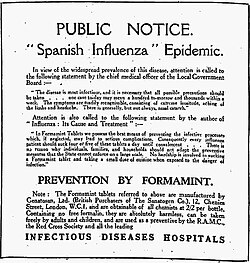
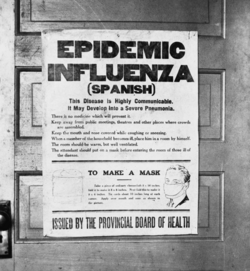
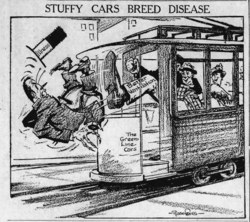
In an era before vaccines or antibiotics, public health officials relied on non-pharmaceutical interventions to slow the spread. These included the closure of schools, theaters, and churches, as well as the banning of public gatherings.
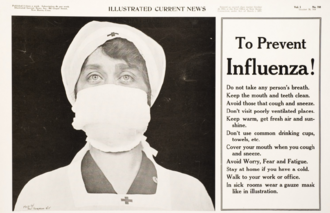
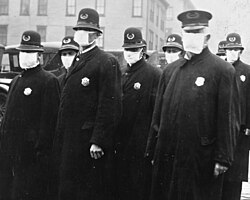
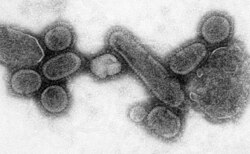
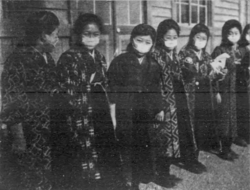
Mask-wearing became common in several cities, often promoted by organizations like the American Red Cross. However, these measures were not always followed; in some cities, wealthy socialites were publicly named for violating gathering bans, and in San Francisco, an "Anti-Mask League" formed in 1919 to protest the mandates.
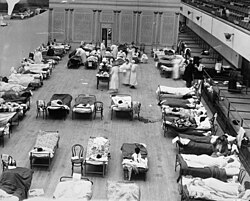
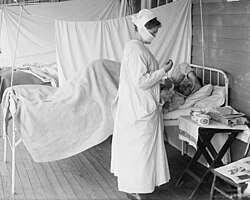
Medical treatment was limited to supportive care. Temporary wards were established in public spaces, such as the Oakland Municipal Auditorium, to handle the overflow of patients.
The Role of World War I
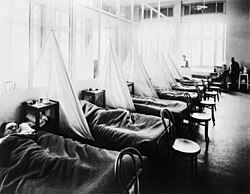
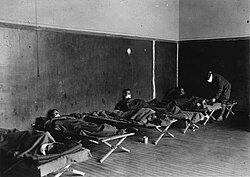
The First World War acted as a catalyst for the pandemic. The mass movement of troops in cramped ships and trains facilitated the rapid global transmission of the virus. Soldiers deployed to Europe carried the flu with them, turning military camps into hotspots for infection.
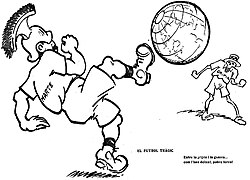
The synergy between the war and the pandemic created a global catastrophe, as seen in the depiction of Mars, the god of war, playing a "tragic game of football" with a skeleton representing the flu.
Comparative Pandemic Severity
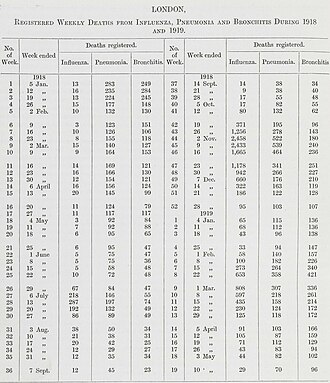
To understand the scale of the 1918 pandemic, it is helpful to compare it with other major influenza outbreaks.
| Pandemic Name | Date | Subtype | Estimated Deaths | Severity Score |
|---|---|---|---|---|
| Spanish Flu | 1918–20 | H1N1 | 17–100 Million | 5 |
| Asian Flu | 1957–58 | H2N2 | 1–4 Million | 2 |
| Hong Kong Flu | 1968–69 | H3N2 | 1–4 Million | 2 |
| 2009 Swine Flu | 2009–10 | H1N1/09 | 151,700–575,400 | 1 |
Scientific Legacy
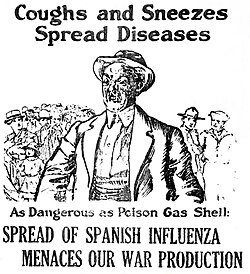
Decades after the pandemic, scientists have used reconstructed versions of the 1918 virus to study its properties. By examining the genetic makeup of the virus, researchers at the CDC and other institutions have worked to improve global preparedness for future pandemics.

Frequently Asked Questions
Why was it called the "Spanish Flu"?
It was not called the Spanish flu because it started in Spain, but because Spain was neutral during WWI and did not censor news of the outbreak, making it seem as though the disease was more prevalent there than in countries with strict wartime censorship.
Who was most affected by the 1918 pandemic?
While influenza usually affects the very young and very old, the 1918 pandemic was uniquely deadly to healthy adults between the ages of 20 and 40.
How did World War I contribute to the spread?
The war caused the mass movement of millions of soldiers across borders in crowded conditions, which allowed the virus to spread rapidly from military camps to the general global population.
What were the primary public health measures used?
Since there were no vaccines, officials used social distancing, banned public gatherings, closed public institutions, and encouraged the use of cloth face masks.
What caused the high death toll?
The high mortality was caused by a combination of a highly virulent H1N1 strain and secondary bacterial pneumonia infections that occurred in the lungs of the infected.