Space Westerns: The Evolution of the Galactic Frontier
The space Western is a captivating subgenre of science fiction that blends the rugged individualism and frontier spirit of the American Old West with the vast, unknown reaches of outer space. By transplanting the themes of law, order, and survival from the prairie to the stars, creators have spent decades exploring the human condition through a futuristic lens.
The Early Roots of the Galactic Frontier
The intersection of Westerns and science fiction began in the early days of pulp magazines. During this era, writers frequently submitted stories to both genres, and magazines often utilized Western-style cover art to highlight the parallels between the two. In the 1930s, C. L. Moore introduced Northwest Smith, one of the first true space Western heroes. Other early influences included the adventurous spirits of Buck Rogers and Flash Gordon.
As the 1940s progressed, a shift in the American comic book market occurred. When superhero comics declined in popularity, they were largely replaced by Western and horror comics. However, by the mid-1950s, the introduction of the Comics Code Authority made horror themes untenable, leading to a surge in popularity for science-fiction themes and space Western narratives.
From Revisionist Cinema to Space Operas
By the mid-1960s, the classic Western film began to fade, giving way to revisionist Westerns. Simultaneously, television series like Lost in Space and Star Trek reimagined the "frontier" as the deep reaches of space. This transition was often driven by industry pragmatism; for example, director Peter Hyams noted that 1980s studio heads were reluctant to fund traditional Westerns. Consequently, he created Outland, which transposed the plot of the 1952 film High Noon to the Jovian moon of Io.
The influence of the Western is perhaps most visible in the Star Wars saga. George Lucas drew heavily from Western tropes, specifically in the creation of the Mos Eisley cantina and characters like Han Solo, whose rogue gunslinger persona and costume reflect the genre. In the DVD commentary for The Empire Strikes Back, Lucas explicitly attributes the character of Boba Fett to the "Man with No Name" archetype.
Critical Backlash and the "Bat Durston" Era
Not all science-fiction creators embraced this blending of genres. The Turkey City science-fiction writers' workshop, through a document called the Turkey City Lexicon, condemned the space Western as a "pernicious" shortcut that allowed writers to avoid the hard work of building original worlds.
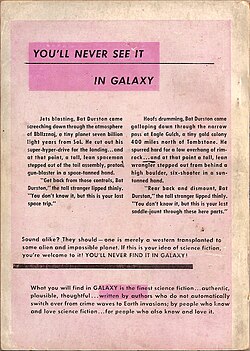
This sentiment was echoed by Galaxy Science Fiction, which ran a back-cover advertisement titled "You'll never see it in Galaxy." The ad featured snippets of parallel Western and sci-fi stories centered on a character named Bat Durston. As a result, space Westerns were informally and often derisively referred to as "Bat Durston" stories. This critical bias persisted for years, casting the subgenre as "hack writing" rather than "true" science fiction.
The Modern Revival and Global Influence
The perception of the space Western shifted in the 1980s. The release of Outland and children's animation such as BraveStarr and The Adventures of the Galaxy Rangers brought explicit cowboy themes back to the mainstream. BraveStarr focused on a Space Marshal maintaining law in the 23rd century, while The Adventures of the Galaxy Rangers featured Texas Ranger-style heroes riding robotic horses across alien prairies, blending six-guns with spaceships.
In the 1990s, the genre found a new home in Japanese manga and anime. Series such as Trigun (1995), Outlaw Star (1996), and Cowboy Bebop (1997) expanded the aesthetic and thematic boundaries of the space Western. Later, the critical acclaim of the series Firefly prompted a broader reassessment of the subgenre's artistic value.
Today, the space Western continues to thrive in interactive media and film. Video games like StarCraft, The Outer Worlds, RimWorld, and the Borderlands series have popularized the theme, while films such as The Chronicles of Riddick maintain the legacy of the galactic frontier.
Key Facts
- Origins: Emerged from early pulp magazines and the influence of 1930s characters like Northwest Smith.
- Cinematic Shift: Outland adapted the plot of High Noon to a setting on Jupiter's moon, Io.
- Star Wars Influence: Boba Fett was inspired by the "Man with No Name" archetype.
- Critical Term: "Bat Durston" stories became a derisive term for space Westerns due to criticism from Galaxy Science Fiction.
- Global Reach: The genre was significantly evolved by 1990s anime like Cowboy Bebop and Trigun.
| Era/Period | Key Examples | Primary Influence/Characteristic |
|---|---|---|
| 1930s - 1950s | Northwest Smith, Buck Rogers | Pulp magazines and early comic books |
| 1960s - 1980s | Star Trek, Outland, Star Wars | Revisionist Westerns and frontier exploration |
| 1980s | BraveStarr, Galaxy Rangers | Explicit "Cowboys in Space" themes in animation |
| 1990s - Present | Cowboy Bebop, Firefly, Borderlands | Anime influence and critical reassessment |
Frequently Asked Questions
What is a space Western?
A space Western is a subgenre of science fiction that combines the settings and technology of space exploration with the themes, character archetypes, and morals of the American Western.
Why were space Westerns once looked down upon?
Some critics and writers, including those from the Turkey City workshop, felt the genre relied on pre-established backgrounds (like the "frontier") rather than creating original, imaginative worlds, leading to the label of "hack writing."
Who is Bat Durston?
Bat Durston was a character used in a Galaxy Science Fiction advertisement to mock the similarities between Westerns and sci-fi. The name subsequently became a derogatory term for the space Western subgenre.
How did Star Wars incorporate Western elements?
Star Wars utilized Western tropes through the design of the Mos Eisley cantina, Han Solo's rogue gunslinger personality, and the character of Boba Fett, who was modeled after the "Man with No Name."
Which anime series helped popularize the space Western?
Major Japanese series including Trigun, Outlaw Star, and Cowboy Bebop were instrumental in exploring and popularizing the genre in the late 1990s.