Southland District Demographics and Population Trends
The Southland District is a vast region of New Zealand, spanning 29,575.19 km (11,419.04 sq mi). Characterized by its expansive landscapes and low population density, the district provides a unique look at regional living and growth. As of June 2025, the estimated population reached 33,900, maintaining a sparse distribution of approximately 1.1 people per km.
Key Facts
- 2023 Census Population: 31,833 people.
- Population Density: 1.1 people per km (estimated 2025).
- Median Age: 40.3 years, which is higher than the national average of 38.1 years.
- Median Income: $44,100, exceeding the national median of $41,500.
- Primary Ethnicity: 86.3% European (Pākehā).
- Religious Affiliation: 56.7% of residents identify as having no religion.
Population Growth and Distribution
The Southland District has seen steady growth over the last two decades. According to census data, the population rose from 28,437 in 2006 to 31,833 in 2023. This represents a 3.1% increase since 2018 and a 7.5% increase since 2013.
The 2023 census recorded 16,533 males, 15,219 females, and 78 people of other genders residing in 13,371 dwellings. Additionally, 2.0% of the population identified as LGBTIQ+.
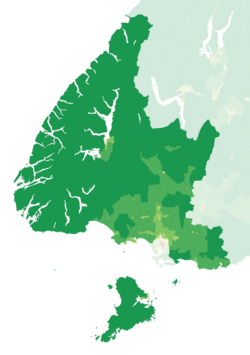
Age Structure
The district's age profile shows a significant concentration of working-age adults. The breakdown is as follows:
- Under 15 years: 6,387 (20.1%)
- 15 to 29 years: 5,025 (15.8%)
- 30 to 64 years: 14,874 (46.7%)
- 65 years or older: 5,544 (17.4%)
Cultural and Social Profile
The ethnic composition of the Southland District is predominantly European (Pākehā) at 86.3%, followed by Māori at 13.0%, Asian at 7.6%, and Pasifika at 1.4%. Other groups include Middle Eastern, Latin American and African New Zealanders (MELAA) at 0.8% and others (including those identifying simply as "New Zealander") at 3.7%.
English is the primary language, spoken by 97.4% of the population. Other languages include Māori (2.0%), Samoan (0.2%), and various other languages (7.3%). New Zealand Sign Language is known by 0.5% of residents. Notably, 15.3% of the population was born overseas, significantly lower than the national average of 28.8%.
Religion and Beliefs
A majority of residents (56.7%) report having no religion. Among those with affiliations, 31.8% are Christian, 0.8% are Buddhist, 0.5% are Hindu, 0.3% follow Māori religious beliefs, 0.3% identify with New Age beliefs, and 0.1% are Muslim. Approximately 8.7% of respondents did not answer the question.
Education, Income, and Employment
Educational attainment among residents aged 15 and older varies, with 56.5% holding a post-high school certificate or diploma. 12.5% have achieved a bachelor's degree or higher, while 27.6% hold exclusively high school qualifications.
Economically, the district performs well relative to the national median. The median income in Southland is $44,100, compared to $41,500 nationally. However, a smaller percentage of the population earns high incomes; 8.7% earn over $100,000, compared to 12.1% nationwide.
Employment for those 15 and older is characterized by a strong full-time workforce: 56.4% are employed full-time, 15.6% work part-time, and 1.5% are unemployed.
Regional Ward Comparison
The district is divided into several wards, each with distinct demographic characteristics. The Oreti Ward is the most densely populated, while the Stewart Island/Rakiura Ward has the highest median age.
| Ward Name | Area (km) | Population | Density (per km) | Median Age | Median Income |
|---|---|---|---|---|---|
| Mararoa Waimea | 17,419.42 | 8,319 | 0.48 | 41.0 years | $44,900 |
| Waiau Aparima | 6,405.50 | 8,142 | 1.27 | 41.2 years | $38,500 |
| Oreti | 1,641.77 | 8,559 | 5.21 | 39.6 years | $47,700 |
| Waihopai Toetoe | 2,360.78 | 6,324 | 2.68 | 38.9 years | $46,200 |
| Stewart Island/Rakiura | 1,747.72 | 486 | 0.28 | 47.4 years | $38,400 |
Frequently Asked Questions
What is the current population of the Southland District?
As of the 2023 census, the population was 31,833, with an updated estimate of 33,900 by June 2025.
How does the median income in Southland compare to the rest of New Zealand?
The median income in the Southland District is $44,100, which is higher than the national median income of $41,500.
What is the most common ethnic group in the region?
The most common ethnic group is European (Pākehā), making up 86.3% of the population.
Which ward in the Southland District has the highest population density?
The Oreti Ward has the highest population density, with 5.21 people per square kilometer.
What are the primary languages spoken in the district?
English is the dominant language (97.4%), followed by other languages (7.3%) and the Māori language (2.0%).